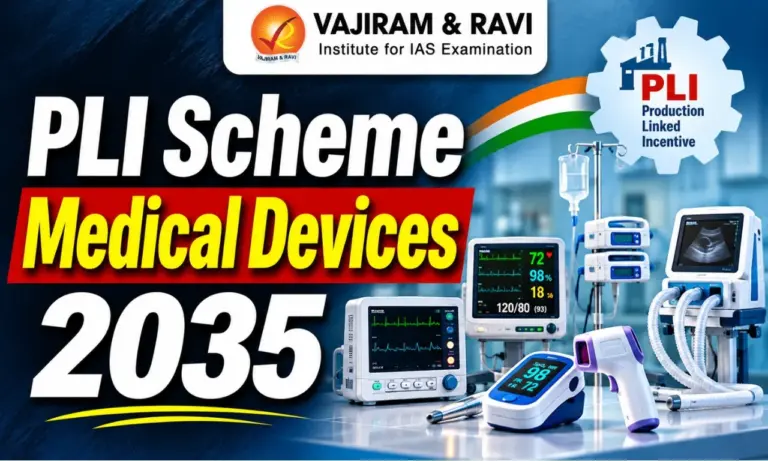
PLI Scheme Medical Devices 2035 aims to strengthen India’s domestic medical device manufacturing ecosystem through financial incentives, simplified eligibility conditions and long term investment support. With an allocation of approximately ₹2,700 crore, the extended Medical Devices PLI Scheme seeks to reduce import dependence, promote advanced medical technologies, generate employment and improve India’s competitiveness in the global medical device industry.
PLI Scheme Medical Devices 2035 Latest News
The Government of India has extended the Production Linked Incentive (PLI) Scheme for Promoting Domestic Manufacturing of Medical Devices (PLI-MD 2.0) until 2035-36. With a financial outlay of approximately ₹2,700 crore, the scheme invites fresh applications to encourage domestic manufacturing and investment.
PLI Scheme Medical Devices Features
The extended PLI Scheme Medical Devices 2035 introduces simplified eligibility, flexible applications and targeted incentives to strengthen domestic manufacturing across four major medical device segments.
- Extended Scheme Duration: The government has extended the Medical Devices PLI Scheme by eight years until 2035-36, providing manufacturers with a longer period for investment, production planning and capacity expansion.
- Financial Outlay: The scheme has an allocation of approximately ₹2,700 crore to support domestic manufacturing, encourage investment and strengthen India’s capabilities in producing advanced medical devices and critical components.
- Simplified Eligibility Conditions: The mandatory minimum sales threshold for claiming incentives has been removed, while the minimum investment requirement has been reduced to make participation easier for manufacturers.
- Four Target Segments: The scheme covers medical consumables, disposables and implants (TS-1), critical components (TS-2), advanced devices with limited domestic manufacturing (TS-3), and devices currently assembled in India (TS-4).
- Incentive Rates: The average tapering incentive rate is approximately 5% for TS-1, 9% for TS-2 and TS-3, and 6% for TS-4, encouraging investment across manufacturing categories.
- Manufacturing Timeline: Applicants receive three years to establish greenfield or brownfield manufacturing facilities across the identified segments, providing flexibility to develop production infrastructure and operational capabilities.
- Flexible Application Process: Companies can submit multiple applications across one or more target segments. The application window remains continuously open for an extended period, improving ease of doing business.


PLI Scheme Medical Devices 2035 Significance
The PLI Scheme Medical Devices 2035 has strategic, economic and healthcare significance by promoting indigenous manufacturing, technological development and affordable access to medical equipment.
- Reduced Import Dependence: India relies on overseas suppliers for approximately 70-80% of its medical equipment requirements. Domestic manufacturing can reduce import dependence and strengthen the country’s medical supply chains.
- Affordable Healthcare: Increasing indigenous production can reduce dependence on expensive imported equipment, potentially lowering medical technology costs and improving the affordability and accessibility of healthcare services.
- Employment Generation: Expansion of medical device manufacturing can create employment opportunities across engineering, research, production, quality management and other specialised areas of the manufacturing ecosystem.
- Technological Advancement: The scheme encourages domestic production of advanced equipment, including 3T MRI, PET-CT, ultrasound consoles and high throughput IVD analysers, strengthening India’s technological capabilities.
- Support for MSMEs: Incentives for critical component manufacturing can strengthen MSME participation, encourage local suppliers and improve integration across different stages of the medical device value chain.
- Global Competitiveness: Strengthening manufacturing capacity and product quality can improve India’s position in international markets. Medical device exports reached USD 4.1 billion in FY 2024-25, covering 187 countries.
PLI Scheme Medical Devices 2035 Challenges
Despite policy support, India needs stronger technological capabilities, research infrastructure, skilled manpower and integrated supply chains to achieve sustainable manufacturing growth.
- Import Dependence: Continued reliance on imported high end equipment and specialised components limits domestic manufacturing. Promoting indigenous production and developing reliable local suppliers can gradually address this dependence.
- Limited Research and Development: Inadequate R&D investment restricts innovation in advanced medical technologies. Increased research funding, industry academia collaboration and Centres of Excellence can strengthen indigenous product development.
- Technological Gaps: Manufacturing complex medical equipment requires advanced engineering capabilities and specialised technologies. Technology transfer, international collaboration and domestic innovation can help bridge existing technological limitations.
- Infrastructure Constraints: Limited access to testing laboratories, calibration facilities, sterilisation units and specialised manufacturing infrastructure increases production costs. Developing common facilities and medical device parks can address these gaps.
- Quality and Regulatory Standards: Meeting international quality requirements and ensuring product safety remain important challenges. Strong quality control systems, effective testing facilities and harmonised regulatory practices can improve global acceptance.
- MSME Constraints: Smaller manufacturers often face difficulties accessing finance, skilled workers and advanced technologies. Easier credit facilities, technical assistance and skill development programmes can improve their manufacturing capabilities.
- Strengthening Supply Chains: Dependence on imported raw materials and electronic components affects manufacturing resilience. Developing indigenous component suppliers and integrating different production stages can create a stronger domestic value chain.
- Public-Private Partnerships: Collaboration between government, research institutions and manufacturers can accelerate innovation, technology development and commercialisation. Greater investment in R&D and specialised workforce training can support long term sectoral growth.

 Last updated on Nov, 2026
→ UPSC 2027 Notification will be released on 13 January 2027 at upsconline.nic.in.
→ Check Nobel Prize 2026 Winners List here.
→ Download PIB PRiSM Monthly Magazine 2026 here.
→ Check UPSC Monthly Current Affairs Magazine The Recitals here.
→ Check out the latest UPSC Syllabus here.
→ Download UPSC Model Answers for Mains 2026
→ UPSC Mains Question Paper 2026 is out now for Essay & GS Paper 1, 2, 3 & 4.
→ UPSC Calendar 2027 has been released.
→ Enroll in Vajiram & Ravi’s UPSC Mains Test Series 2027 for structured answer writing practice, expert evaluation, and exam-oriented feedback.
→ Join Vajiram & Ravi’s UPSC Mentorship Program 2027 for personalized guidance, strategy planning, and one-to-one support from experienced mentors.
→ Go through the UPSC Mains Previous Year Papers to enhance your preparation.
→ UPSC has released UPSC Toppers List 2025 with the Civil Services final result on its official website.
→ Also check Best UPSC Coaching in India
PLI Scheme Medical Devices 2035 FAQs
Q1. What is the PLI Scheme Medical Devices 2035?+
Q2. What is the total outlay of the Medical Devices PLI Scheme?+
Q3. What are the four target segments under PLI-MD 2.0?+
Q4. What are the incentive rates under the PLI Scheme for Medical Devices?+
Q5. How does the PLI Medical Devices Scheme reduce import dependence?+
Tags: pli scheme medical pli scheme medical devices pli scheme medical devices 2035