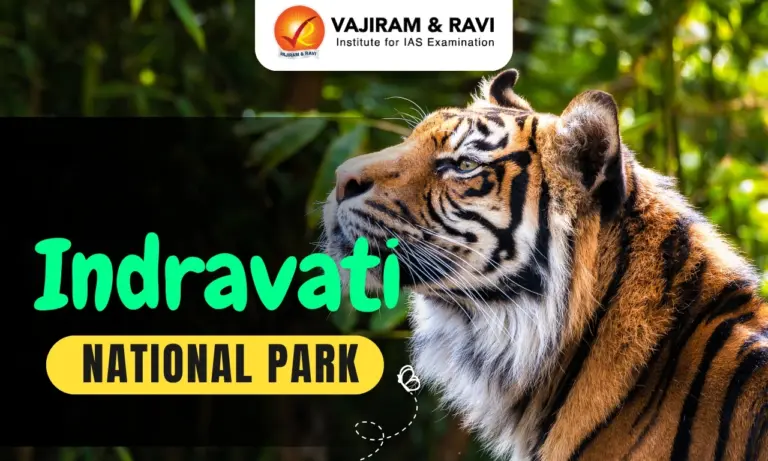
Indravati National Park is one of Chhattisgarh’s most important protected areas and a renowned tiger reserve in central India. It is located in the Bijapur district, the park is famous for its rich biodiversity, dense deciduous forests, and one of the last surviving populations of the endangered wild water buffalo. Besides its ecological significance, the park has also been in the spotlight due to anti-Naxal operations conducted in the surrounding Bastar region.
Indravati National Park Location
Indravati National Park is situated in the Bijapur district of Chhattisgarh, within the Bastar region. The park derives its name from the Indravati River, which flows from east to west and forms its northern boundary with Maharashtra. The reserve is part of the Central Indian Highlands, an ecologically significant landscape supporting diverse wildlife.
Indravati National Park Climate & Vegetation
Indravati National Park experiences a tropical monsoon climate, characterized by hot summers, heavy monsoon rainfall, and mild winters. The favorable climate supports dense tropical deciduous forests, making the park an important habitat for diverse flora and fauna.
- Climate: Tropical monsoon with hot summers (March-June), heavy rainfall during the southwest monsoon (June-September), and pleasant winters (November-February).
- Rainfall: Receives an average annual rainfall of 1,200–1,500 mm, mainly during the monsoon season.
- Moist Mixed Deciduous Forest with Teak: Dominated by teak, along with species like haldu, arjun, and shisham.
- Moist Mixed Deciduous Forest without Teak: Supports trees such as achar, karra, kullu, jamun, and bel, along with dense undergrowth.
- Southern Dry Mixed Deciduous Forest: Found in relatively drier areas and consists of hardwood species, bamboo, shrubs, and grasses.
- Riverine Vegetation: The Indravati River and seasonal streams support lush vegetation, bamboo patches, and grasslands that provide food and shelter for herbivores and other wildlife.


Indravati National Park Flora
Indravati National Park is covered by rich tropical deciduous forests, supporting a wide variety of timber, medicinal, and fruit-bearing plant species that sustain its diverse wildlife.
- Teak is the dominant tree species and forms extensive forest cover across the park.
- Achar (Char), Karra, and Kullu are common deciduous trees found throughout the reserve.
- Shisham, Haldu, Arjun, Semal, Bel, and Jamun contribute to the park’s rich floral diversity.
- Bamboo grows abundantly in many parts of the park, providing habitat and food for several animal species.
- Grasses, shrubs, climbers, and medicinal plants flourish in forest clearings and riverine areas, supporting herbivores and maintaining ecological balance.
Indravati National Park Fauna
Indravati National Park is one of Central India’s richest wildlife habitats, renowned for its Tiger Reserve status and one of the last surviving populations of the endangered Wild Water Buffalo.
- Mammals: Bengal Tiger, Leopard, Wild Water Buffalo, Gaur (Indian Bison), Sloth Bear, Dhole (Indian Wild Dog), Sambar, Chital, Nilgai, Blackbuck, Wild Boar, and Barking Deer.
- Birds: Home to Peafowl, Hornbills, Eagles, Kingfishers, Woodpeckers, Parakeets, and numerous resident and migratory bird species.
- Reptiles: Includes Marsh Crocodile (Mugger), Indian Rock Python, Monitor Lizard, Cobra, and other snake species.
- Aquatic Life: The Indravati River and its tributaries support a variety of freshwater fish, turtles, and amphibians.
- Flagship Species: The park is internationally recognized for conserving the endangered Wild Water Buffalo and the Royal Bengal Tiger.
- The diverse fauna reflects the park’s healthy tropical deciduous ecosystem, making it a vital biodiversity hotspot in the Central Indian landscape.
Anti-Naxal Operations Around Indravati National Park
The forests surrounding Indravati National Park lie within the Bastar region of Chhattisgarh, a long-affected area of Left Wing Extremism (LWE). To restore security and governance, the government has intensified coordinated anti-Naxal operations involving central and state security forces.
- Operation Green Hunt, Operation Kagar, and Operation Black Forest are among the major campaigns launched to dismantle Maoist networks.
- Central Armed Police Forces (CAPFs), Chhattisgarh Police, and elite units such as the Commando Battalion for Resolute Action (CoBRA) and Greyhounds conduct joint counter-insurgency operations.
- Security forces have increased the establishment of forward operating bases (FOBs) and strengthened surveillance in remote forest areas.
- The operations aim to eliminate Maoist presence, improve law and order, and facilitate development, infrastructure, and conservation activities in the region.
- Recent operations have resulted in a significant decline in Maoist activities, particularly in the Bastar division, which includes areas surrounding the national park.
Indravati National Park Significance
Indravati National Park is one of India’s most important protected areas, known for its rich biodiversity, tiger conservation, and ecological importance in the Central Indian landscape.
- Tiger Reserve: Declared a Tiger Reserve in 1983 under Project Tiger, it plays a vital role in conserving the Royal Bengal Tiger.
- Wild Water Buffalo Conservation: Protects one of the last remaining populations of the endangered Wild Water Buffalo, the state animal of Chhattisgarh.
- Biodiversity Hotspot: Supports diverse mammals, birds, reptiles, and plant species, contributing to ecological balance and genetic diversity.
- Watershed Protection: The Indravati River sustains the park’s ecosystems and provides water for wildlife and surrounding habitats.
- Climate and Environmental Benefits: Dense forests help in carbon sequestration, soil conservation, groundwater recharge, and climate regulation.

 Last updated on Sep, 2026
→ UPSC 2027 Notification will be released on 13 January 2027 at upsconline.nic.in.
→ Asian Games 2026 are being held in Aichi-Nagoya, Japan, from 19 September to 4 October.
→ Check out the latest UPSC Syllabus here.
→ Download UPSC Model Answers for Mains 2026
→ UPSC Mains Question Paper 2026 is out now for Essay & GS Paper 1, 2, 3 & 4.
→ UPSC Calendar 2027 has been released.
→ Enroll in Vajiram & Ravi’s UPSC Mains Test Series 2027 for structured answer writing practice, expert evaluation, and exam-oriented feedback.
→ Join Vajiram & Ravi’s UPSC Mentorship Program 2027 for personalized guidance, strategy planning, and one-to-one support from experienced mentors.
→ Go through the UPSC Mains Previous Year Papers to enhance your preparation.
→ UPSC has released UPSC Toppers List 2025 with the Civil Services final result on its official website.
→ Also check Best UPSC Coaching in India
Indravati National Park FAQs
Q1. Which is the 2nd largest national park in India?+
Q2. Which river flows through Indravati National Park?+
Q3. What is Indravati National Park known for?+
Q4. Is Indravati a tiger reserve?+
Q5. When was Indravati National Park established?+
Tags: indravati national park upsc current affairs