Tuvalu Latest News
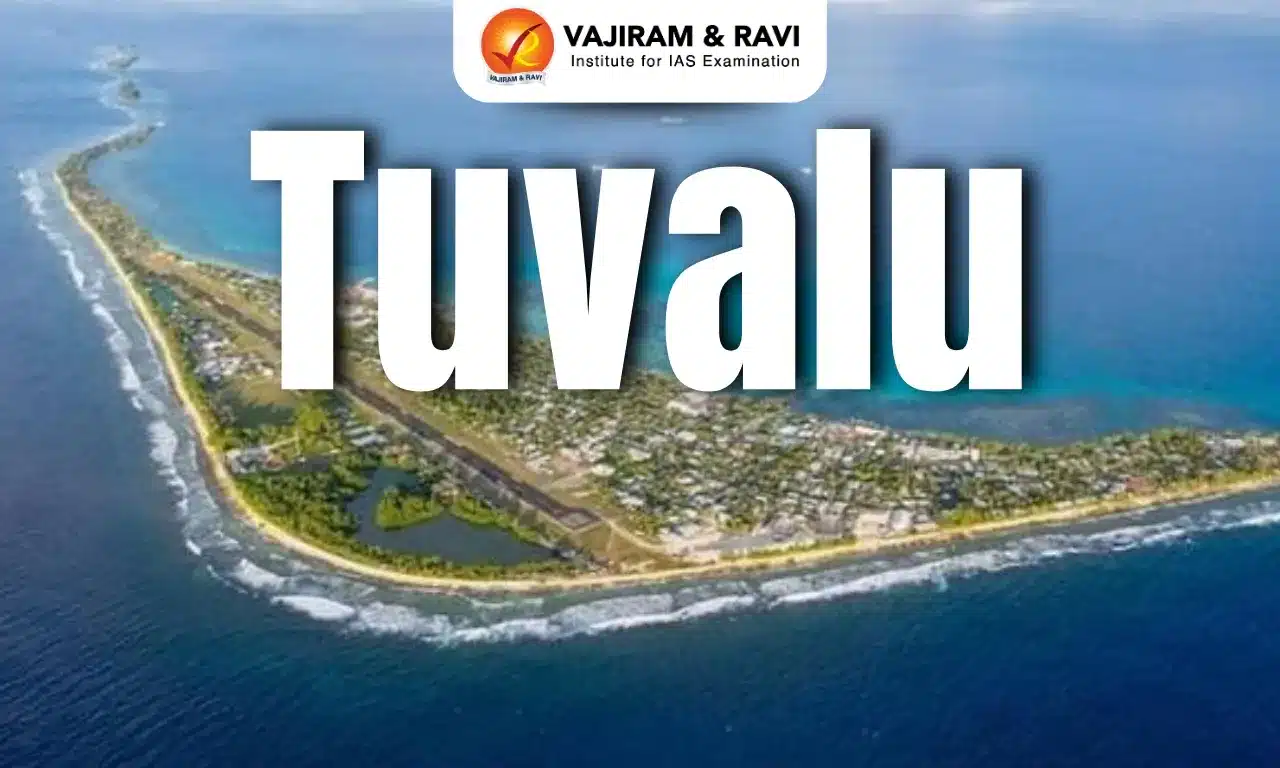
Scientists fear the entire Tuvalu archipelago could be unliveable by the end of the century as it is impacted by climate change.
About Tuvalu
- Location: It was formerly known as the Ellice Islands, is a Polynesian island country in the west-central Pacific Ocean.
- It is the 4th smallest country in the world with 26 sq.km. of land.
- It sits about halfway between Australia and Hawaii.
- Neighboring Countries: Its neighbours include Kiribati, to the north, and Fiji, to the south.
- It comprises nine islands (four reef islands and five coral atolls).
- Nanumanga, Niutao, and Niulakita are the three main islands that make up Tuvalu.
- Capital: The Funafuti atoll is the capital of Tuvalu and is also the most populous among all the 9 atolls.
- Climate: There are no rivers. Tuvalu’s climate is hot and rainy.
- Economy: A small quantity of copra is produced for export, the sale of stamps accounts for modest earnings, and fees are collected from foreign fishing fleets, but the country depends heavily on foreign aid.
Source: PIB


 Last updated on Oct, 2026
→ UPSC 2027 Notification will be released on 13 January 2027 at upsconline.nic.in.
→ Check Nobel Prize 2026 Winners List here.
→ Download PIB PRiSM Monthly Magazine 2026 here.
→ Check UPSC Monthly Current Affairs Magazine The Recitals here.
→ Check out the latest UPSC Syllabus here.
→ Download UPSC Model Answers for Mains 2026
→ UPSC Mains Question Paper 2026 is out now for Essay & GS Paper 1, 2, 3 & 4.
→ UPSC Calendar 2027 has been released.
→ Enroll in Vajiram & Ravi’s UPSC Mains Test Series 2027 for structured answer writing practice, expert evaluation, and exam-oriented feedback.
→ Join Vajiram & Ravi’s UPSC Mentorship Program 2027 for personalized guidance, strategy planning, and one-to-one support from experienced mentors.
→ Go through the UPSC Mains Previous Year Papers to enhance your preparation.
→ UPSC has released UPSC Toppers List 2025 with the Civil Services final result on its official website.
→ Also check Best UPSC Coaching in India
Tuvalu FAQs
Q1. Where is Tuvalu located?+
Q2. Which are the main islands of Tuvalu?+
Tags: tuvalu island