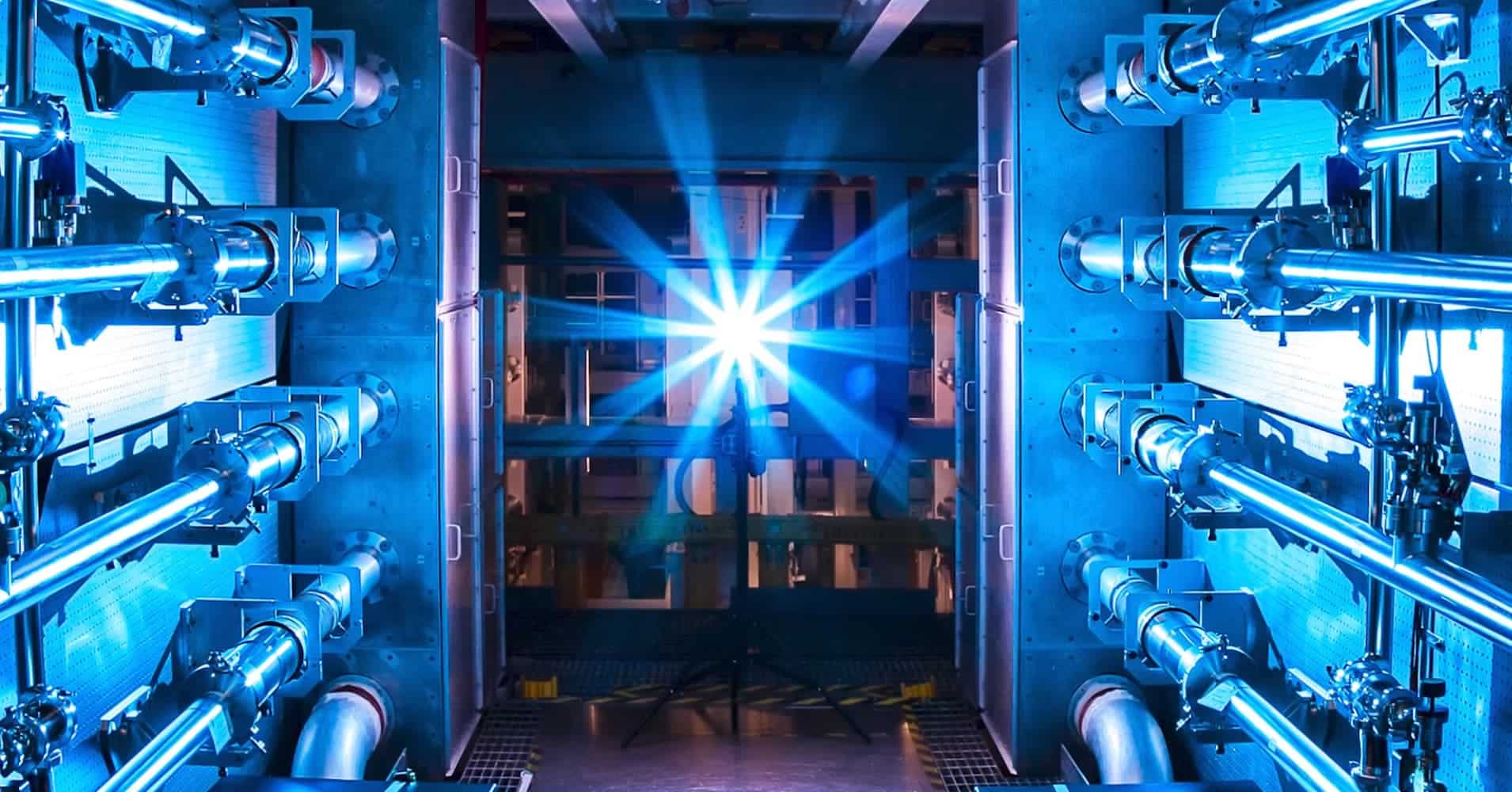
About Nuclear Fusion Reaction
- Nuclear fusion reaction involves combining two atomic nuclei to form a single heavier one, releasing an enormous amount of energy.
- Such reactions do not occur at room temperature and large amounts of energy are required to create conditions conducive to generating fusion-powered energy.
- It is the same fundamental reaction that powers the sun and other stars.
What is Nuclear Fission?
- Nuclear Fission is a type of nuclear reaction in which the nucleus of an atom is split into two or more smaller nuclei, along with the release of a significant amount of energy.
- Process:
- It occurs when a large, heavy atomic nucleus, typically of elements like uranium-235 or plutonium-239, absorbs a neutron.
- The nucleus becomes unstable and splits into two or more smaller nuclei, releasing additional neutrons, gamma rays, and a vast amount of energy in the form of kinetic energy.
- The additional neutrons can further cause fission in nearby nuclei, leading to a chain reaction.
Nuclear Reactors:
- Nuclear fission is employed in nuclear reactors to generate electricity.
- In these reactors, controlled fission reactions take place within fuel assemblies, typically using enriched uranium or plutonium.
- The heat produced during fission is used to generate steam, which drives turbines to produce electricity.
- Issues with Nuclear Fission Reactors:
- Radioactive Waste: Nuclear fission produces radioactive waste that remains hazardous for thousands of years.
- Nuclear Accidents: The potential for nuclear accidents, although rare, is a significant concern.
- High Initial Costs: Building nuclear fission reactors involves substantial upfront costs, making it a capital-intensive energy option.
- Limited Fuel Supply: Most nuclear fission reactors use enriched uranium as fuel, which is a finite resource. While there is plenty of uranium in the world, the high-grade, economically viable deposits are limited.
- Advantages of Nuclear Fusion Reactors:
- Nuclear Fusion produces more energy than fission does. This means that a given amount of fuel yields much greater amounts of energy with fusion than with fission.
- It also doesn’t produce radioactive byproducts that need to be stored, or harmful carbon emissions; it simply produces inert helium and a neutron.
- Unlimited Fuel supply: The fuel to make fusion happen is simply heavy hydrogen atoms, which can be found in something that Earth has in abundance: seawater. No mining of uranium is required.
- It is much safer than nuclear fission, since fusion can’t create runaway reactions.
Q1) What is Radioactivity?
Radioactivity is a natural phenomenon by which certain unstable atomic nuclei spontaneously decay, emitting radiation in the form of particles or electromagnetic waves. This process is a result of the fundamental forces and interactions within the atomic nucleus.
Source: Unleashing Limitless Energy: US Scientists Repeat Nuclear Fusion Breakthrough


 Last updated on Sep, 2026
→ UPSC 2027 Notification will be released on 13 January 2027 at upsconline.nic.in.
→ Check out the latest UPSC Syllabus here.
→ Download UPSC Model Answers for Mains 2026
→ UPSC Mains Question Paper 2026 is out now for Essay & GS Paper 1, 2, 3 & 4.
→ UPSC Calendar 2027 has been released.
→ Enroll in Vajiram & Ravi’s UPSC Mains Test Series 2027 for structured answer writing practice, expert evaluation, and exam-oriented feedback.
→ Join Vajiram & Ravi’s UPSC Mentorship Program 2027 for personalized guidance, strategy planning, and one-to-one support from experienced mentors.
→ Go through the UPSC Mains Previous Year Papers to enhance your preparation.
→ UPSC has released UPSC Toppers List 2025 with the Civil Services final result on its official website.
→ Also check Best UPSC Coaching in India