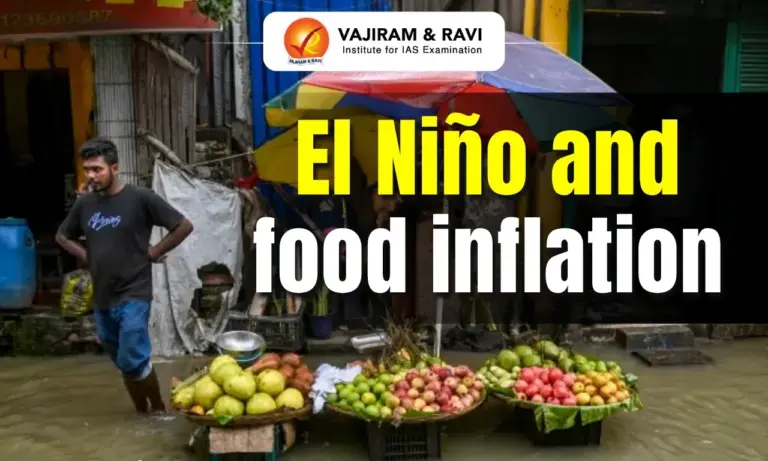
El Niño and Food Inflation Latest News
- India’s southwest monsoon this year has been erratic and deficient, largely because of a strengthening El Niño.
- The combined effect of a weak monsoon, a likely very strong El Niño in the coming months, and escalating geopolitical tensions in West Asia and Russia-Ukraine could push up food inflation, which has so far remained relatively under control.
How the Monsoon Unfolded
- The season’s performance varied sharply month by month:
- June: Normally sees about three low-pressure systems (LPS) covering around 11 days. This year, not a single LPS formed. Rainfall was 38 per cent below the long-period average (LPA).
- July: Four LPSs formed, close to the climatological average. They persisted longer, giving 24 LPS days against the normal 13.56. Rainfall was 1 per cent above the LPA.
- August: Six LPSs formed against the average of 5.38, with 26 LPS days against the normal 16.3. Yet rainfall was 16.3 per cent below the LPA. El Niño weakened the easterly trade winds, reducing the transport of moisture-laden air towards the subcontinent.
- A low-pressure system brings rain when warm, moist air near the ground rises, cools and condenses into clouds.


Overall Monsoon Picture
- Cumulative all-India rainfall was 14.7 per cent below the LPA as of September 13.
- 24 of the country’s 36 meteorological subdivisions recorded deficiency above 10 per cent.
- The southern states, along with Marathwada and Vidarbha in Maharashtra, were worst affected.
- Rainfall was largely confined to Odisha, Chhattisgarh, eastern Madhya Pradesh, Gangetic West Bengal, Jharkhand and Uttar Pradesh.
Impact on Kharif Crops
- The headline sowing figure looks reassuring. Total kharif acreage stood at 1,096.5 lakh hectares as of September 11, only 1.4 per cent below the 1,112.5 lakh hectares of the same period in 2025.
- But three better indicators tell a more worrying story.
- Fertiliser sales: Sales of di-ammonium phosphate, muriate of potash and complex fertilisers were significantly lower in April–July 2026 than a year earlier. Even urea sales fell 6.6 per cent, despite government efforts to ensure gas availability for domestic production and imports amid West Asia-induced supply shocks.
- Market prices: Wholesale prices have risen sharply over last year, reflecting bullish trader expectations of a smaller crop.
- Production forecasts: The US Department of Agriculture projects India’s rice output falling to 147 million tonnes from last year’s record 154 mt, and maize to 50 mt from 55.1 mt.
- The uneven temporal distribution (long dry spells interspersed with heavy downpours) and spatial distribution of rainfall are likely to lower yields even where sowing has been completed.
El Niño Outlook
- El Niño is currently in a strong state, with sea surface temperatures (SST) in the equatorial Pacific off Ecuador and Peru about 1.8°C above normal.
- The US National Oceanic and Atmospheric Administration projects:
- Over 90 per cent chance of a very strong El Niño (SST more than 2°C above normal) from September to January.
- Strong conditions (more than 1.5°C above normal) till March.
- Weak-to-moderate conditions (0.5°C to 1.5°C above normal) till May.
Threat to the Rabi Season
- El Niño suppresses rainfall and raises temperatures in India. A very strong event could produce a short, warm winter.
- The rabi crops most at risk include wheat, rapeseed-mustard, chana, masoor, matar, potato, onion, garlic, jeera, saunf and dhaniya.
Global Price Pressures Are Building
- The West Asia conflict has not yet caused a dramatic spike in global food prices, unlike Russia’s invasion of Ukraine in 2022.
- This is because back-to-back bumper crops in 2024-25 and 2025-26 produced record output of wheat, rice, maize, sugar, soyabean, rapeseed and palm oil. That cushion is now eroding:
- The FAO Food Price Index stood at 133.3 points in August, the highest since November 2022, though below the all-time high of 160.2 in March 2022.
- The index is a weighted average of world food commodity prices against a 2014-16 base of 100.
- The FAO vegetable oil index in August was the highest since June 2022; the cereals index touched a 27-month high.
- Running down of stocks, disrupted trade logistics from geopolitical tensions and a strengthening El Niño could push global prices further upward.
Conclusion
- A deficient and uneven monsoon, a strengthening El Niño threatening the rabi season, and tightening global markets for cereals and edible oils point in one direction: food inflation is set to return and stay elevated.
- Policymakers must prepare for supply management, buffer stock use and calibrated trade measures.

 Last updated on Oct, 2026
→ UPSC 2027 Notification will be released on 13 January 2027 at upsconline.nic.in.
→ Check Nobel Prize 2026 Winners List here.
→ Download PIB PRiSM Monthly Magazine 2026 here.
→ Check UPSC Monthly Current Affairs Magazine The Recitals here.
→ Check out the latest UPSC Syllabus here.
→ Download UPSC Model Answers for Mains 2026
→ UPSC Mains Question Paper 2026 is out now for Essay & GS Paper 1, 2, 3 & 4.
→ UPSC Calendar 2027 has been released.
→ Enroll in Vajiram & Ravi’s UPSC Mains Test Series 2027 for structured answer writing practice, expert evaluation, and exam-oriented feedback.
→ Join Vajiram & Ravi’s UPSC Mentorship Program 2027 for personalized guidance, strategy planning, and one-to-one support from experienced mentors.
→ Go through the UPSC Mains Previous Year Papers to enhance your preparation.
→ UPSC has released UPSC Toppers List 2025 with the Civil Services final result on its official website.
→ Also check Best UPSC Coaching in India
El Niño and food inflation FAQs
Q1. How can El Niño and food inflation affect India?+
Q2. How has El Niño affected India’s monsoon?+
Q3. Which crops face risks from El Niño?+
Q4. Why could global food prices rise further?+
Q5. What measures can policymakers take against food inflation?+
Tags: El Niño and food inflation mains articles upsc current affairs upsc mains current affairs