BRICS and the Global South Latest News
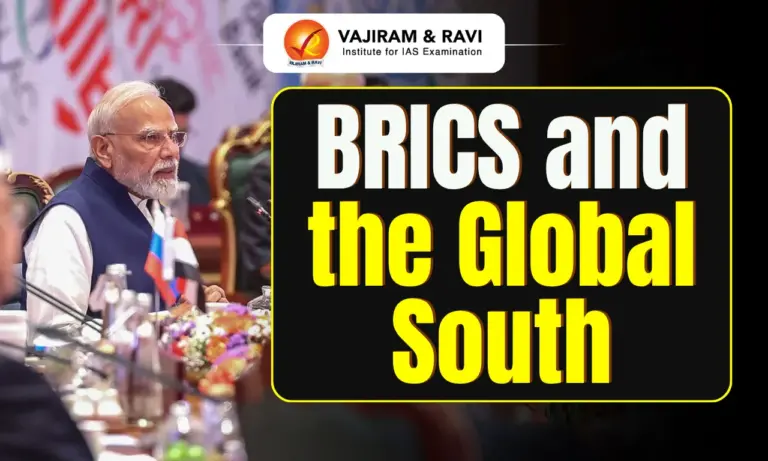
- At the concluding session of the BRICS Summit hosted by India, the Indian Prime Minister warned that the weaponisation of technology and critical minerals could undermine collective progress.
- Without naming any country, the remarks come amid concerns over China’s dominant position in critical-mineral processing and restrictions affecting the supply of rare earths and advanced technologies.
- India’s BRICS chairship centred on four pillars—Resilience, Innovation, Cooperation and Sustainability—with an emphasis on making BRICS a platform for inclusive global growth, particularly for the Global South.
Critical Minerals and Technology
- Critical minerals are increasingly central to clean energy, electronics, defence, semiconductors and advanced manufacturing.
- Excessive concentration of their processing and supply chains creates strategic vulnerabilities.
- Modi stressed that weaponising technology and critical minerals can hinder shared development.
- The New Delhi Declaration consequently called for –
- Reliable, diversified, resilient and just critical-mineral supply chains.
- Greater value addition and benefit sharing.
- Economic diversification in resource-rich countries.
- Respect for countries’ sovereign rights over their mineral resources.
- India’s position reflects a broader push for supply-chain diversification, strategic autonomy and technology inclusivity.


BRICS as a Platform for the Global South
- The Indian PM highlighted the growing confidence of developing countries in BRICS because their voices are heard, experiences respected and solutions developed jointly rather than imposed upon them.
- This reflects India’s effort to position BRICS as a mechanism for reformed and more representative global governance.
- The grouping’s diversity is presented as a strength that can facilitate cooperation among countries with different developmental realities.
- The emphasis is therefore shifting from merely articulating grievances of the Global South towards creating practical, scalable and accessible solutions.
Four Pillars of India’s BRICS Chairship
- Resilience:
- The increasing frequency of conflicts, pandemics, climate disasters and supply-chain disruptions demonstrates the vulnerability of an interconnected world.
- Crises originating in one region can rapidly produce global consequences.
- India highlighted –
- BRICS Integrated Early Warning System for prevention and response to infectious diseases.
- Early Warning Data Integration Guidelines for disaster management.
- BRICS Logistics Supply Chain Cooperation Framework to strengthen reliability and resilience of supply chains.
- The broader objective is to move from crisis response to anticipatory governance, through early identification, preparedness and prompt action.
- Innovation:
- India sought to use innovation for inclusive development through –
- BRICS Incubator Network to connect start-ups and incubators.
- BRICS Startup Innovation Fund to promote innovative and scalable solutions.
- BRICS Network on Digital Agriculture, linking AI, geospatial technology and Digital Public Infrastructure (DPI) with farmers’ needs.
- This approach seeks to ensure that emerging technologies are not confined to technologically advanced economies but contribute directly to agricultural productivity and livelihoods.
- India sought to use innovation for inclusive development through –
- Cooperation and wider participation:
- India stressed that BRICS cooperation should extend beyond governments to entrepreneurs, farmers, researchers, women, youth and ordinary citizens.
- Key initiatives include –
- BRICS CONNECT for skills, employability, women’s workforce participation, social security and capacity building.
- BRICS MSME Cooperation Portal to connect small enterprises with knowledge, finance and markets.
- BRICS Urban Mobility Hub for sharing urban best practices.
- This represents a shift towards people-centric and multi-stakeholder cooperation.
- Sustainability:
- India emphasised the need to balance human development with environmental protection, keeping intergenerational equity at the centre of sustainable development.
- Initiatives include –
- BRICS Digital Centre of Excellence for smart grids and energy storage.
- Centres of Excellence for Agro-Ecology and Regenerative Agriculture, connecting traditional knowledge with modern science.
- These initiatives seek to make clean-energy systems more reliable, efficient and accessible.
Way Forward
- As BRICS enters its third decade, its credibility will increasingly depend on translating declarations into concrete, measurable outcomes.
- Priorities should include diversified critical-mineral supply chains, responsible technology governance, resilient logistics, inclusive digitalisation and stronger participation of developing countries.
Conclusion
- India’s BRICS chairship seeks to transform the grouping from a forum for political coordination into an “ecosystem of solutions”.
- Its central challenge is to ensure that technology, critical minerals and economic integration become instruments of shared prosperity rather than geopolitical leverage.
- For the Global South, BRICS can contribute most effectively when cooperation remains inclusive, sovereign, sustainable and development-oriented.

 Last updated on Oct, 2026
→ UPSC 2027 Notification will be released on 13 January 2027 at upsconline.nic.in.
→ Check Nobel Prize 2026 Winners List here.
→ Download PIB PRiSM Monthly Magazine 2026 here.
→ Check UPSC Monthly Current Affairs Magazine The Recitals here.
→ Check out the latest UPSC Syllabus here.
→ Download UPSC Model Answers for Mains 2026
→ UPSC Mains Question Paper 2026 is out now for Essay & GS Paper 1, 2, 3 & 4.
→ UPSC Calendar 2027 has been released.
→ Enroll in Vajiram & Ravi’s UPSC Mains Test Series 2027 for structured answer writing practice, expert evaluation, and exam-oriented feedback.
→ Join Vajiram & Ravi’s UPSC Mentorship Program 2027 for personalized guidance, strategy planning, and one-to-one support from experienced mentors.
→ Go through the UPSC Mains Previous Year Papers to enhance your preparation.
→ UPSC has released UPSC Toppers List 2025 with the Civil Services final result on its official website.
→ Also check Best UPSC Coaching in India
BRICS and the Global South FAQs
Q1. How can the weaponisation of critical minerals undermine global economic security?+
Q2. What is the significance of India’s emphasis on technology inclusivity within BRICS?+
Q3. How does the BRICS Integrated Early Warning System strengthen resilience?+
Q4. How can BRICS contribute to inclusive growth in the Global South? +
Q5. Why is balancing human development with environmental sustainability important for BRICS? +
Tags: BRICS and the Global South