About Sacred Ensembles of the Hoysala:
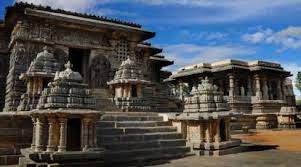
- The Sacred Ensembles of the Hoysalas consist of a collection of Hoysala temples.
- These are built in the 12th-13th centuries and represented here by the three components of Belur, Halebid and Somnathapura.
- The three temples include;
- The Chennakeshava temple: It is the main temple in the complex at Belur (Hassan district), located at the centre of the traditional settlement which is surrounded by the remnants of a mud fort and a moat.
- The Hoysaleswara Temple: It is on the banks of Dwarasamudra tank in Halebidu (Hassan district), a town which has many protected and unprotected temples, archaeological ruins and mounds.
- The Keshava Temple: It is at the centre of Somanathapura village (Mysore district).
- These are primarily dedicated to Hindu deities like Shiva and Vishnu, with some also devoted to the Jain faith.
- The Hoysala temples have a basic Darvidian morphology but show strong influences of the Bhumija mode widely used in Central India, the Nagara traditions of northern and western India, and the Karntata Dravida modes favoured by the Kalyani Chalukyas.
- Features of the architecture:
- The Hoysala architects made considered and informed eclectic selections of features from other temple typologies which they further modified and then complemented with their own particular innovations.
- The Hoysala style was created through a careful selection of contemporary temple features and those from the past to create a different identity from neighboring kingdoms.
- The shrines are characterized by hyper-real sculptures and stone carvings that cover the entire architectural surface, a circumambulatory platform, a large-scale sculptural gallery, a multi-tiered frieze, and sculptures of the Sala legend.
Q1) Who are Hoysalas?
The Hoysala dynasty was a medieval Indian dynasty that ruled over the Deccan region of southern India, primarily in the present-day Karnataka state, during the 10th to 14th centuries CE. The Hoysala Empire is known for its significant contributions to South Indian art, architecture, and culture.
Source: Karnataka’s sacred ensembles of Hoysalas inscribed on the UNESCO World Heritage list


 Last updated on Oct, 2026
→ UPSC 2027 Notification will be released on 13 January 2027 at upsconline.nic.in.
→ Check Nobel Prize 2026 Winners List here.
→ Download PIB PRiSM Monthly Magazine 2026 here.
→ Check UPSC Monthly Current Affairs Magazine The Recitals here.
→ Check out the latest UPSC Syllabus here.
→ Download UPSC Model Answers for Mains 2026
→ UPSC Mains Question Paper 2026 is out now for Essay & GS Paper 1, 2, 3 & 4.
→ UPSC Calendar 2027 has been released.
→ Enroll in Vajiram & Ravi’s UPSC Mains Test Series 2027 for structured answer writing practice, expert evaluation, and exam-oriented feedback.
→ Join Vajiram & Ravi’s UPSC Mentorship Program 2027 for personalized guidance, strategy planning, and one-to-one support from experienced mentors.
→ Go through the UPSC Mains Previous Year Papers to enhance your preparation.
→ UPSC has released UPSC Toppers List 2025 with the Civil Services final result on its official website.
→ Also check Best UPSC Coaching in India