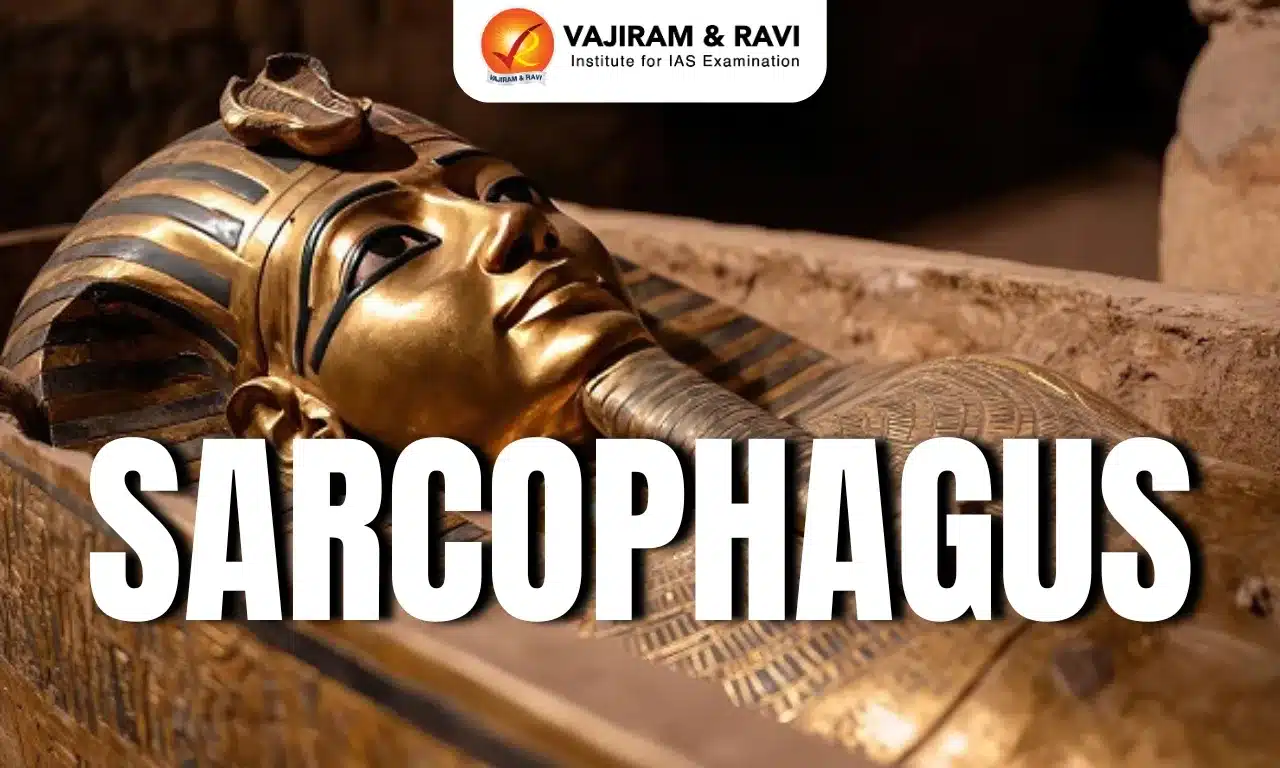
Sarcophagus Latest News
The first-ever scientific dating of a sarcophagus (terracotta coffin) found recently in Kilnamandi village in Tiruvannamalai district indicates that Tamil Nadu might have had trade contact with the north during the time of the Late Harappan civilisation.
About Sarcophagus
- Used to bury leaders and wealthy residents in ancient Egypt, Rome, and Greece, a sarcophagus is a coffin or a container to hold a coffin.
- They were intended to be displayed above ground, but they were sometimes entombed or placed in burial chambers.
- The word “sarcophagus” comes from ancient Greek words. Sarx means “flesh,” and phagein means “to eat.” So, “sarcophagus” literally means “flesh-eating.”
- This name came from a special type of limestone that people believed could help bodies decompose quickly.
- First used in Ancient Egypt and Ancient Greece, the sarcophagus gradually became popular throughout the ancient world.
- The earliest stone sarcophagi were used by Egyptian pharaohs of the 3rd dynasty, which reigned from about 2686 to 2613 B.C.E.
- It carried over through the later years of European society, often used for high status members of the clergy, government, or aristocracy.
- Features:
- They differ in detail from one culture to another.
- They are almost always made of stone, limestone being the most popular, but sometimes of granite, sandstone, or marble.
- Sarcophagi were elaborately decorated with carvings, images, and writing, usually including the name of the person who died.
- Archaeological Significance:
- Sarcophagi are important artifacts for archaeologists and historians because they provide insights into the art, culture, and beliefs of the societies that created them.
- The carvings and inscriptions on sarcophagi often contain valuable historical information.
- Example: The most famous Egyptian sarcophagus is perhaps the golden sarcophagus of King Tutankhamun.
Source: TOI


 Last updated on Sep, 2026
→ UPSC 2027 Notification will be released on 13 January 2027 at upsconline.nic.in.
→ Asian Games 2026 are being held in Aichi-Nagoya, Japan, from 19 September to 4 October.
→ Check out the latest UPSC Syllabus here.
→ Download UPSC Model Answers for Mains 2026
→ UPSC Mains Question Paper 2026 is out now for Essay & GS Paper 1, 2, 3 & 4.
→ UPSC Calendar 2027 has been released.
→ Enroll in Vajiram & Ravi’s UPSC Mains Test Series 2027 for structured answer writing practice, expert evaluation, and exam-oriented feedback.
→ Join Vajiram & Ravi’s UPSC Mentorship Program 2027 for personalized guidance, strategy planning, and one-to-one support from experienced mentors.
→ Go through the UPSC Mains Previous Year Papers to enhance your preparation.
→ UPSC has released UPSC Toppers List 2025 with the Civil Services final result on its official website.
→ Also check Best UPSC Coaching in India
Sarcophagus FAQs
Q1. What is a Sarcophagus?+
Q2. Which ancient civilization first used stone sarcophagi?+
Q3. Where were sarcophagi typically placed?+
Q4. Besides Egypt, which other ancient civilizations commonly used sarcophagi?+
Tags: prelims pointers sarcophagus upsc current affairs upsc prelims current affairs