Key findings
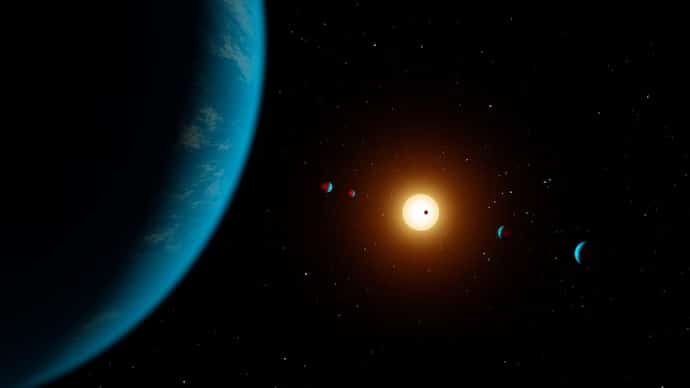
- The star, known as HD110067, is located approximately 100 light-years away in the constellation Coma Berenices and is about 20% less massive than our Sun.
- The six planets were detected by observing minute dimming of the star’s brightness as each planet transited, or passed in front of, the star from our perspective on Earth
- The orbital resonance of these planets i.e their orbits are synchronised in such a way that they have remained stable for about 4 billion years.
About Sub-Neptune planets
- These are the most commonly observed type of planet in our galaxy.
- They could be rocky worlds with thick atmospheres of hydrogen and helium gas, or perhaps composed of rock and ice with warm, water-rich atmospheres.
- These planets have radii between that of the Earth and Neptune.


Key points about Neptune
- It’s the last of the planets in our solar system.
- It’s more than 30 times as far from the sun as Earth is.
- Neptune is very similar to Uranus. It’s made of a thick fog of water, ammonia, and methane over an Earth-sized solid center.
- Its atmosphere is made of hydrogen, helium, and methane.
- Structure and Surface
- Neptune is encircled by six rings and is an ice giant.
- It is made of a thick soup of water, ammonia, and methane flowing over a solid core about the size of Earth.
- It has a thick, windy atmosphere.
- Time on Neptune
- One day on Neptune goes by in 16 hours.
- Neptune has such a long journey around the Sun it takes 165 Earth years to go around once.
Q1) What is Methane?
It is a colourless, odourless gas that occurs abundantly in nature and as a product of certain human activities. Methane is the simplest member of the paraffin series of hydrocarbons and is among the most potent of the greenhouse gases. Its chemical formula is CH4.
Source: Six alien planets dancing in sync found. They have been stable for 4 billion years

 Last updated on Oct, 2026
→ UPSC 2027 Notification will be released on 13 January 2027 at upsconline.nic.in.
→ Check Nobel Prize 2026 Winners List here.
→ Download PIB PRiSM Monthly Magazine 2026 here.
→ Check UPSC Monthly Current Affairs Magazine The Recitals here.
→ Check out the latest UPSC Syllabus here.
→ Download UPSC Model Answers for Mains 2026
→ UPSC Mains Question Paper 2026 is out now for Essay & GS Paper 1, 2, 3 & 4.
→ UPSC Calendar 2027 has been released.
→ Enroll in Vajiram & Ravi’s UPSC Mains Test Series 2027 for structured answer writing practice, expert evaluation, and exam-oriented feedback.
→ Join Vajiram & Ravi’s UPSC Mentorship Program 2027 for personalized guidance, strategy planning, and one-to-one support from experienced mentors.
→ Go through the UPSC Mains Previous Year Papers to enhance your preparation.
→ UPSC has released UPSC Toppers List 2025 with the Civil Services final result on its official website.
→ Also check Best UPSC Coaching in India