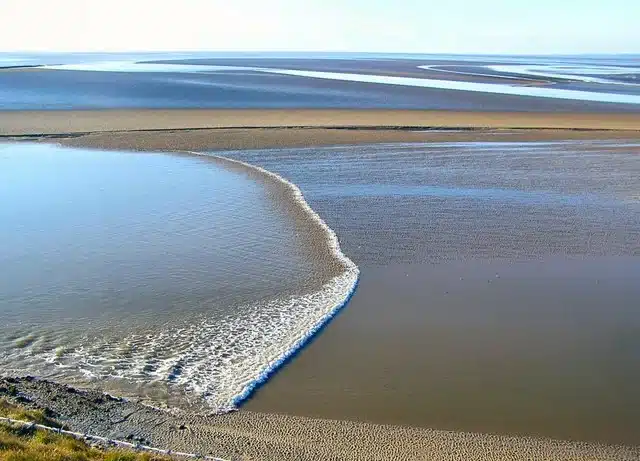
About Qiantang River
- It is a southeast Chinese River that originates on the borders of Anhui and Jiangxi provinces.
- It runs for 459 kilometers through Zhejiang, passing through the capital city – Hangzhou and Yanguan Town, Haining, Jiaxing City before flowing into the East China Sea via Hangzhou Bay.
- The river is also the southern terminal of the ancient Grand Canal that links five major rivers in China from north to south, enabling traffic north to Beijing from Hangzhou via the Canal.
- It is encircled by a group of economically booming cities, including Shanghai, the leading industrial and commercial hub of the country, and Ningbo, one of China’s leading port cities.
- The spectacular Qiantang River Tidal Bore is known as one of the largest tidal bores in the world. The highest tidal bore can reach up to 9 meters (30 feet) high.
What is a Tidal Bore?
- A tidal bore occurs along a coast where a river empties into an ocean or sea.
- A tidal bore is a strong tide that pushes up the river, against the current.
- A tidal bore is a surge. A surge is a sudden change in depth.
- When a channel suddenly gets deeper, it experiences a positive surge. When a channel suddenly gets shallower, it experiences a negative surge. Tidal bores are positive surges.
- The height of the bore is greater near the banks of a river than at midstream.
- Because of momentum, some bores continue to move upstream for about one-half hour after high water.
- Bores occur at spring tides and at several tides preceding and following spring tides, but never at neap tides.
Q1) What are Tides?
Tides are very long-period waves that move through the ocean in response to the forces exerted by the moon and sun. Tides originate in the ocean and progress toward the coastlines where they appear as the regular rise and fall of the sea surface. When the highest part, or crest, of the wave reaches a particular location, high tide occurs; low tide corresponds to the lowest part of the wave, or its trough. The difference in height between the high tide and the low tide is called the tidal range.
Source: Tree-shaped patterns appear on frozen Qiantang River


 Last updated on Oct, 2026
→ UPSC 2027 Notification will be released on 13 January 2027 at upsconline.nic.in.
→ Check Nobel Prize 2026 Winners List here.
→ Download PIB PRiSM Monthly Magazine 2026 here.
→ Check UPSC Monthly Current Affairs Magazine The Recitals here.
→ Check out the latest UPSC Syllabus here.
→ Download UPSC Model Answers for Mains 2026
→ UPSC Mains Question Paper 2026 is out now for Essay & GS Paper 1, 2, 3 & 4.
→ UPSC Calendar 2027 has been released.
→ Enroll in Vajiram & Ravi’s UPSC Mains Test Series 2027 for structured answer writing practice, expert evaluation, and exam-oriented feedback.
→ Join Vajiram & Ravi’s UPSC Mentorship Program 2027 for personalized guidance, strategy planning, and one-to-one support from experienced mentors.
→ Go through the UPSC Mains Previous Year Papers to enhance your preparation.
→ UPSC has released UPSC Toppers List 2025 with the Civil Services final result on its official website.
→ Also check Best UPSC Coaching in India