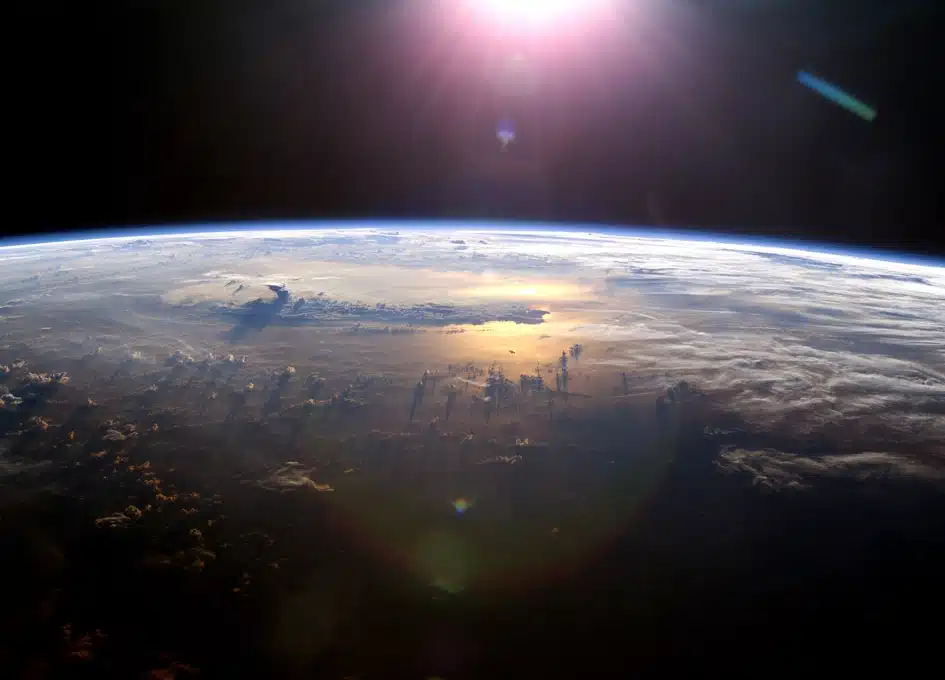
About Karman Line
- Located at 100 km (62 miles) above sea level, it is an imaginary line that demarcates the earth’s atmosphere from space.
- It was established in the 1960s by a record-keeping body called the Fédération Aéronautique Internationale (FAI).
- It was named after aerospace pioneer Theodore von Kármán.
- Though not all scientists and spacefarers accept it (for example, the Federal Aviation Administration, NASA, and the U.S. military place the line between outer space and the atmosphere at 80 km (50 miles) above the Earth’s surface) , a majority of countries and space organisations recognise this boundary between earthsky and space.
- It is based on physical reality in the sense that it roughly marks the altitude where traditional aircraft can no longer effectively fly.
- Anything traveling above the Kármán line needs a propulsion system that doesn’t rely on lift generated by Earth’s atmosphere—the air is simply too thin that high up.
- In other words, the Kármán line is where the physical laws governing a craft’s ability to fly shift.
- Anyone who crosses this line qualifies as an astronaut.
- Why do we need a Kármán line?
- The 1967 Outer Space Treaty says that space should be accessible to all countries and can be freely and scientifically investigated.
- Defining a legal boundary of what and where space can help avoid disputes and keep track of space activities and human space travel.
Q1) What is the Fédération Aéronautique Internationale (FAI)?
It is a non-governmental and non-profit making international organisation with the basic aim of furthering aeronautical and astronautical activities worldwide, ratifying world and continental records and coordinating the organisation of international competitions.
Source: The crucial role of the Kármán Line in space defense strategies


 Last updated on Oct, 2026
→ UPSC 2027 Notification will be released on 13 January 2027 at upsconline.nic.in.
→ Check Nobel Prize 2026 Winners List here.
→ Download PIB PRiSM Monthly Magazine 2026 here.
→ Check UPSC Monthly Current Affairs Magazine The Recitals here.
→ Check out the latest UPSC Syllabus here.
→ Download UPSC Model Answers for Mains 2026
→ UPSC Mains Question Paper 2026 is out now for Essay & GS Paper 1, 2, 3 & 4.
→ UPSC Calendar 2027 has been released.
→ Enroll in Vajiram & Ravi’s UPSC Mains Test Series 2027 for structured answer writing practice, expert evaluation, and exam-oriented feedback.
→ Join Vajiram & Ravi’s UPSC Mentorship Program 2027 for personalized guidance, strategy planning, and one-to-one support from experienced mentors.
→ Go through the UPSC Mains Previous Year Papers to enhance your preparation.
→ UPSC has released UPSC Toppers List 2025 with the Civil Services final result on its official website.
→ Also check Best UPSC Coaching in India