Stratospheric Aerosol Injection Latest News
A study recently published in the journal Earth’s Future offered an innovative approach to Stratospheric aerosol injection (SAI) technique that could reduce its costs but also bring it closer to fruition despite the opposition to it.
About Stratospheric Aerosol Injection
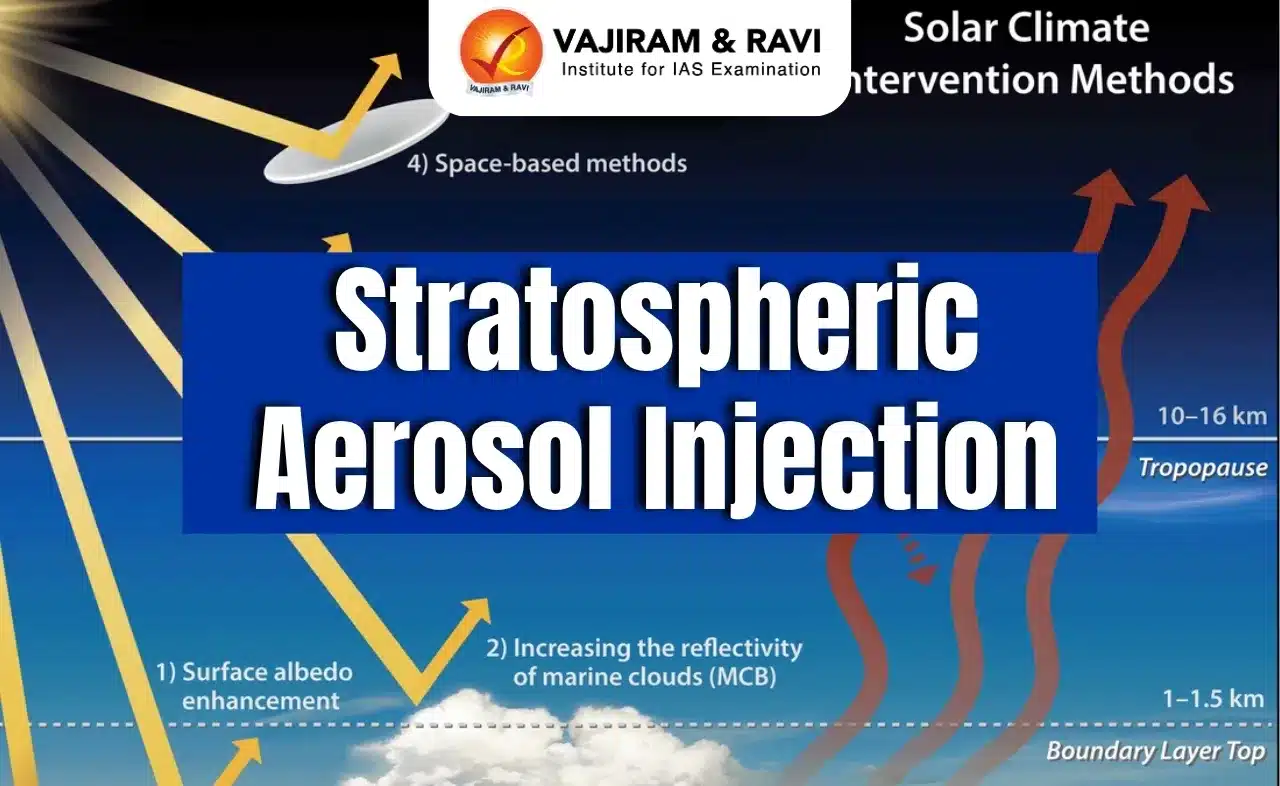
- It is a method of cooling the planet and reducing the impacts of climate change by adding a layer of tiny reflective particles to the high atmosphere.
- The method was inspired by volcanic eruptions, which have been known to have a cooling effect on the planet by spewing aerosols into the air.
- It aims to mimic the cooling effects of volcanic eruptions by injecting sulfur dioxide (SO2) directly into the stratosphere, where it forms sunlight-reflecting sulfate aerosols.
Key Facts about Aerosols
- They are tiny solid or liquid particles suspended in air or a gas.
- Aerosols can be natural, such as fog or gas from volcanic eruptions, or artificial, such as smoke from burning fossil fuels.
- Aerosol particles are either emitted directly into the atmosphere (primary aerosols) or produced in the atmosphere from precursor gases (secondary aerosols).
- Aerosol particles are tiny, but numerous, and often comprise a number of inorganic and organic substances.
- True aerosol particles range in diameter from a few milli micrometres to about 1 micrometre (equal to 10-4 cm).
- Particles with a diameter of less than 0.1 micrometre are sometimes referred to as Aitken nuclei.
- Visible forms of atmospheric aerosol plumes include smoke, smog, haze, and dust.


Stratospheric Aerosol Injection FAQs
Q1: What is the Stratosphere?
Ans: It is the layer of Earth’s atmosphere lying between the troposphere and the mesosphere. The stratosphere extends from the tropopause at about 10 to 17 km (about 6 to 11 miles) altitude to its upper boundary (the stratopause) at about 50 km (30 miles).
Q2: What is smog?
Ans: Smog is a specific type of air pollution. It is a combination of harmful pollutants (often appearing relatively low to the ground as a yellow-brown haze) that are introduced into the atmosphere by both natural and human induced processes.
Source: TH

 Last updated on Oct, 2026
→ UPSC 2027 Notification will be released on 13 January 2027 at upsconline.nic.in.
→ Check Nobel Prize 2026 Winners List here.
→ Download PIB PRiSM Monthly Magazine 2026 here.
→ Check UPSC Monthly Current Affairs Magazine The Recitals here.
→ Check out the latest UPSC Syllabus here.
→ Download UPSC Model Answers for Mains 2026
→ UPSC Mains Question Paper 2026 is out now for Essay & GS Paper 1, 2, 3 & 4.
→ UPSC Calendar 2027 has been released.
→ Enroll in Vajiram & Ravi’s UPSC Mains Test Series 2027 for structured answer writing practice, expert evaluation, and exam-oriented feedback.
→ Join Vajiram & Ravi’s UPSC Mentorship Program 2027 for personalized guidance, strategy planning, and one-to-one support from experienced mentors.
→ Go through the UPSC Mains Previous Year Papers to enhance your preparation.
→ UPSC has released UPSC Toppers List 2025 with the Civil Services final result on its official website.
→ Also check Best UPSC Coaching in India
Tags: prelims pointers stratospheric aerosol injection upsc current affairs upsc prelims current affairs