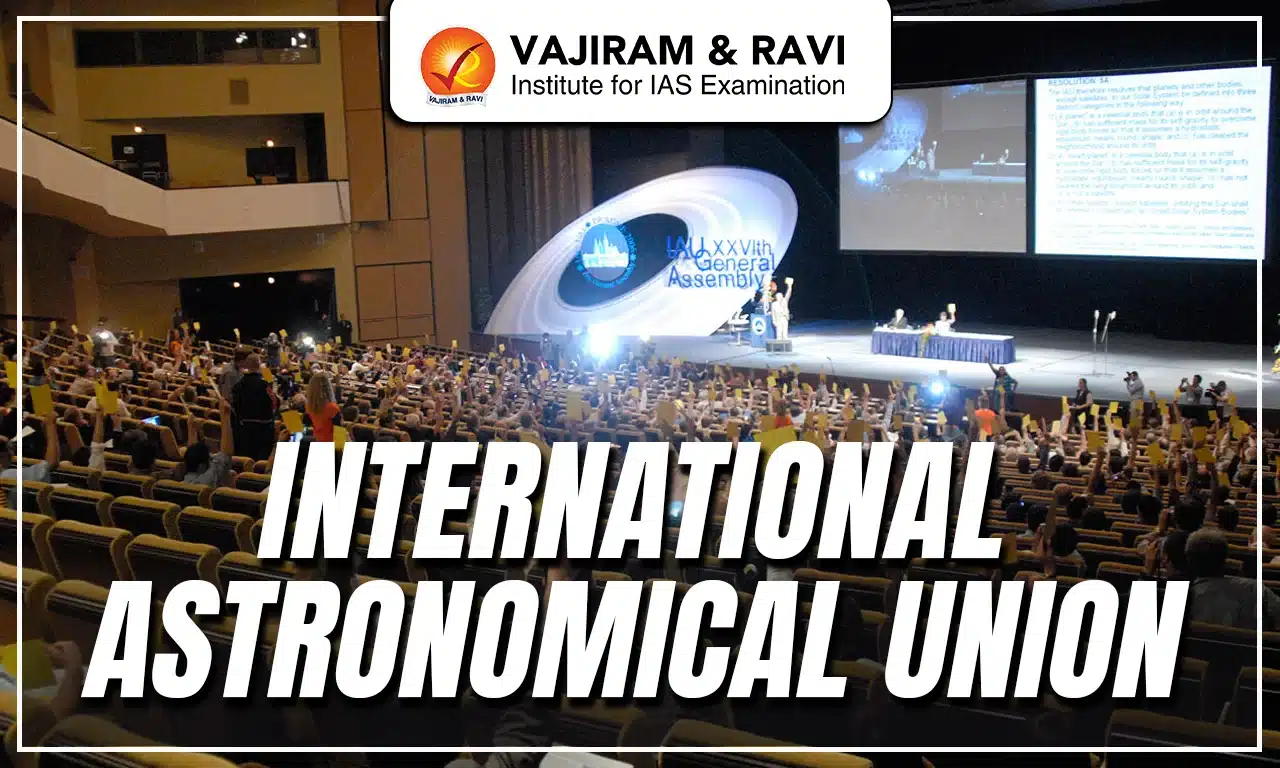
International Astronomical Union (IAU) Latest News
A 3.5-billion-year-old Martian crater has been named after pioneering Indian geologist M.S. Krishnan, following the International Astronomical Union’s (IAU’s) approval of this and several other Kerala-proposed names for Martian landforms.
About International Astronomical Union (IAU)
- It was founded in 1919 as a senior body governing international professional astronomical activities worldwide.
- Its mission is to promote and safeguard the science of astronomy in all its aspects, including research, communication, education, and development, through international cooperation.
- Activities:
- Definition of fundamental astronomical and dynamical constants and unambiguous astronomical nomenclature
- Rapid dissemination of new discoveries
- Organization of international observing campaigns
- Promotion of educational activities in astronomy to early informal discussions of possible future international large-scale facilities.
- It is the only organization recognized professionally for the naming of astronomical bodies, which it does solely on the basis of merit, history, or discoverer’s privilege.
- The IAU holds a general assembly every three years in varying parts of the world. The long-term policy of the IAU is defined by the General Assembly.
- Headquarters: Paris, France.
- A key activity of the IAU is the organization of scientific meetings. Every year the IAU sponsors 9 international IAU Symposia.
- Membership:
- Its individual Members — structured into Divisions, Commissions, and Working Groups — are professional astronomers from all over the world, at the Ph.D. level and beyond, who are active in professional research, education and outreach in astronomy.
- The IAU also has Junior Members.
- The IAU has a total membership of 12742.
- These members are labeled as “active” in the IAU database, meaning they have a valid email (are able to vote and stay connected to the IAU activities) and are affiliated to at least one Division.
- IAU membership spans 92 countries. Out of those countries, 85 are National Members.
Source: TH


 Last updated on Sep, 2026
→ UPSC 2027 Notification will be released on 13 January 2027 at upsconline.nic.in.
→ Asian Games 2026 are being held in Aichi-Nagoya, Japan, from 19 September to 4 October.
→ Check out the latest UPSC Syllabus here.
→ Download UPSC Model Answers for Mains 2026
→ UPSC Mains Question Paper 2026 is out now for Essay & GS Paper 1, 2, 3 & 4.
→ UPSC Calendar 2027 has been released.
→ Enroll in Vajiram & Ravi’s UPSC Mains Test Series 2027 for structured answer writing practice, expert evaluation, and exam-oriented feedback.
→ Join Vajiram & Ravi’s UPSC Mentorship Program 2027 for personalized guidance, strategy planning, and one-to-one support from experienced mentors.
→ Go through the UPSC Mains Previous Year Papers to enhance your preparation.
→ UPSC has released UPSC Toppers List 2025 with the Civil Services final result on its official website.
→ Also check Best UPSC Coaching in India
International Astronomical Union (IAU) FAQs
Q1. In which year was the International Astronomical Union (IAU) founded?+
Q2. What is the primary mission of the IAU?+
Q3. Where is the headquarters of the International Astronomical Union (IAU) located?+
Q4. How often does the International Astronomical Union (IAU) hold its General Assembly?+
Tags: international astronomical union prelims pointers upsc current affairs upsc prelims current affairs