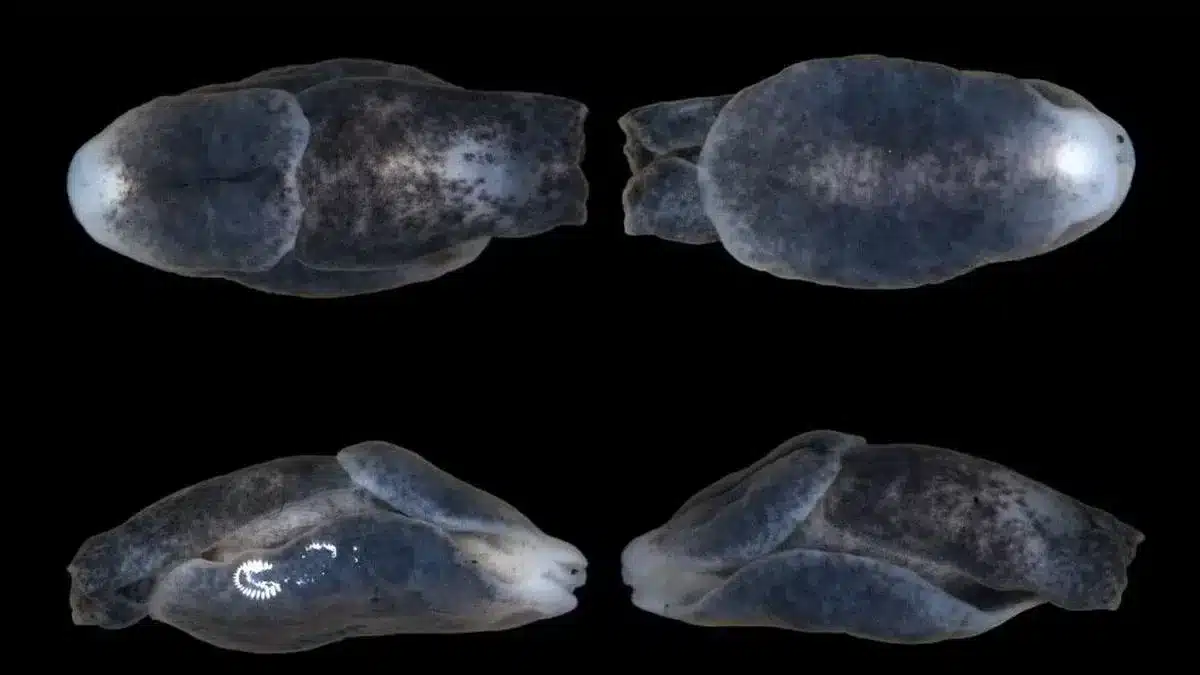
About Melanochlamys Droupadi
- It is a new marine species of head-shield sea slug with ruby red spot.
- This species belonging to Melanochlamys genus was discovered from Digha of West Bengal coast and Udaipur of Odisha coast.
- Features:
- It is a small invertebrate with a maximum length of up to 7 mm.
- Habitat: It inhabits wet and soft sandy beaches.
- It is brownish black in colour with a ruby red spot in the hind end.
- This particular species of sea slug is hermaphrodite (having both male and female reproductive parts); however, they need another sea slug for reproduction.
- It has a shell inside the body. It has a posterior, accounting for 61 percent of its body length.
- It continuously secretes transparent mucus to form a sheath that prevents sand grains from entering parapodial space.
- It crawls beneath smooth sand to form a moving capsule where the body is rarely visible, leaving behind a trail like a turtle.
What are Sea Slugs?
- Sea slugs are a group of molluscs that live primarily in marine habitats and are slug-like.
- They can be found from the shallow intertidal to the deep sea and from the polar regions to the tropics.
- The sea slugs are rapid hunters and feed upon mobile prey such as other shelled and unshelled sea slugs, roundworms, marine worms, and small fishes.
- So far, 18 species have been discovered across the globe.
- They are distributed in temperate regions of the Indo-Pacific Oceanic realm, but three species are truly tropically distributed, Melanochlamys papillata from the Gulf of Thailand, Melanochlamys bengalensis from West Bengal and Odisha coast and the present species.
Q1) What are invertebrates?
Invertebrate is any animal that lacks a vertebral column, or backbone, in contrast to the cartilaginous or bony vertebrates. More than 90 percent of all living animal species are invertebrates. Worldwide in distribution, they include animals as diverse as sea stars, sea urchins, earthworms, sponges, jellyfish, lobsters, crabs, insects, spiders, snails, clams, and squid.
Source: Zoologists spot new sea slug species, name it after Prez


 Last updated on Oct, 2026
→ UPSC 2027 Notification will be released on 13 January 2027 at upsconline.nic.in.
→ Check Nobel Prize 2026 Winners List here.
→ Download PIB PRiSM Monthly Magazine 2026 here.
→ Check UPSC Monthly Current Affairs Magazine The Recitals here.
→ Check out the latest UPSC Syllabus here.
→ Download UPSC Model Answers for Mains 2026
→ UPSC Mains Question Paper 2026 is out now for Essay & GS Paper 1, 2, 3 & 4.
→ UPSC Calendar 2027 has been released.
→ Enroll in Vajiram & Ravi’s UPSC Mains Test Series 2027 for structured answer writing practice, expert evaluation, and exam-oriented feedback.
→ Join Vajiram & Ravi’s UPSC Mentorship Program 2027 for personalized guidance, strategy planning, and one-to-one support from experienced mentors.
→ Go through the UPSC Mains Previous Year Papers to enhance your preparation.
→ UPSC has released UPSC Toppers List 2025 with the Civil Services final result on its official website.
→ Also check Best UPSC Coaching in India