About Coral Reef Watch
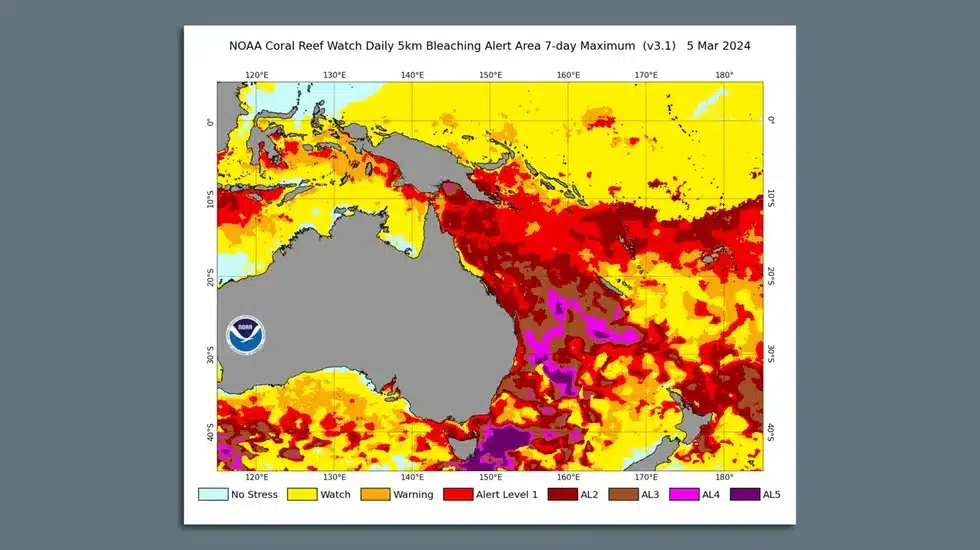
- It is a free online tool that provides a global analysis of sea surface temperature (SST) and outlooks to identify coral reefs that are at risk of bleaching.
- It is offering the world’s only global early-warning system of coral reef ecosystem environmental changes.
- It remotely monitors conditions that can cause coral bleaching, disease, and death; delivers information and early warnings in near real-time to our extensive and diverse user community; it uses operational climate forecasts to provide outlooks of stressful environmental conditions on coral reefs worldwide.
- Its products are primarily sea surface temperature (SST)-based but also incorporate light and ocean color, among other variables.
- It has been using remote sensing, modeled, and in situ data to operate a decision support system to help all stakeholders around the world prepare for and respond to coral reef ecosystem stressors, predominantly resulting from climate change and warming of the Earth’s oceans.
- This online tool was developed by National Oceanic and Atmospheric Administration (NOAA).
Key facts about Corals
- Corals are marine invertebrates or animals not possessing a spine.
- Each coral is called a polyp and thousands of such polyps live together to form a colony, which grows when polyps multiply to make copies of themselves.
- Corals share a symbiotic relationship with single-celled algae called zooxanthellae.
- The algae provides the coral with food and nutrients, which they make through photosynthesis, using the sun’s light.
- In turn, the corals give the algae a home and key nutrients. The zooxanthellae also give corals their bright colour.
- Australia’s Great Barrier Reef is the world’s largest reef system stretching across 2,300 km.
Also Read: Fourth Mass Coral Reef Bleaching
Q1) What is Coral Bleaching?
It happens when corals experience stress in their environment due to changes in temperature, pollution or high levels of ocean acidity.Under stressed conditions, the zooxanthellae or food-producing algae living inside coral polyps start producing reactive oxygen species, which are not beneficial to the corals.
Source: Fourth global mass coral bleaching? Great Barrier Reef severely affected, corals seen dying


 Last updated on Sep, 2026
→ UPSC 2027 Notification will be released on 13 January 2027 at upsconline.nic.in.
→ Asian Games 2026 are being held in Aichi-Nagoya, Japan, from 19 September to 4 October.
→ Check out the latest UPSC Syllabus here.
→ Download UPSC Model Answers for Mains 2026
→ UPSC Mains Question Paper 2026 is out now for Essay & GS Paper 1, 2, 3 & 4.
→ UPSC Calendar 2027 has been released.
→ Enroll in Vajiram & Ravi’s UPSC Mains Test Series 2027 for structured answer writing practice, expert evaluation, and exam-oriented feedback.
→ Join Vajiram & Ravi’s UPSC Mentorship Program 2027 for personalized guidance, strategy planning, and one-to-one support from experienced mentors.
→ Go through the UPSC Mains Previous Year Papers to enhance your preparation.
→ UPSC has released UPSC Toppers List 2025 with the Civil Services final result on its official website.
→ Also check Best UPSC Coaching in India