


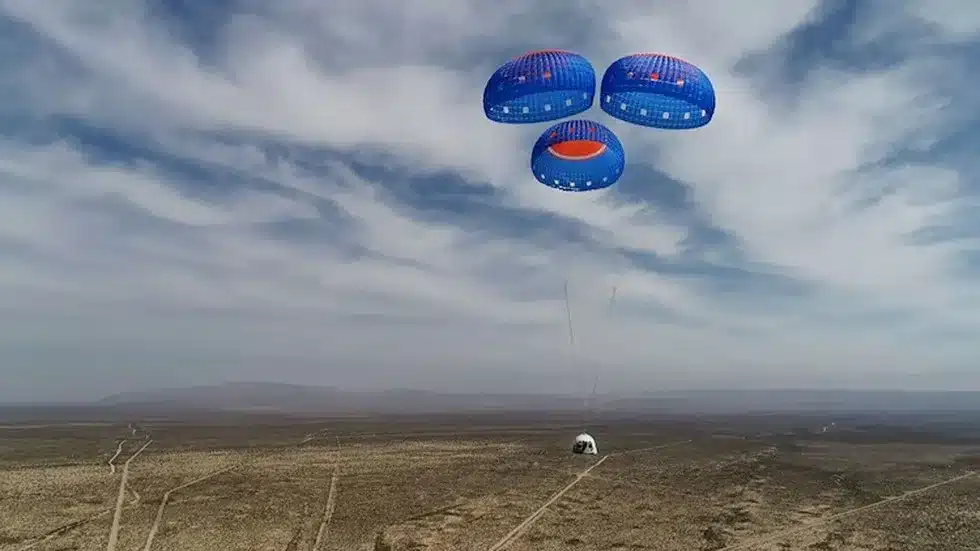
About New Shepard Spacecraft:
- It is a suborbital space travel vehicle, offering a unique experience for both scientific research and space tourism.
- It is named after Alan Shepard, the first American in space, New Shepard is a fully reusable rocket system designed for human spaceflight.
- It consists of two main components: a reusable booster and a pressurized crew capsule.
- The capsule can accommodate six passengers, providing each with a window seat to witness breathtaking views of Earth.
- Among its notable features are the largest windows ever flown in space, offering an unparalleled visual experience for astronauts.
- New Shepard’s 11-minute journey takes passengers beyond the Karman line. During the flight, passengers experience several minutes of weightlessness before making a controlled descent back to Earth aided by parachutes.
- In addition to its space tourism potential, New Shepard serves as a valuable platform for scientific research.
What is the Karman line?
- Located at 100 km (62 miles) above sea level, it is an imaginary line that demarcates the earth’s atmosphere from space.
- It was established in the 1960s by a record-keeping body called the Fédération Aéronautique Internationale (FAI).
- It was named after aerospace pioneer Theodore von Kármán.
- Though not all scientists and spacefarers accept it (for example, the Federal Aviation Administration, NASA, and the U.S. military place the line between outer space and the atmosphere at 80 km (50 miles) above the Earth’s surface) , a majority of countries and space organisations recognise this boundary between earth sky and space.
- Anything traveling above the Kármán line needs a propulsion system that doesn’t rely on lift generated by Earth’s atmosphere—the air is simply too thin that high up.
Q1:What is a suborbital spaceflight?
It refers to a height of around 100km from the Earth’s surface, and is done at a lower altitude than an orbital flight, which reaches at least a low-Earth orbit — between around 200km to 2,000km from Earth.
Source: Meet New Shepard: Blue Origin’s spacecraft set to take Indians to space


 Last updated on Sep, 2026
→ UPSC 2027 Notification will be released on 13 January 2027 at upsconline.nic.in.
→ Check out the latest UPSC Syllabus here.
→ Download UPSC Model Answers for Mains 2026
→ UPSC Mains Question Paper 2026 is out now for Essay & GS Paper 1, 2, 3 & 4.
→ UPSC Calendar 2027 has been released.
→ Enroll in Vajiram & Ravi’s UPSC Mains Test Series 2027 for structured answer writing practice, expert evaluation, and exam-oriented feedback.
→ Join Vajiram & Ravi’s UPSC Mentorship Program 2027 for personalized guidance, strategy planning, and one-to-one support from experienced mentors.
→ Go through the UPSC Mains Previous Year Papers to enhance your preparation.
→ UPSC has released UPSC Toppers List 2025 with the Civil Services final result on its official website.
→ Also check Best UPSC Coaching in India








