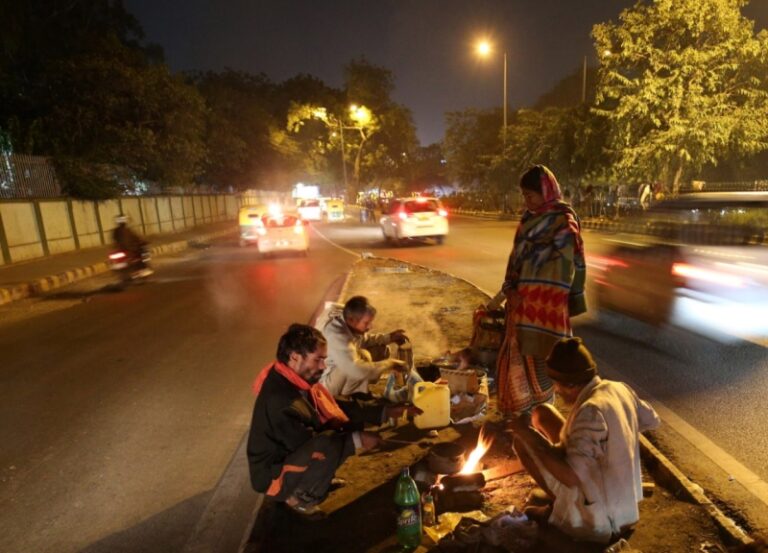
Extreme Poverty in India Latest News
- The World Bank’s (WB) latest Poverty & Equity Brief indicates that India’s extreme poverty rate has declined significantly.
- However, persistent unemployment, stagnant real earnings and regional disparities raise concerns about the sustainability of poverty reduction.
- The central challenge is to translate economic growth into productive employment, higher incomes and improved living standards, particularly in India’s poorer states.
Declining Poverty – WB Estimates
- Significant reduction in poverty:
- Extreme poverty, measured using the World Bank’s $3-per-day poverty line, declined from 5.3% in 2022 to 2.6% in 2023.
- Using the Lower Middle-Income Country (LMIC) threshold of $4.20 per day, poverty declined from 23.9% to 16.1%.
- The poverty rate under the $4.20 threshold is projected to decline further to 14.2% in 2026 and 12.1% by 2028.
- Employment remains the critical determinant:
- The WB emphasises that future poverty reduction depends on the creation of productive jobs in India’s poorest states.
- For example,
- Youth unemployment increased to 15.9% over the preceding year.
- Real earnings have remained largely stagnant.
- The sustainability of poverty reduction depends on employment quality, not merely employment numbers.


The ‘Feeling’ of Growth – A Disconnect Between GDP and Incomes
- Economic growth without equitable gains:
- India recorded GDP growth of 7.8% in the April–June quarter, exceeding most forecasts.
- Yet, the benefits of growth are not uniformly reflected in household incomes and living standards.
- The International Labour Organization (ILO) highlights a weakening relationship between productivity and wages.
- For example,
- The global share of income accruing to labour declined from approximately 54% in 2004 to 52.6% in 2025.
- Rising productivity does not necessarily translate into proportionately higher wages.
- This weakens purchasing power and limits the ability of economic growth to reduce poverty.
- Demographic dividend under pressure:
- India’s demographic dividend cannot be taken for granted.
- For instance,
- Youth unemployment and inadequate skills threaten the productive absorption of the working-age population.
- Excessive dependence on smartphones, social media and AI raises concerns about attention spans, cognitive skills and social well-being.
- Unlike earlier ageing economies, India must manage demographic pressures alongside rapid technological transformation.
Regional Concentration of Poverty
- A new BIMARU?
- The World Bank estimates that 57% of India’s poor live in a contiguous belt extending from UP to West Bengal.
- This recalls the term BIMARU, coined by demographer Ashish Bose to describe Bihar, Madhya Pradesh, Rajasthan and UP.
- The emerging poverty belt suggests a shift in the geographical concentration of poverty, with West Bengal becoming an important part of the region.
- Poverty estimates based:
- The earlier Rangarajan Committee estimated the monthly per capita poverty line at – Urban areas: ₹1,407 (approximately ₹47 per day); and Rural areas: ₹972 (approximately ₹32 per day).
- It estimated India’s poverty rate at 29.5%.
- State-wise poverty rates (2022–23):
- Chhattisgarh (25.1% rural poverty, 13.3% urban), Jharkhand (16.6% and 12.6%), MP (9.6% and 11.6%), WB (7.5% and 12.4%), Bihar (5.9% and 9.1%), and UP (5.7% and 9.9%).
- Despite relatively high poverty levels, these states have achieved substantial reductions between 2011–12 and 2022–23.
- Urban Bihar recorded the largest decline among states, from 50.8% to 9.1%.
Employment Challenges – A New Reckoning
- The WB estimates that employment increased by 13.4 crore between 2017 and 2023, nearly twice the increase in the working-age population. However, there is a mismatch between employment quantity and quality.
- Emerging concerns:
- Wage stagnation: Factory workers’ wages in Jharkhand declined by 5.2% in 2024–25, against an all-India increase of 5.3%.
- NEET youth: In 2025, 81% of Bihar’s districts had more than one-fourth of their 15–29-year-olds neither employed nor in education or training (NEET).
- Regional disparities: Poorer states face inadequate industrial diversification, low productivity and limited access to quality employment.
- AI-driven disruption: Automation may intensify pressure on low-skilled workers and require large-scale reskilling.
- Nevertheless, progress is visible. UP recorded the largest increase in the number of factories in 2024–25, at 12.8%.
Way Forward
- Labour-intensive manufacturing: Promote textiles, food processing, footwear and other employment-intensive sectors in poorer states.
- Human capital development: Strengthen foundational literacy, vocational education, healthcare and digital skills to improve labour productivity.
- Decentralised development: Improve infrastructure, logistics, urbanisation and investment conditions in lagging regions.
- Employment quality: Focus on formalisation, social security, minimum wages and productive self-employment.
- Evidence-based policy: Use updated consumption surveys, employment data and multidimensional poverty indicators to identify vulnerable groups.
Conclusion
- India’s declining poverty is a significant development achievement, but sustaining it requires a transition from growth-led poverty reduction to employment-led inclusive development.
- Creating productive jobs, improving real wages and addressing regional inequalities will be essential to realise the demographic dividend and achieve the vision of Viksit Bharat by 2047.
Source: IE

 Last updated on Oct, 2026
→ UPSC 2027 Notification will be released on 13 January 2027 at upsconline.nic.in.
→ Check Nobel Prize 2026 Winners List here.
→ Download PIB PRiSM Monthly Magazine 2026 here.
→ Check UPSC Monthly Current Affairs Magazine The Recitals here.
→ Check out the latest UPSC Syllabus here.
→ Download UPSC Model Answers for Mains 2026
→ UPSC Mains Question Paper 2026 is out now for Essay & GS Paper 1, 2, 3 & 4.
→ UPSC Calendar 2027 has been released.
→ Enroll in Vajiram & Ravi’s UPSC Mains Test Series 2027 for structured answer writing practice, expert evaluation, and exam-oriented feedback.
→ Join Vajiram & Ravi’s UPSC Mentorship Program 2027 for personalized guidance, strategy planning, and one-to-one support from experienced mentors.
→ Go through the UPSC Mains Previous Year Papers to enhance your preparation.
→ UPSC has released UPSC Toppers List 2025 with the Civil Services final result on its official website.
→ Also check Best UPSC Coaching in India
Extreme Poverty in India FAQs
Q1. What does the World Bank’s poverty data indicate about India’s poverty reduction?+
Q2. Why is India’s demographic dividend not guaranteed?+
Q3. What does the emerging BIMARU phenomenon signify?+
Q4. Why does high GDP growth not necessarily translate into poverty reduction?+
Q5. What measures can achieve employment-led poverty reduction in India?+
Tags: extreme poverty in india mains articles upsc current affairs upsc mains current affairs