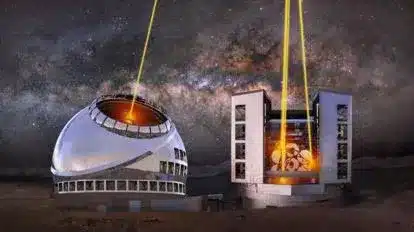
About Thirty Meter Telescope:
- It is a revolutionary class of extremely large telescopes that will enable us to explore deeper into space and observe cosmic objects.
- It is an ambitious international project involving India, the United States, Canada, China, and Japan that aims to significantly advance our understanding of the universe.
- It is a next-generation astronomical observatory designed to provide unprecedented resolution and sensitivity with its massive 30-meter primary mirror, advanced adaptive optics system, and state-of-the-art instruments.
- Primary goals:
- Study the early universe and the formation and evolution of the first galaxies and stars after the Big Bang.
- Investigate the formation, structure, and evolution of galaxies across cosmic time.
- Study the relationship between supermassive black holes and their host galaxies.
- Investigate the formation of stars and planetary systems.
- Characterize exoplanets and study their atmospheres.
Key Features of the TMT
- Mirror System
- Primary Mirror: 30 meters in diameter, composed of 492 hexagonal segments.
- Secondary Mirror: Composed of 118 smaller hexagonal segments.
- Tertiary Mirror: 3.5 meters by 2.5 meters, positioned centrally within the primary mirror.
- The TMT will feature instruments like the Infrared Imaging Spectrometer (IRIS) and the Wide-Field Optical Spectrograph (WFOS) for various observations.


What is an Adaptive Optics System?
- The TMT’s AOS, known as the Narrow Field Infrared Adaptive Optics System (NFIRAOS), uses deformable mirrors and laser guide stars to correct atmospheric turbulence, enhancing image resolution.
- Indian scientists have developed a tool to generate a comprehensive all-sky catalogue of NIR stars for this system.
Q1: What is a galaxy?
It is a huge collection of gas, dust, and of stars and their solar systems. A galaxy is held together by gravity. Our galaxy, the Milky Way, also has a in the middle.
Source: What is Thirty Meter Telescope and why is it significant for India?

 Last updated on Oct, 2026
→ UPSC 2027 Notification will be released on 13 January 2027 at upsconline.nic.in.
→ Check Nobel Prize 2026 Winners List here.
→ Download PIB PRiSM Monthly Magazine 2026 here.
→ Check UPSC Monthly Current Affairs Magazine The Recitals here.
→ Check out the latest UPSC Syllabus here.
→ Download UPSC Model Answers for Mains 2026
→ UPSC Mains Question Paper 2026 is out now for Essay & GS Paper 1, 2, 3 & 4.
→ UPSC Calendar 2027 has been released.
→ Enroll in Vajiram & Ravi’s UPSC Mains Test Series 2027 for structured answer writing practice, expert evaluation, and exam-oriented feedback.
→ Join Vajiram & Ravi’s UPSC Mentorship Program 2027 for personalized guidance, strategy planning, and one-to-one support from experienced mentors.
→ Go through the UPSC Mains Previous Year Papers to enhance your preparation.
→ UPSC has released UPSC Toppers List 2025 with the Civil Services final result on its official website.
→ Also check Best UPSC Coaching in India