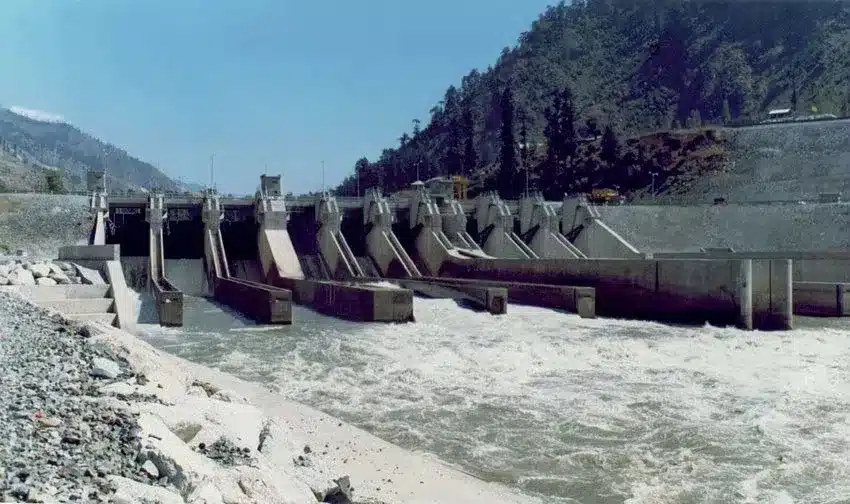
About Uri-I Hydroelectric Project:
- It is an operating hydroelectric power plant located in the Jhelum River of Uri town in the Baramulla district of Jammu & Kashmir.
- It is located very near the Line of Control (LOC), the de facto border between India and Pakistan.
- The power project was commissioned in 1997 with a total installed capacity of 480 MW.
- It is owned by the Central Government, and the operating company of the plant is National Hydroelectric Power Corporation Limited (NHPC).
- The unit size of the power plant is 480 MW, having 4 units of 120 MW each.
Key Facts about Jhelum River:
- It is a river that flows in India and Pakistan.
- It is a tributary of the Indus River.
- It is the main waterway of the Kashmir valley.
- It is the largest and most western of the five rivers of Punjab and passes through the Jhelum District in the north of Punjab province, Pakistan.
- Course:
- Origin: It originates at the Verinag Spring at Anantnag, at the foot of the Pir Panjal range in the Kashmir Valley.
- It then flows via Srinagar and Wular Lake prior to entering Pakistan.
- The river makes a deep, narrow gorge on its way to Pakistan.
- It joins the Chenab River near Trimmu, Pakistan.
- Length: It has a total length of about 725 km (450 mi).
- Major Tributaries:
- The largest tributary of the Jhelum is the Kishenganga (Neelum) River, which joins near Muzaffarabad and enters the Punjab province, Pakistan.
- Kunhar River is the second largest tributary of the river, which connects Pakistan-occupied Kashmir (PoK) and Pakistan on the Kohala Bridge of Kanghan valley.
- Other tributaries include the Sandran River, Bringi River, Arapath River, Watlara River, Lidder River, and Veshaw River.
Q1: Which are the main tributaries of the Jhelum River?
The largest tributary of the Jhelum is the Kishenganga (Neelum) River, which joins near Muzaffarabad and enters the Punjab province, Pakistan. Kunhar River is the second largest tributary of the river, which connects Pakistan-occupied Kashmir (PoK) and Pakistan on the Kohala Bridge of Kanghan valley. Other tributaries include Sandran River, Bringi River, Arapath River, Watlara River, Lidder River and Veshaw River.
Source: EAC defers proposal for grant of EC to Stage-II of Uri-I Hydroelectric Project


 Last updated on Oct, 2026
→ UPSC 2027 Notification will be released on 13 January 2027 at upsconline.nic.in.
→ Check Nobel Prize 2026 Winners List here.
→ Download PIB PRiSM Monthly Magazine 2026 here.
→ Check UPSC Monthly Current Affairs Magazine The Recitals here.
→ Check out the latest UPSC Syllabus here.
→ Download UPSC Model Answers for Mains 2026
→ UPSC Mains Question Paper 2026 is out now for Essay & GS Paper 1, 2, 3 & 4.
→ UPSC Calendar 2027 has been released.
→ Enroll in Vajiram & Ravi’s UPSC Mains Test Series 2027 for structured answer writing practice, expert evaluation, and exam-oriented feedback.
→ Join Vajiram & Ravi’s UPSC Mentorship Program 2027 for personalized guidance, strategy planning, and one-to-one support from experienced mentors.
→ Go through the UPSC Mains Previous Year Papers to enhance your preparation.
→ UPSC has released UPSC Toppers List 2025 with the Civil Services final result on its official website.
→ Also check Best UPSC Coaching in India