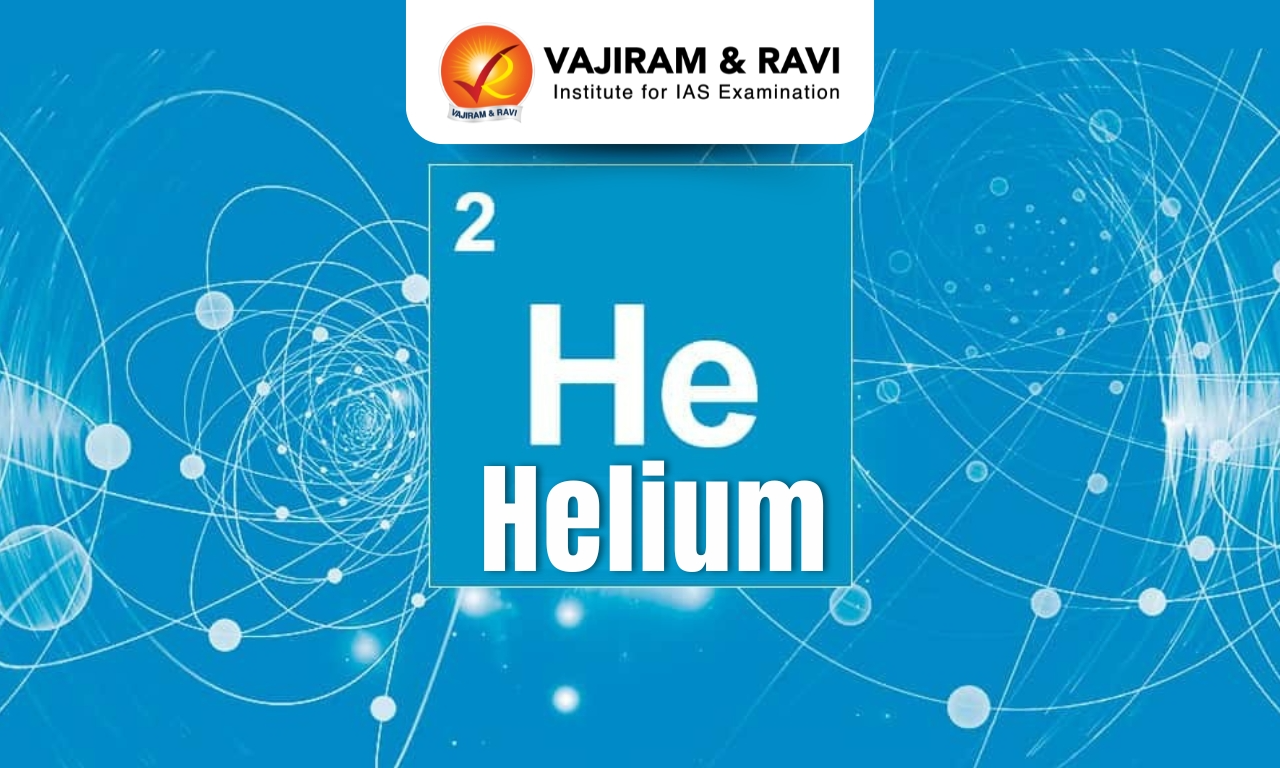
Helium Latest News
Recently, the Ministry of Commerce and General Administration of Customs, China, has temporarily but immediately banned helium exports from the country.
About Helium
- It is an inert gas and does not react with other substances or combust.
- It was discovered in 1868 by Jules Janssen and Norman Lockyer via a yellow spectral line during a solar eclipse.
- Formation: It is a non-renewable resource generated deep in the earth’s crust, where the radioactive decay of uranium and thorium atoms emits alpha particles, which capture electrons to form helium atoms.


Properties of Helium
- Its atomic number is 2, making it the second lightest element after hydrogen.
- Helium also has a very low boiling point (-268.9° C), allowing it to remain a gas even in super-cold environments.
- It does not participate easily in chemical reactions.
- Helium is the second-lightest element, after hydrogen, and is not manufactured.
- The gas is non-toxic, but cannot be breathed on its own, because it displaces the oxygen humans need for respiration.
- It is the only element that cannot be solidified by sufficient cooling at normal atmospheric pressure.
- Largest global reserves: United States, Algeria, and Russia.
- India’s Rajmahal Volcanic Basin (Jharkhand) is a significant helium reservoir trapped for billions of years.
Applications of Helium
- Used as Coolant: It is used as coolant to cool the magnets in MRI machines, the silicon wafers in the semiconductor fabricating industry, and, increasingly, some of the devices used in quantum computers.
- Leak Detector: Engineers use helium as a leak-detector.
- Optical Fibre Manufacture: It is also used in the process of drawing optical fibres to rapidly and uniformly cool molten glass and to displace oxygen or nitrogen from forming bubbles inside the material.
- Aerospace: Spaceflight organisations like ISRO, NASA, and SpaceX use helium to pressurise fuel tanks in rockets.
- Research and the tourism sector in many parts of the world also use helium to inflate balloons and airships.
Source: TH

 Last updated on Oct, 2026
→ UPSC 2027 Notification will be released on 13 January 2027 at upsconline.nic.in.
→ Check Nobel Prize 2026 Winners List here.
→ Download PIB PRiSM Monthly Magazine 2026 here.
→ Check UPSC Monthly Current Affairs Magazine The Recitals here.
→ Check out the latest UPSC Syllabus here.
→ Download UPSC Model Answers for Mains 2026
→ UPSC Mains Question Paper 2026 is out now for Essay & GS Paper 1, 2, 3 & 4.
→ UPSC Calendar 2027 has been released.
→ Enroll in Vajiram & Ravi’s UPSC Mains Test Series 2027 for structured answer writing practice, expert evaluation, and exam-oriented feedback.
→ Join Vajiram & Ravi’s UPSC Mentorship Program 2027 for personalized guidance, strategy planning, and one-to-one support from experienced mentors.
→ Go through the UPSC Mains Previous Year Papers to enhance your preparation.
→ UPSC has released UPSC Toppers List 2025 with the Civil Services final result on its official website.
→ Also check Best UPSC Coaching in India
Helium FAQs
Q1. Which property of Helium makes it useful for leak detection?+
Q2. Who discovered the Helium?+
Tags: helium prelims pointers upsc current affairs upsc prelims current affairs