About Agasthyamalai Bambootail:
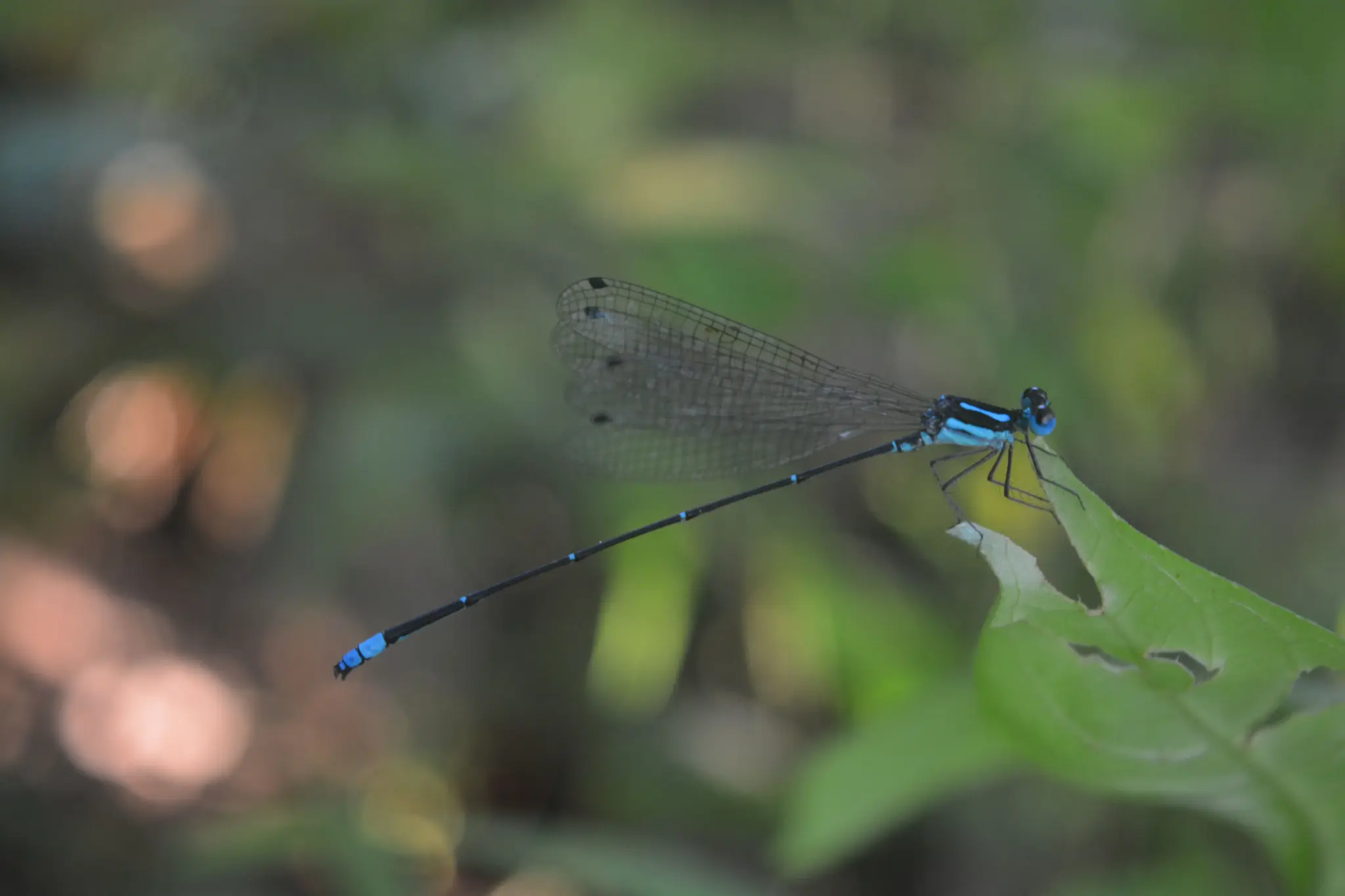
- It is a new species of damselfly.
- It is a rare species belonging to the group of bambootails, so named because of their long cylindrical abdomen resembling a bamboo stalk.
- It was discovered from the Agasthyamalai landscape of Western Ghats.
- The only other species in this genus is the Malabar Bambootail (Melanoneura bilineata) that is found in the Coorg-Wayanad landscape of the Western Ghats.
- The members of this genus can be separated from other bambootails by the absence of the anal bridge vein in their wings.
- This genus of damselflies has long black bodies with brilliant blue markings.
- The new species differs from the Malabar Bambootail in the structure of prothorax, anal appendages, and secondary genitalia.
Key Facts about Damselflies:
- Damselfly is any of a group of predatory, aerial insects that are in the order Odonata.
- Damselflies are found mainly near shallow, freshwater habitats and are graceful fliers with slender bodies and long, filmy, net-veined wings.
- They are generally smaller, more delicate, and fly weakly in comparison with dragonflies.
- The large eyes of damselflies differ from those of dragonflies in that they are always widely separated, rather than close together or touching each other.
- Their colours can be stunningly vivid.
- Wingspans among the 2,600 damselfly species range from 18 mm (0.71 inch) to about 19 cm (7.5 inches) in Megaloprepus caerulatus, a giant damselfly of tropical Central and South America.
- Immature damselflies, called larvae (or sometimes nymphs or naiads), are, with very few exceptions, aquatic predators in freshwater habitats.
Q1: What are Dragonflies?
Dragonfly is any of a group of roughly 3,000 species of aerial predatory insects most commonly found near freshwater habitats throughout most of the world. Damselflies (suborder Zygoptera) are sometimes also called dragonflies in that both are odonates (order Odonata).Dragonfly species (Anisoptera) are characterized by long bodies with two narrow pairs of intricately veined, membranous wings that, while generally transparent, may have coloured markings. Unlike damselflies, the front and rear wing pairs are shaped differently.
Source: New species of damselfly discovered at Manjadininnavila in Kerala


 Last updated on Sep, 2026
→ UPSC 2027 Notification will be released on 13 January 2027 at upsconline.nic.in.
→ Asian Games 2026 are being held in Aichi-Nagoya, Japan, from 19 September to 4 October.
→ Check out the latest UPSC Syllabus here.
→ Download UPSC Model Answers for Mains 2026
→ UPSC Mains Question Paper 2026 is out now for Essay & GS Paper 1, 2, 3 & 4.
→ UPSC Calendar 2027 has been released.
→ Enroll in Vajiram & Ravi’s UPSC Mains Test Series 2027 for structured answer writing practice, expert evaluation, and exam-oriented feedback.
→ Join Vajiram & Ravi’s UPSC Mentorship Program 2027 for personalized guidance, strategy planning, and one-to-one support from experienced mentors.
→ Go through the UPSC Mains Previous Year Papers to enhance your preparation.
→ UPSC has released UPSC Toppers List 2025 with the Civil Services final result on its official website.
→ Also check Best UPSC Coaching in India