Why in News?
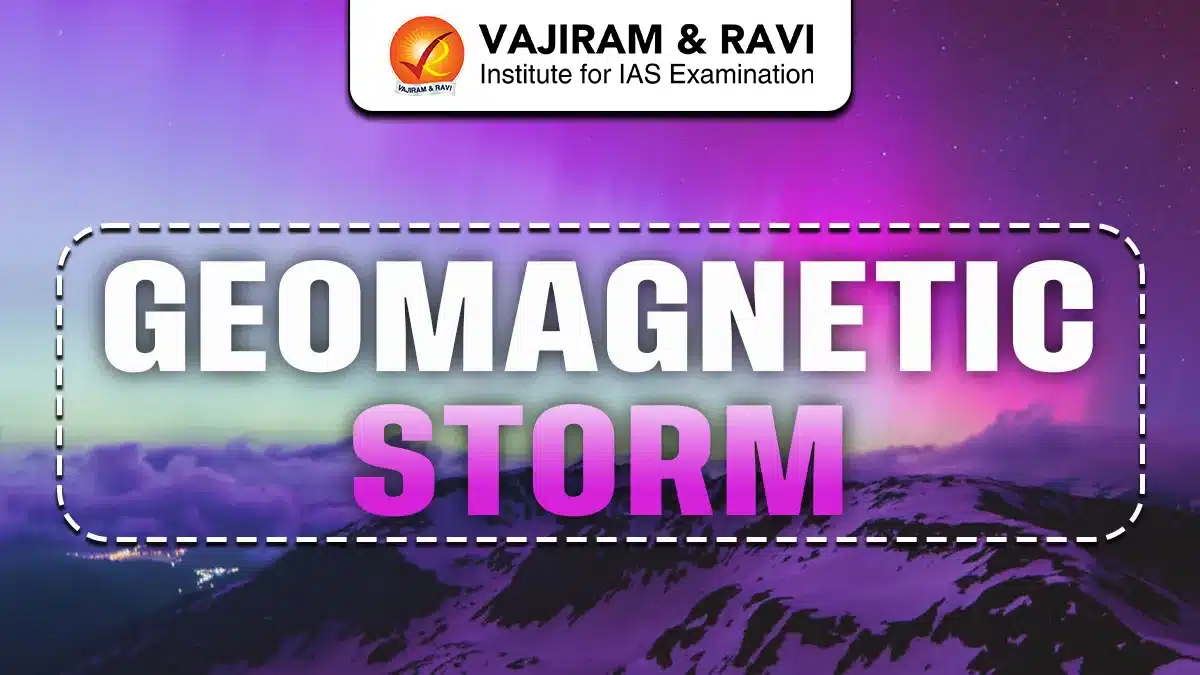
A powerful G4 (Severe) Geomagnetic Storm, caused by solar activity, has lit up the night skies with spectacular auroras visible across multiple continents.
About Geomagnetic Storms
- A geomagnetic storm is a major disturbance of Earth’s magnetosphere that occurs when there is a very efficient exchange of energy from the solar wind into the space environment surrounding Earth.
- These storms result from variations in the solar wind that produce major changes in the currents, plasmas, and fields in Earth’s magnetosphere.
- The solar wind conditions that are effective for creating geomagnetic storms are sustained (for several hours) periods of the high-speed solar wind and a southward-directed solar wind magnetic field (opposite the direction of Earth’s field) at the dayside of the magnetosphere.
- The largest such storms are associated with solar coronal mass ejections (CMEs), where a billion tons or so of plasma from the sun, with its embedded magnetic field, arrives at Earth.
- Effects:
- It results in intense currents in the magnetosphere, changes in the radiation belts, and changes in the ionosphere, including heating the ionosphere and an upper atmosphere region called the thermosphere.
- These storms can heat the ionosphere, causing beautiful auroras on earth.
- Because the ionosphere is heated and distorted during storms, long-range radio communication that relies on sub-ionospheric reflection gets affected.
- Ionospheric expansion due to these storms can increase satellite drag and make their orbits difficult to control.
- Satellite electronics can be damaged through the buildup and discharge of static-electric charges.
- It can disrupt global navigation systems.
- It can create harmful geomagnetic-induced currents (GICs)in the power grid and pipelines.
What is Solar Wind?
- It is a continual stream of protons and electrons from the sun’s outermost atmosphere, the corona.
- These charged particles breeze through the solar system at speeds ranging from around 250 miles (400 kilometers) per second to 500 miles (800 km) per second, in a plasma state.
- Solar magnetic field is embedded in the plasma and flows outward with the solar wind.
- Different regions of the Sun produce solar wind of different speeds and densities.
When the solar wind reaches Earth, it sends a flurry of charged particles into the magnetosphere and along Earth’s magnetic field lines, towards the poles.


 Last updated on Sep, 2026
→ UPSC 2027 Notification will be released on 13 January 2027 at upsconline.nic.in.
→ Asian Games 2026 are being held in Aichi-Nagoya, Japan, from 19 September to 4 October.
→ Check out the latest UPSC Syllabus here.
→ Download UPSC Model Answers for Mains 2026
→ UPSC Mains Question Paper 2026 is out now for Essay & GS Paper 1, 2, 3 & 4.
→ UPSC Calendar 2027 has been released.
→ Enroll in Vajiram & Ravi’s UPSC Mains Test Series 2027 for structured answer writing practice, expert evaluation, and exam-oriented feedback.
→ Join Vajiram & Ravi’s UPSC Mentorship Program 2027 for personalized guidance, strategy planning, and one-to-one support from experienced mentors.
→ Go through the UPSC Mains Previous Year Papers to enhance your preparation.
→ UPSC has released UPSC Toppers List 2025 with the Civil Services final result on its official website.
→ Also check Best UPSC Coaching in India
Geomagnetic Storms FAQs
Q1. What are Coronal Mass Ejections (CMEs)?+
Q2. Can CMEs harm humans on Earth?+
Q3. How are geomagnetic storms classified?+