End-Permian Mass Extinction Latest News
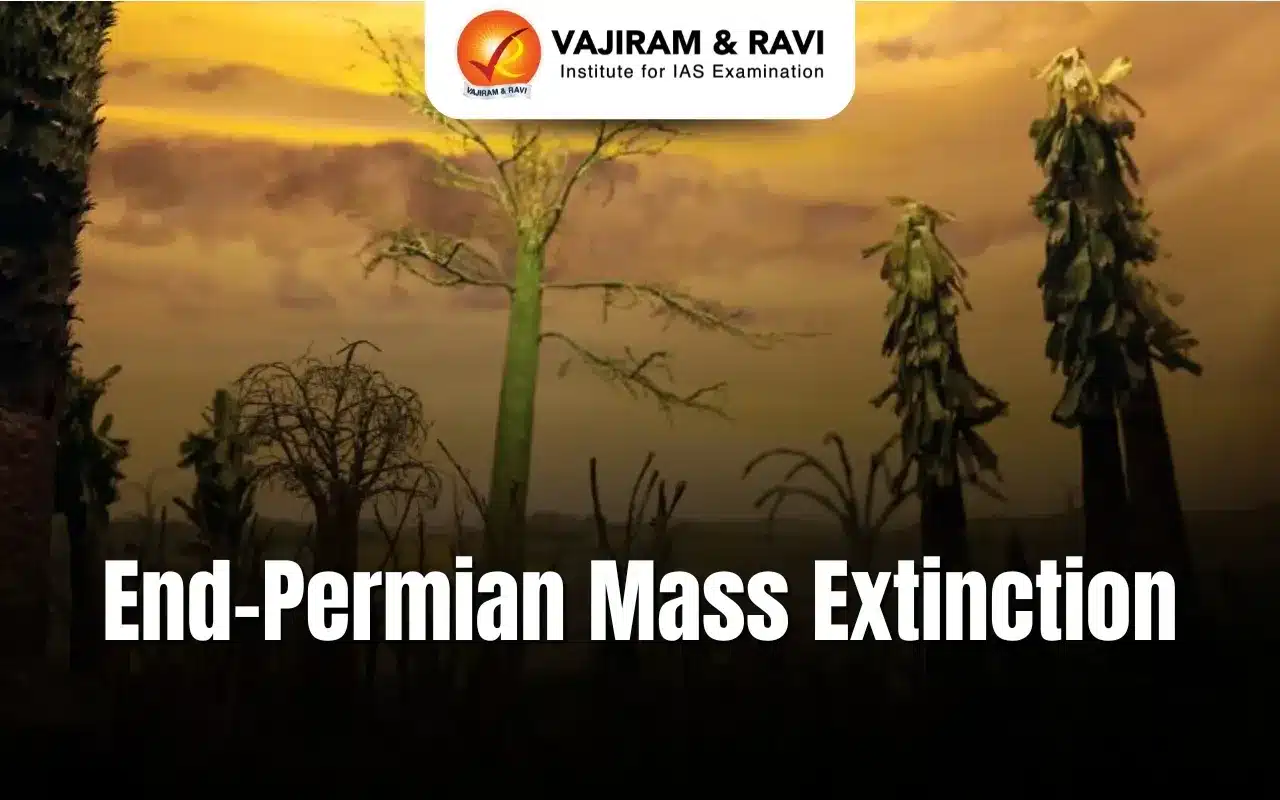
The End-Permian Mass Extinction that killed 80% of life on Earth 250 million years ago may not have been quite so disastrous for plants, new fossils hint.
About End-Permian Mass Extinction
- The End-Permian Mass Extinction (EPME), also known as the Permian-Triassic Extinction Event or “The Great Dying,” was the most severe extinction event in Earth’s history.
- It occurred approximately 252 million years ago and marked the transition from the Permian to the Triassic Period.
- The Triassic Period is the first period of the Mesozoic Era, lasting from 252 million to 201 million years ago.


End-Permian Mass Extinction Cause
- At that time, the supercontinent Pangea was in the process of breaking up, but all land on Earth was still largely clustered together, with the newly formed continents separated by shallow seas.
- An enormous eruption from a volcanic system called the Siberian Traps seems to have pushed carbon dioxide levels to extremes.
- The eruption covered around 2 million square kilometers with lava and wasone of the largest volcanic events in Earth’s history.
- The eruptions may have caused large amounts of carbon dioxide to be released into the atmosphere and caused a large-scale global warming effect of more than 10°C on land and around 8°C on the ocean surface in a short period of time.
- The eruptions may have also caused acid aerosols and dust clouds to be released into the atmosphere, which blocked out the sun and prevented photosynthesis from occurring, effectively causing many food chains to collapse.
- This caused global warming and ocean acidification, leading to a massive collapse of the ocean ecosystem.
End-Permian Mass Extinction Impacts
- EPME was characterized by the elimination of about 90 percent of the species on Earth, which included more than 95 percent of the marine species and 70 percent of the terrestrial species.
- In addition, more than half of all taxonomic families present at the time disappeared.
- It ranks first in severity among the five major extinction episodes that span geologic time.
End-Permian Mass Extinction FAQs
Q1. Which extinction killed the dinosaurs?
Ans. The extinction that killed the dinosaurs is called the Cretaceous-Paleogene (K-Pg) mass extinction, which occurred around 66 million years ago.
Q2. What was the worst mass extinction in history?
Ans. End-Permian Mass Extinction (EPME)
Q3. What is the oldest mass extinction?
Ans. The oldest mass extinction is the Ordovician-Silurian (O-S) extinction, which occurred around 443 million years ago.
Source: LS

 Last updated on Sep, 2026
→ UPSC 2027 Notification will be released on 13 January 2027 at upsconline.nic.in.
→ Check out the latest UPSC Syllabus here.
→ Download UPSC Model Answers for Mains 2026
→ UPSC Mains Question Paper 2026 is out now for Essay & GS Paper 1, 2, 3 & 4.
→ UPSC Calendar 2027 has been released.
→ Enroll in Vajiram & Ravi’s UPSC Mains Test Series 2027 for structured answer writing practice, expert evaluation, and exam-oriented feedback.
→ Join Vajiram & Ravi’s UPSC Mentorship Program 2027 for personalized guidance, strategy planning, and one-to-one support from experienced mentors.
→ Go through the UPSC Mains Previous Year Papers to enhance your preparation.
→ UPSC has released UPSC Toppers List 2025 with the Civil Services final result on its official website.
→ Also check Best UPSC Coaching in India