What’s in today’s article:
- About radio telescope
- About SARAS 3
- News Summary
Why In News:
- SARAS 3, a radio telescope designed and built at the Raman Research Institute (RRI), Bengaluru, has revealed information about the origins of the Universe’s first stars and galaxies.
About Radio telescope:

- Optical telescopes collect visible light, bring it to a focus, amplify it and make it available for analysis by various instruments.
- Similarly, radio telescopes collect weak radio light waves (usually referred to by its frequency), bring it to a focus, amplify it and make it available for analysis.
- Radio telescopes are used to study naturally occurring radio light from stars, galaxies, black holes and other astronomical objects.
- They can also be used to transmit and reflect radio light off of planetary bodies in our solar system.
- Naturally occurring radio waves are extremely weak by the time they reach earth from space.
- Therefore, detecting the signal even using the most powerful existing radio telescopes, has remained a challenge for astronomers.
- These specially-designed telescopes observe the longest wavelengths of light, ranging from 1 millimeter to over 10 meters long (visible light waves only a few hundred nanometers long).


About Shaped Antenna measurement of the background Radio Spectrum 3 (SARAS) telescope:
- Experiment and science:
- SARAS is a niche high-risk high-gain experimental effort to design, build and deploy in India a precision radio telescope.
- The CMB Distortion Laboratory at RRI has pioneered the development of state-of-the-art radio telescopes which are designed to detect signals of high wavelength and low frequency.
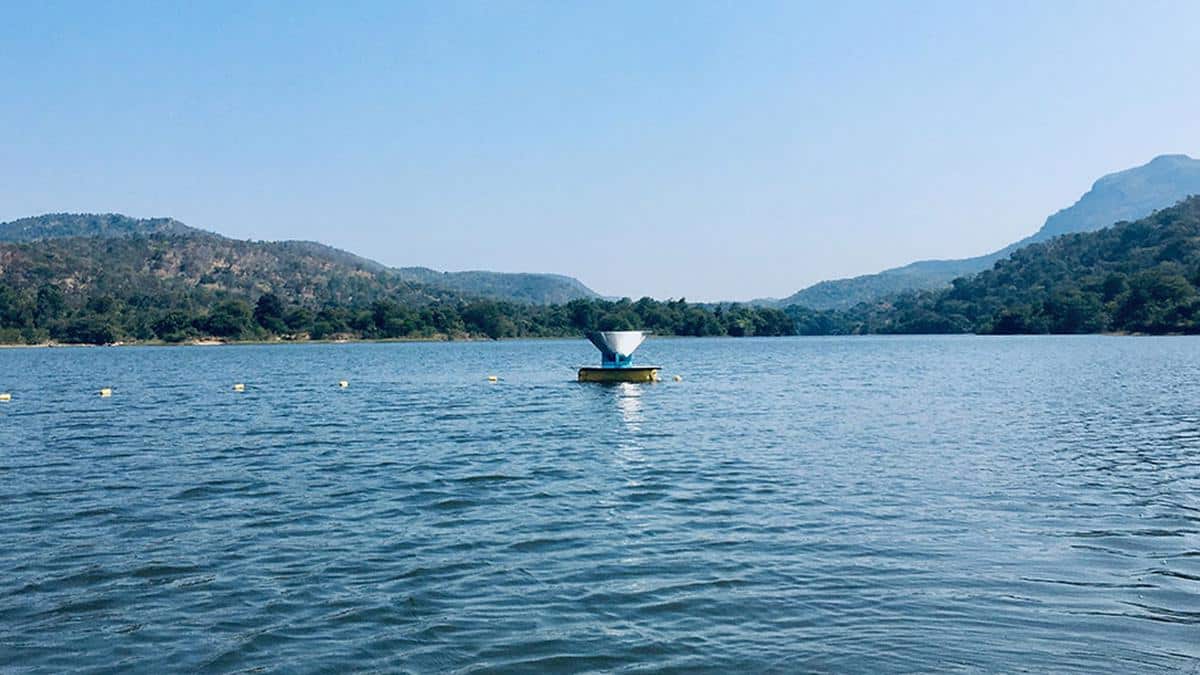
- Latest unique deployment over water:
- In 2020, the radio telescope was deployed in lakes in Northern Karnataka, on Dandiganahalli Lake and Sharavati backwaters by the RRI.
- This intelligent design substantially enhanced telescope performance and had never been conceived of in the world.
- This helped provide a homogenous medium below the antenna improving sensitivity and reducing confusing radio waves emitted by the very ground beneath radio telescopes.
- Significance of SARAS 3 telescope: It is indeed the first experiment to reach the required sensitivity and cross-verify the claim of the signal detection.
News Summary:
- Researchers from RRI, the Commonwealth Scientific and Industrial Research Organisation (CSIRO) in Australia, etc., used data from SARAS-3 to throw light on the energy output, luminosity and masses of the first generation of galaxies.
- Scientists study properties of very early galaxies by observing radiation from hydrogen atoms in and around galaxies, emitted at a frequency of approximately 1420 MHz
- The radiation is stretched by the expansion of the universe, as it travels across space and time and arrives at Earth in lower frequency radio bands 50-200 MHz, also used by FM and TV transmissions.
- According to the RRI, in a first-of-its-kind work, using data from an Indian telescope, scientists have determined properties of radio luminous galaxies formed just 200 million years after the Big Bang, a period known as the Cosmic Dawn.
- SARAS 3 has improved the understanding of astrophysics of Cosmic Dawn. It has shown that less than 3% of the gaseous matter within early galaxies was converted into stars, and that the earliest galaxies that were bright in radio emission were also strong in X-rays.
- Earlier the SARAS-3 team used the same data to reject claims of the detection of a signal from Cosmic Dawn made by the EDGES radio telescope developed by researchers from Arizona State University (ASU) and MIT, USA.
- SARAS-3 has been able to put an upper limit to excess radiation at radio wavelengths, lowering existing limits set by the ARCADE and Long Wavelength Array (LWA) experiments in the US.

 Last updated on Oct, 2026
→ UPSC 2027 Notification will be released on 13 January 2027 at upsconline.nic.in.
→ Check Nobel Prize 2026 Winners List here.
→ Download PIB PRiSM Monthly Magazine 2026 here.
→ Check UPSC Monthly Current Affairs Magazine The Recitals here.
→ Check out the latest UPSC Syllabus here.
→ Download UPSC Model Answers for Mains 2026
→ UPSC Mains Question Paper 2026 is out now for Essay & GS Paper 1, 2, 3 & 4.
→ UPSC Calendar 2027 has been released.
→ Enroll in Vajiram & Ravi’s UPSC Mains Test Series 2027 for structured answer writing practice, expert evaluation, and exam-oriented feedback.
→ Join Vajiram & Ravi’s UPSC Mentorship Program 2027 for personalized guidance, strategy planning, and one-to-one support from experienced mentors.
→ Go through the UPSC Mains Previous Year Papers to enhance your preparation.
→ UPSC has released UPSC Toppers List 2025 with the Civil Services final result on its official website.
→ Also check Best UPSC Coaching in India