What’s in today’s article?
- Why in news?
- Türkiye’s electoral system
- Political system of Turkey
Why in news?
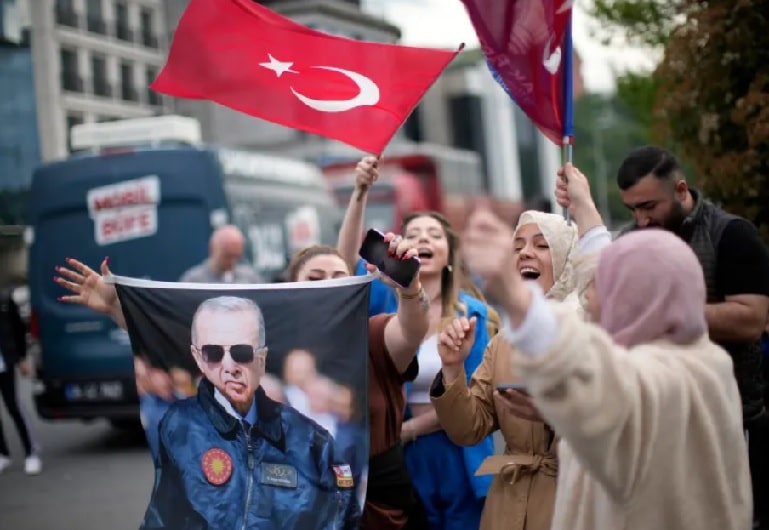
- The name of Turkey’s new President is unlikely to be revealed for another two weeks as the election in Turkey is headed for a run-off.
- A run-off vote is a second round of voting that takes place when no candidate receives more than half of the presidential vote.
- Neither the incumbent Recep Tayyip Erdogan nor his challenger Kemal Kilicdaroglu cleared the 50% threshold needed to avoid a second round.
Türkiye’s electoral system
- Mixed system
- Türkiye’s electoral system is a mixed system, a combination of both proportional representation and majority voting.
- In proportional representation the number of seats held by a political group or party in a legislative body is determined by the number of popular votes received.
- A majority vote is valid for the presidential election and it simply means obtaining more than half of the national vote share.
- Türkiye’s electoral system is a mixed system, a combination of both proportional representation and majority voting.
- The two-ballot system
- One is to elect a president. And the other is meant for voting members of Parliament from each electoral district.
- The threshold requirement
- According to a new election law passed in April 2022, to enter parliament, a political party must receive a minimum of 7 percent of the national vote.
- The law permits the formation of alliances between different political parties.
- Therefore, any party may be able to secure a seat in parliament if they form an alliance that collectively receives over 7 percent of the vote across any district in Türkiye.
- Choosing the president
- Turkish citizens elect their president separately from the parliament, using a two-round majority system.
- If no candidate wins a majority of votes in the first round, the top two candidates compete in a second round of voting where one candidate should get more than 50 percent to be elected.
- Frequency of election
- Turkey holds simultaneous presidential and parliamentary elections every five years.


Political system of Turkey
- Turkey transitioned from a parliamentary to a presidential system in July 2018, a month after Erdogan won the presidential election.
- The powers of the president were broadened after a 2017 referendum approving the change to an executive presidency.
- The post of prime minister was abolished and the president also became the head of government.
- In the new system, voters elect the president directly.
Q1) What is Presidential system?
A presidential system is a form of government in which a president serves as the head of state and the head of government. In this system, the president is elected directly by the people or through an electoral college for a fixed term and holds significant executive powers.
Q2) What is mixed electoral system?
A mixed electoral system, also known as a hybrid electoral system, combines elements of both proportional representation (PR) and plurality/majoritarian systems. It is a method of allocating seats in a legislative body that aims to strike a balance between proportional representation and geographic representation.
Source: Why is Turkey likely to hold a second election on May 28 to elect its President? | Aljazeera | TRTWorld

 Last updated on Sep, 2026
→ UPSC 2027 Notification will be released on 13 January 2027 at upsconline.nic.in.
→ Asian Games 2026 are being held in Aichi-Nagoya, Japan, from 19 September to 4 October.
→ Check out the latest UPSC Syllabus here.
→ Download UPSC Model Answers for Mains 2026
→ UPSC Mains Question Paper 2026 is out now for Essay & GS Paper 1, 2, 3 & 4.
→ UPSC Calendar 2027 has been released.
→ Enroll in Vajiram & Ravi’s UPSC Mains Test Series 2027 for structured answer writing practice, expert evaluation, and exam-oriented feedback.
→ Join Vajiram & Ravi’s UPSC Mentorship Program 2027 for personalized guidance, strategy planning, and one-to-one support from experienced mentors.
→ Go through the UPSC Mains Previous Year Papers to enhance your preparation.
→ UPSC has released UPSC Toppers List 2025 with the Civil Services final result on its official website.
→ Also check Best UPSC Coaching in India