What’s in today’s article?
- Why in news?
- What are Conocarpus plants?
- News Summary: Gujarat bans Conocarpus plants
- Why Gujarat govt has banned the planting of ornamental Conocarpus trees?
- Other examples of plant species that have fallen out of favour after widespread use
Why in news?
- The Gujarat govt has banned the planting of ornamental Conocarpus trees in forest or non-forest areas, citing their adverse impacts on environment and human health.
- Earlier, Telangana too had banned the plant species.
Conocarpus plants
- About
- Conocarpus is a genus of two species of flowering plants in the Combretaceae family.
- One species is a widespread mangrove, and the other is restricted to a small area around the southern Red Sea coasts.
- They are native to tropical regions of the world.
- Two types
- Conocarpus erectus, also known as buttonwood or button mangrove,
- It is a mangrove shrub that grows on shorelines in tropical and subtropical regions around the world.
- It is widely used in gardens, parks, and indoors.
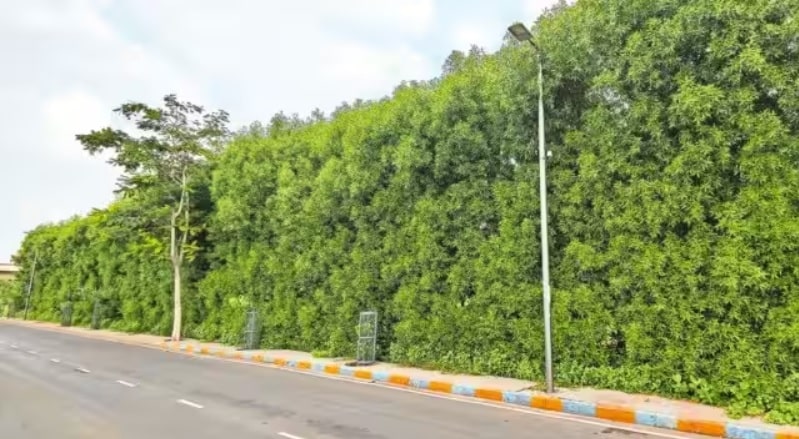
- It is a fast-growing plant that does not shed its leaves much. If pruned with skill, it can make a natural green wall.
- Conocarpus lancifolius
- It is a tree that is native to coastal and riverine areas of Somalia, Djibouti, and Yemen.
- It is found throughout the Horn of Africa, the Arabian Peninsula, and South Asia.
- Conocarpus erectus, also known as buttonwood or button mangrove,


News Summary: Gujarat bans Conocarpus plants
- The Gujarat government has banned the planting of ornamental Conocarpus trees in forest or non-forest areas. Conocarpus, a fast-growing exotic mangrove species, had been a popular choice for increasing the green cover in Gujarat in recent years.
Why Gujarat govt has banned the planting of ornamental Conocarpus trees?
- Research reports have highlighted adverse impacts/ disadvantages of this species on environment and human health.
- Trees of this species, flower in winter and spread pollen in nearby areas. It is learnt that this is causing diseases like cold, cough, asthma, allergy etc.
- Roots of this species go deep inside the soil and develop extensively, damaging telecommunication lines, drainage lines and freshwater systems.
- Also, the leaves of Conocarpus are unpalatable to plant-eating animals.
Other examples of plant species that have fallen out of favour after widespread use
- Vilayati Kikar in Delhi
- In 2018, the Delhi government agreed to clear the capital’s green lungs, the Central Ridge, of the Vilayati Kikar.
- The Vilayati Kikar is not native to Delhi, and was brought to the city in the 1930s by the British.
- As the tree grows fast even in arid conditions, it can quickly increase the green cover of an area, and be used as firewood.
- However, it also kills off competition.
- Thus, within a decade, it had taken over the Ridge, killing the native trees like acacia, dhak, kadamb, amaltas, flame-of-the-forest, etc.
- Along with the trees disappeared the fauna — birds, butterflies, leopards, porcupines and jackals.
- The tree also depletes the water table of the area it is planted in.
- Eucalyptus in Kerala
- In Kerala’s case too, it was the British who introduced the Eucalyptus tree to Munnar, so its wood could be used as fuel in tea plantation boilers.
- The state forest department stopped the cultivation of acacia and eucalyptus in forest tracts in 2018.
- A study had found that foreign invasive plants had reduced the availability of fodder in forests, forcing animals to foray into settlements and farmlands.
- The quality of forest habitats had been lost due to the cultivation of alien plants such as acacia, mangium and eucalyptus in forest tracts for commercial purposes.
Q1) What are mangroves?
Mangroves are trees and shrubs that grow in coastal saltwater zones. They are the only trees in the world that can tolerate saltwater. Mangroves have special adaptations that allow them to tolerate conditions that would kill most plants. They can take in extra oxygen and remove salt.
Q2) What is Vilayati Kikar?
The vilayati kikar (Prosopis juliflora) is an invasive tree species that was introduced to Delhi by the British in the 1930s. It is native to Mexico, South America, and the Caribbean. The British planted the trees to beautify wastelands.
Source: Gujarat bans Conocarpus plants: Which other states stopped cultivating some trees, and why | Globe.gov | Indian Express | Times of India

 Last updated on August, 2026
→ UPSC Mains 2026 commenced on 21st August 2026 and will continue through 30th August 2026, as per the official examination schedule.
→ UPSC Mains Question Paper 2026 is out now for Essay & GS Paper 1, 2, 3 & 4.
→ UPSC Mains GS Paper 1 2026 is out now.
→ UPSC Mains GS Paper 2 2026 is out now.
→ Check out the latest UPSC Syllabus 2026 here.
→ UPSC Mains Admit Card 2026 is now out.
→ Enroll in Vajiram & Ravi’s UPSC Mains Test Series 2027 for structured answer writing practice, expert evaluation, and exam-oriented feedback.
→ Join Vajiram & Ravi’s UPSC Mentorship Program 2027 for personalized guidance, strategy planning, and one-to-one support from experienced mentors.
→ Go through the UPSC Mains Previous Year Papers to enhance your preparation.
→ Download UPSC Mains Essay Paper 2025, UPSC Mains GS Paper-I 2025, UPSC Mains GS Paper-II 2025, UPSC Mains GS Paper-III 2025, UPSC Mains GS Paper-IV 2025, UPSC Mains English (Compulsory) Paper 2025, UPSC Mains Hindi (Qualifying) Paper 2025 here.
→ UPSC has released UPSC Toppers List 2025 with the Civil Services final result on its official website.
→ UPSC Calendar 2027 has been released.
→ Also check Best UPSC Coaching in India