What’s in today’s article?
- Background
- Key Achievements Post-Chandrayaan-3
- Roadmaps and Future Plans
- Involvement of NewSpace India Ltd. (NSIL)
- Private Sector Participation
- Regulatory Updates
Background
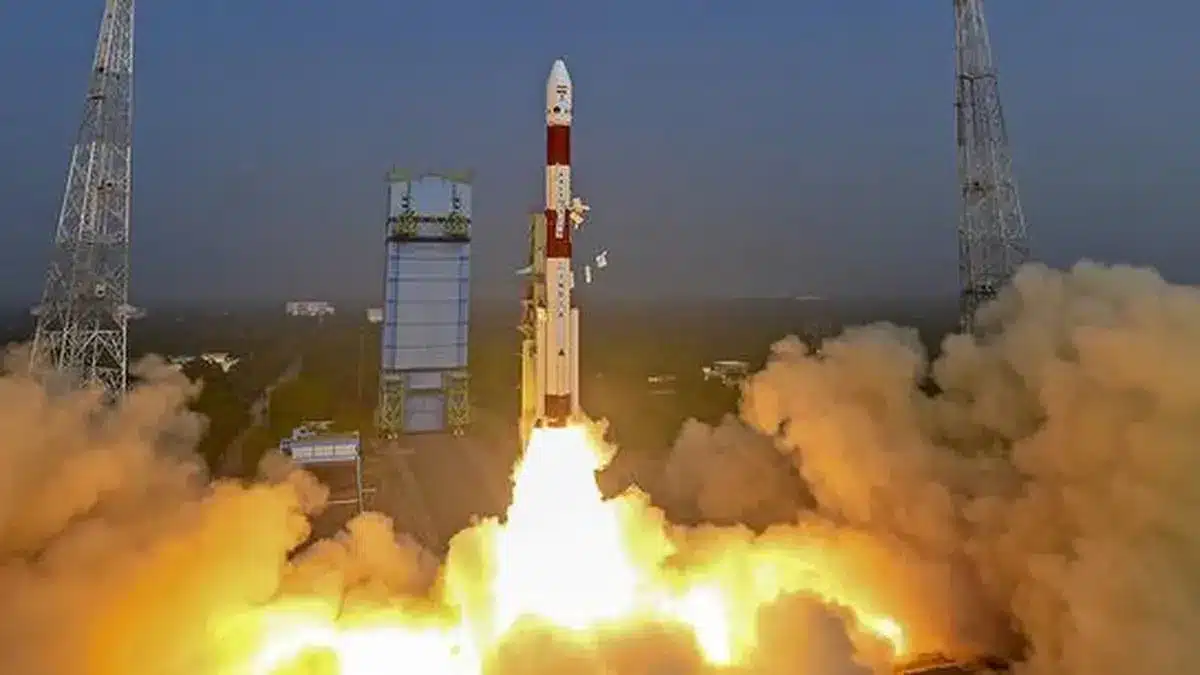
- After the successful landing of Chandrayaan-3 on the moon, India’s space program has continued to make significant strides, even though activities at the Sriharikota spaceport have been relatively quiet.
Key Achievements Post-Chandrayaan-3
- Aditya L1 Mission: Launched on September 2, 2023, this solar science mission reached its orbit around the Earth-Sun Lagrange point (L1) by January 2024, marking a crucial step in solar observation.
- Gaganyaan TV-D1: The first abort mission for India’s human spaceflight mission, Gaganyaan, successfully tested the Crew Escape System on October 21, 2023, showcasing the readiness for future manned missions.
- XPoSat: Launched on January 1, 2024, this satellite is India’s second space-based observatory dedicated to studying polarized radiation from space, enhancing our understanding of cosmic phenomena.
- INSAT-3DS: This meteorological satellite, launched on February 17, 2024, is vital for proving the reliability of ISRO’s Geosynchronous Satellite Launch Vehicle (GSLV), especially before the upcoming NASA-ISRO Synthetic Aperture Radar (NISAR) mission.
- Reusable Launch Vehicle (RLV-TD): ISRO conducted successful landing experiments for its scaled-down Reusable Launch Vehicle, laying the groundwork for future orbital return flight tests.
- Small Satellite Launch Vehicle (SSLV): With the successful third development flight on August 16, 2024, ISRO has completed the development phase of SSLV, enabling its transfer to industry for broader use.


Roadmaps and Future Plans
- Gaganyaan Program: India is focusing heavily on its human spaceflight program, with astronaut candidates undergoing advanced training. The first uncrewed Gaganyaan mission is expected by late 2024, with a crewed mission planned thereafter.
- Next-Generation Launch Vehicle (NGLV): ISRO is developing a new heavy-lift launch vehicle to support its ambitious goals, including a future Indian space station and extensive lunar exploration.
- Lunar Exploration: ISRO has a 25-year roadmap for lunar exploration, including plans for an Indian on the moon by 2040 and long-duration lunar missions.
Involvement of NewSpace India Ltd. (NSIL)
- NSIL has been assigned the responsibility for conducting space missions and managing commercial activities.
- This includes collaborations with SpaceX for satellite launches and the development of the LVM-3 rocket in partnership with private entities.
Private Sector Participation
- Agnikul Cosmos: Successfully launched its SoRTeD-01 vehicle, marking the first use of a semi-cryogenic engine in India.
- Skyroot Aerospace and Others: Private companies are making significant progress in developing launch vehicles and space technologies, with upcoming missions like Vikram 1.
Regulatory Updates
- IN-SPACe: India’s new space regulatory body has been active, issuing important guidelines and licenses, including allowing 100% FDI in space sectors with specific ceilings in certain areas.
- Overall, India’s space program is rapidly evolving, with a strong emphasis on research, development, and collaboration with private companies to achieve its ambitious space exploration goals.
Q1. What are navigation satellites used for?
Applications of navigation satellites include terrestrial, aerial and marine Navigation, Disaster Management, Vehicle tracking and fleet management, Precise Timing, Mapping and Geodetic data capture, Visual and voice navigation for drivers etc.
Q2. What is GPS?
The Global Positioning System (GPS) is a U.S.-owned utility that provides users with positioning, navigation, and timing (PNT) services. This system consists of three segments: the space segment, the control segment, and the user segment.

 Last updated on Sep, 2026
→ UPSC 2027 Notification will be released on 13 January 2027 at upsconline.nic.in.
→ Check out the latest UPSC Syllabus here.
→ Download UPSC Model Answers for Mains 2026
→ UPSC Mains Question Paper 2026 is out now for Essay & GS Paper 1, 2, 3 & 4.
→ UPSC Calendar 2027 has been released.
→ Enroll in Vajiram & Ravi’s UPSC Mains Test Series 2027 for structured answer writing practice, expert evaluation, and exam-oriented feedback.
→ Join Vajiram & Ravi’s UPSC Mentorship Program 2027 for personalized guidance, strategy planning, and one-to-one support from experienced mentors.
→ Go through the UPSC Mains Previous Year Papers to enhance your preparation.
→ UPSC has released UPSC Toppers List 2025 with the Civil Services final result on its official website.
→ Also check Best UPSC Coaching in India