New Approach for Green Hydrogen Production Latest News
Researchers at the Institute of Nano Science and Technology (INST), Mohali, have developed new insights into proton adsorption on catalyst surfaces, paving the way for more efficient green hydrogen production.
Key Scientific Findings
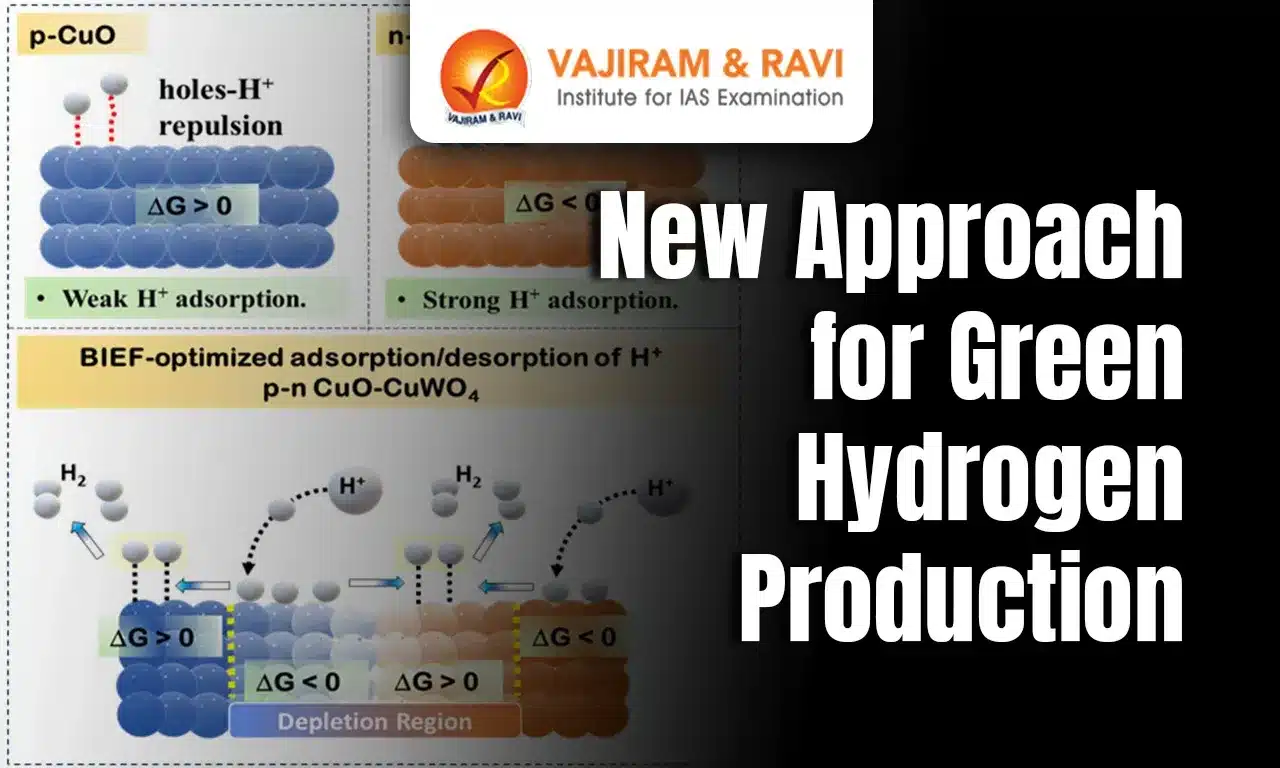
- A novel heterostructure, combining Copper Tungsten Oxide (CuWO₄) and Copper Oxide (CuO), has been created to exploit the Built-In Electric Field (BIEF) effect for enhanced hydrogen evolution.
- The structure is formed by growing CuWO₄ nanoparticles over a Cu(OH)₂ precursor, leading to a p-n heterojunction that creates an asymmetric electronic environment.
- This BIEF plays a crucial role in modulating proton adsorption and desorption, directly influencing the Hydrogen Evolution Reaction (HER) efficiency.
Mechanism of Proton Adsorption
- The interface between CuO and CuWO₄ shows variation in Gibbs Free Energy (∆G), especially near the depletion region.
- A gradient in ∆G across this interface enhances hydrogen adsorption at CuO and desorption at CuWO₄, making the system more favourable for HER.
- This showcases “negative cooperativity”, where increased proton binding at one site reduces affinity at other sites, facilitating proton desorption, a key step in alkaline hydrogen production.


What is Green Hydrogen?
- Green Hydrogen is produced through the electrolysis of water using renewable energy sources like solar, wind, or hydropower, releasing no greenhouse gases.
- It is a clean, sustainable, and flexible energy carrier, with water vapour as its only by-product.
- Unlike grey hydrogen (from fossil fuels), green hydrogen contributes to zero carbon emissions.
Green Hydrogen Production Methods
- Alkaline Electrolysis: Mature, low-cost method using KOH/NaOH; needs nickel/platinum electrodes.
- Proton Exchange Membrane (PEM) Electrolysis: High efficiency, fast, but expensive due to precious metal catalysts.
- Solid Oxide Electrolysis (SOEC): Works at 700–1000°C, enables co-electrolysis of H₂O and CO₂, but involves complex materials and high costs.
New Approach for Green Hydrogen Production FAQs
Q1. What is green hydrogen?
Ans. Green hydrogen is hydrogen produced using renewable energy sources like solar or wind, without emitting carbon dioxide.
Q2. What is the new method recently developed for green hydrogen production?
Ans. Scientists have developed methods like photoelectrochemical water splitting, solid oxide electrolysis, and enzyme-assisted electrolysis, improving efficiency and scalability.
Source: PIB

 Last updated on Oct, 2026
→ UPSC 2027 Notification will be released on 13 January 2027 at upsconline.nic.in.
→ Check Nobel Prize 2026 Winners List here.
→ Download PIB PRiSM Monthly Magazine 2026 here.
→ Check UPSC Monthly Current Affairs Magazine The Recitals here.
→ Check out the latest UPSC Syllabus here.
→ Download UPSC Model Answers for Mains 2026
→ UPSC Mains Question Paper 2026 is out now for Essay & GS Paper 1, 2, 3 & 4.
→ UPSC Calendar 2027 has been released.
→ Enroll in Vajiram & Ravi’s UPSC Mains Test Series 2027 for structured answer writing practice, expert evaluation, and exam-oriented feedback.
→ Join Vajiram & Ravi’s UPSC Mentorship Program 2027 for personalized guidance, strategy planning, and one-to-one support from experienced mentors.
→ Go through the UPSC Mains Previous Year Papers to enhance your preparation.
→ UPSC has released UPSC Toppers List 2025 with the Civil Services final result on its official website.
→ Also check Best UPSC Coaching in India
Tags: New Approach for Green Hydrogen Production prelims pointers upsc prelims current affairs