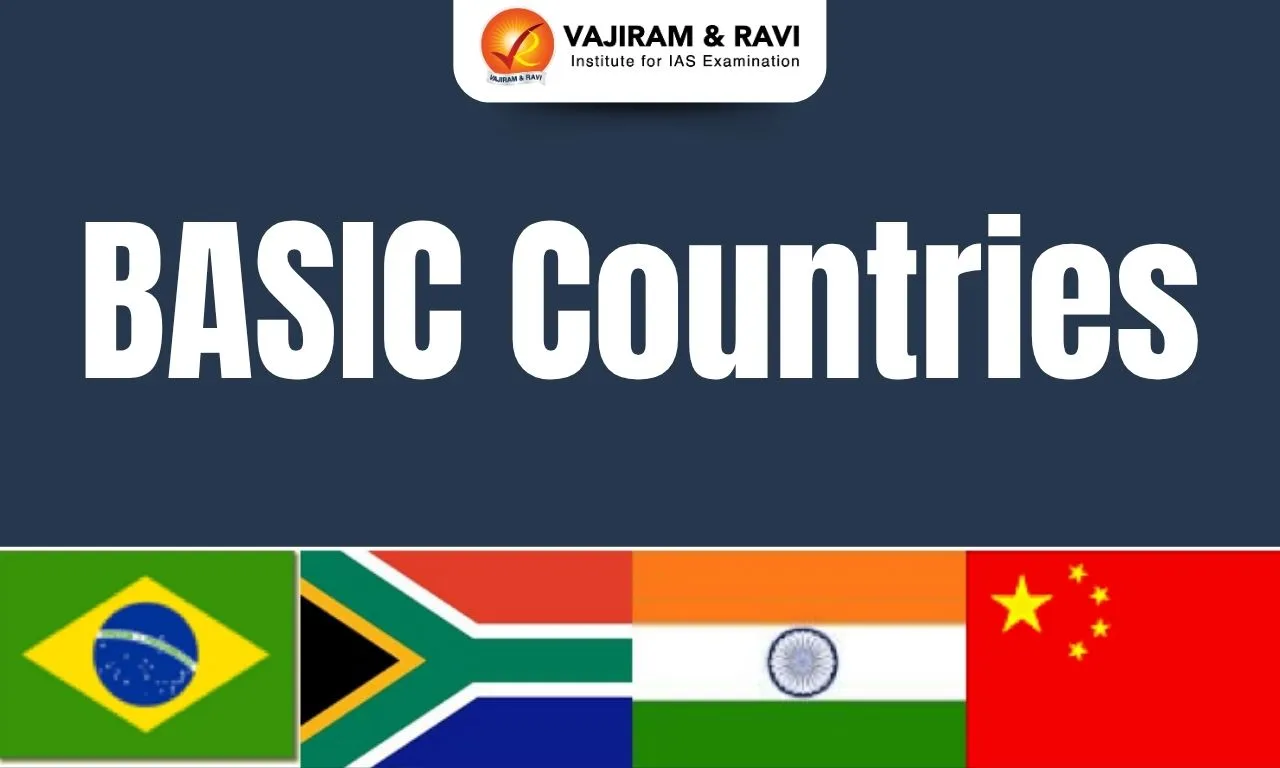
At the United Nations Climate Change Conference 2024 (COP29), the BASIC nations Brazil, South Africa, India, and China renewed their call for stronger climate finance commitments from developed nations. This committee was established on 28th November 2009 to combat the climate issues keeping the development of the country also on priority. Due to the climate changes these countries emphasised the need for equitable solutions to manage the environment globally.
This topic is particularly relevant for UPSC aspirants preparing for the environment and international relations sections. Read on to explore the objectives, challenges and influence of the BASIC countries in global climate discussions.
What are BASIC Countries?
The BASIC Countries comprising Brazil, South Africa, India, and China were formed on 28th November 2009 to represent the shared climate interests of emerging economies. The group played an important role in shaping the Copenhagen Accord during COP 15 under the UNFCCC, working alongside the United States.
Together, these nations account for nearly one-third of global land area and around 40% of the world’s population. They advocate for the principle of Common but Differentiated Responsibilities and Respective Capabilities (CBDR-RC), urging developed nations to take greater responsibility for historical emissions and to provide financial and technological support to developing countries. The BASIC Countries enhances the collective negotiating power of the Global South in international climate discussions.
BASIC Countries List
The BASIC Countries include the developing nations to whom the developed countries provide the financial aid to resolve the climatic challenges and formulate the climate policies to safeguard the world. The BASIC Countries List includes the below mentioned countries in the table where their contributions are also highlighted.
| BASIC Countries List | ||
|
Country |
Region |
Key Contributions |
|
Brazil |
South America |
Prioritises the preservation of the Amazon rainforest while promoting sustainable development practices. |
|
South Africa |
Africa |
Takes the lead in African climate negotiations and spearheads renewable energy initiatives. |
|
India |
South Asia |
Advocates for the interests of developing countries, emphasising renewable energy and sustainable development. |
|
China |
East Asia |
While being the largest global emitter, it also stands out as a leader in renewable energy investments. |


Demand of BASIC Countries in Copenhagen Accord
The BASIC countries (Brazil, South Africa, India, and China) have consistently voiced concerns over global climate policies that disproportionately burden developing nations. These countries advocate for a fair and balanced approach to addressing climate change, focusing on several key areas:
Equity in Climate Responsibility
BASIC nations uphold the principle of “common but differentiated responsibilities” (CBDR), making it clear that while all countries share the obligation to combat climate change, developed nations should bear a greater share of the effort.
Adequate Climate Financing
A critical demand from BASIC countries is the provision of sufficient financial support from wealthier developed nations. This funding is crucial to enable developing economies to implement climate adaptation and mitigation projects effectively. The BASIC Countries continue to press for the fulfilment of the $100 billion annual climate finance commitment that remains unmet.
Access to Green Technology
To ensure sustainable development, the BASIC Countries emphasise the need for access to environmentally friendly technologies. They call for enhanced collaboration and technology transfer from developed countries, enabling them to minimise emissions without compromising economic growth.
Realistic Emission Reduction Goals
The BASIC Nations call for emission reduction targets that are suited to their level of development and available resources. They argue that climate commitments should take into account past emissions and the ongoing differences in resources and infrastructure between developed and developing nations.
COP29 and BASIC’s Renewed Push
At COP29, the BASIC Countries reinforced their demands, urging developed nations to deliver on their financial commitments. They also raised concerns about trade mechanisms like the Carbon Border Adjustment Mechanism (CBAM), which they argue could impose unfair economic burdens on developing nations.
Paris Agreement 2015
The Paris Agreement is a legal document for binding global accord designed to address climate change by reducing greenhouse gas emissions and enhancing climate resilience. It sets the goal of limiting global temperature rise to well below 2°C above pre-industrial levels, with efforts to cap it at 1.5°C.
Nationally Determined Contributions (NDCs)
Under this agreement, countries are required to submit their Nationally Determined Contributions (NDCs), which outline the specific measures they will undertake to reduce emissions. These NDCs are subject to updates every five years to ensure continued progress.
India’s NDC Commitments
India has committed to the following key climate actions by 2030:
- To reduce the emissions intensity of its GDP by 33 to 35 percent by 2030 from 2005 level;
- Establishing a carbon sink of 2.5 to 3 gigatons of CO2 equivalent (GtCO2e) by expanding forest cover and other vegetation.
- Ensuring that 50% of the country’s total electric power capacity comes from non-fossil fuel-based sources.
- India promotes a sustainable and environmentally conscious way of life, drawing from its cultural values of conservation and moderation. The initiative, known as “LIFE” (Lifestyle for Environment), encourages people to adopt lifestyles that reduce their environmental impact and help combat climate change.
BASIC Nations and Copenhagen Accord
The Copenhagen Accord, established in 2009, marked a critical turning point in international climate discussions. A key factor in its development was the influential role of the BASIC Countries (Brazil, South Africa, India, and China). Contributions of BASIC Countries to the Copenhagen Accord:
- Unified Advocacy for the Global South: The BASIC Countries worked unitedly to ensure that the concerns and needs of developing nations were given proper attention in the global dialogue on climate change.
- Focus on Financial Support: One of the key areas of advocacy by BASIC Countries was the push for financial mechanisms from developed countries. These funds would enable developing nations to both lessen the effects of climate change and adapt to its challenges.
- Commitment to Voluntary Climate Actions: BASIC Countries set forward-looking goals for climate action, which included reducing emissions intensity and expanding the capacity for renewable energy production within their own borders.
BASIC Countries at COP29
During the COP29 Summit, the BASIC Countries (Brazil, South Africa, India, and China) maintained a strong position on several key issues:
- Opposition to Financial Shifts: BASIC Nations rejected efforts by developed countries to shift financial responsibilities onto emerging economies, insisting on fair contributions from wealthier nations.
- Championing Climate Justice: The group emphasised that developed countries should take the lead in reducing emissions, advocating for climate justice and fair accountability for past actions.
- Focus on Effective Action: BASIC Nations raised concerns over the lack of progress in the implementation of the Paris Agreement, urging immediate and practical steps to address the existing gaps.
Challenges Faced by BASIC Countries
While the BASIC Bloc is a group of developing nations, working hands in hands, there are some challenges they are facing which are mentioned as follow:
- Balancing Growth and Emission Cuts: Rapid industrialization and urbanisation raise emissions, making it difficult to align economic growth with climate goals.
- International Pressure: Developed countries often urge BASIC Countries to take on more climate responsibility without providing sufficient financial or technological support.
Internal Diversity: Each BASIC member has distinct environmental priorities, such as Brazil’s deforestation focus and China’s coal dependence, complicating coordinated climate action.

 Last updated on Sep, 2026
→ UPSC 2027 Notification will be released on 13 January 2027 at upsconline.nic.in.
→ Asian Games 2026 are being held in Aichi-Nagoya, Japan, from 19 September to 4 October.
→ Check out the latest UPSC Syllabus here.
→ Download UPSC Model Answers for Mains 2026
→ UPSC Mains Question Paper 2026 is out now for Essay & GS Paper 1, 2, 3 & 4.
→ UPSC Calendar 2027 has been released.
→ Enroll in Vajiram & Ravi’s UPSC Mains Test Series 2027 for structured answer writing practice, expert evaluation, and exam-oriented feedback.
→ Join Vajiram & Ravi’s UPSC Mentorship Program 2027 for personalized guidance, strategy planning, and one-to-one support from experienced mentors.
→ Go through the UPSC Mains Previous Year Papers to enhance your preparation.
→ UPSC has released UPSC Toppers List 2025 with the Civil Services final result on its official website.
→ Also check Best UPSC Coaching in India
BASIC Countries FAQs
Q1. What are all the BASIC Countries?+
Q2. Is it BASIC or BRICS?+
Q3. What are the BASIC Countries in cop28?+
Q4. What are 1st world countries?+
Q5. What is the meaning of BASIC Countries?+
Tags: basic countries