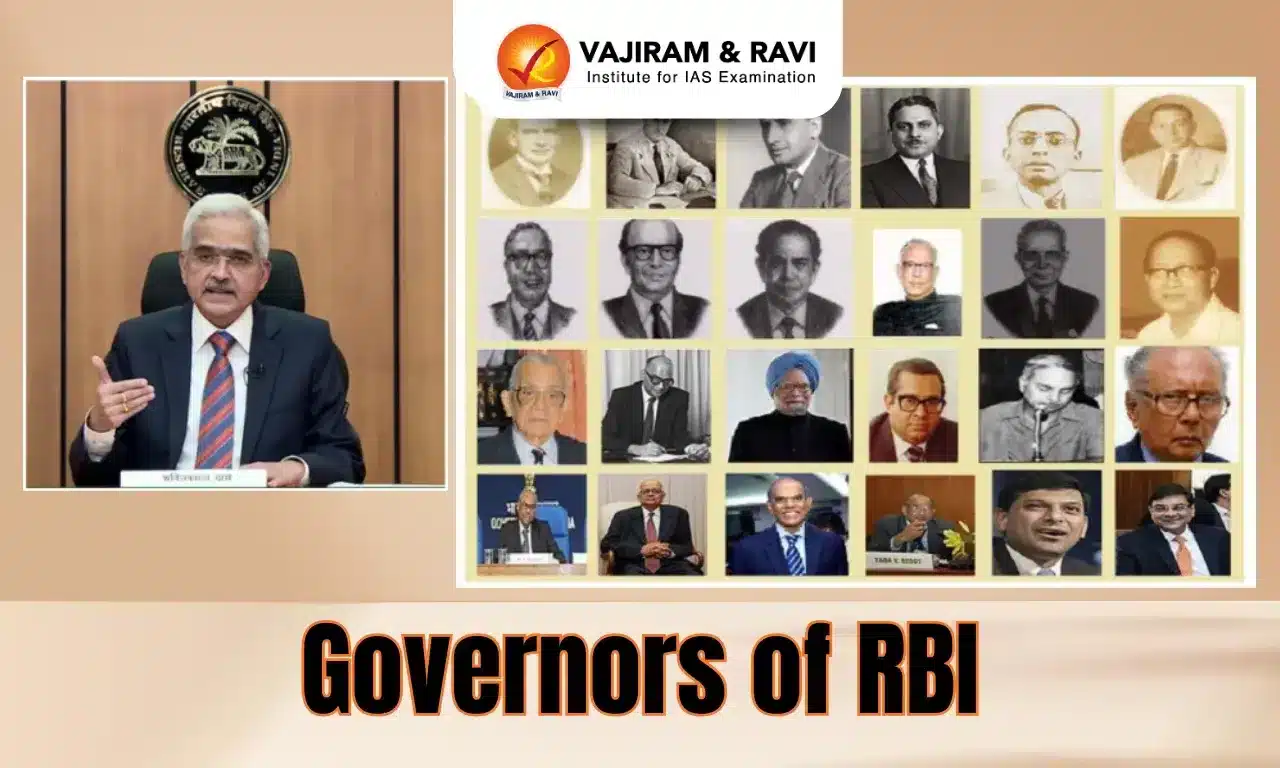
List of RBI Governors in India (1935-2026)
The List of RBI Governors from 1935 to 2026 includes the heads of the Reserve Bank of India (RBI) since its establishment. The RBI commenced operations on 1 April 1935 under the Reserve Bank of India Act, 1934, following the recommendations of the Hilton Young Commission. It was initially privately owned and was brought into public ownership on 1 January 1949.
Sir Osborne Smith was the first Governor of the RBI, while Sanjay Malhotra is the current RBI Governor. He assumed office as the 26th Governor on 11 December 2024. The Governor heads the Central Board of Directors and plays a key role in monetary policy, currency management and financial regulation.
List of RBI Governors from 1935 to 2026
The Governor of RBI is the CEO of the Central Bank of India and the Ex-officio Chairman of the Central Board of Directors. The Reserve Bank of India (RBI) issues the Indian note bearing the signature of the Governor of the Reserve Bank of India. The Government of India appoints the Governors of RBI for a term of three years and can be re-elected for the position. Below is the table we have shared the List of Governors of RBI from 1935-2026:
| List of RBI Governors in India from 1935-2026 | ||
|
S.N. |
Governor Name |
Tenure |
|
1. |
Sir Osborne Smith |
April 1, 1935 to June 30, 1937 |
|
2. |
Sir James Braid Taylor |
July 1, 1937 to February 17, 1943 |
|
3. |
Sir C. D. Deshmukh |
August 11, 1943 to June 30, 1949 |
|
4. |
Sir Benegal Rama Rau |
July 1, 1949 to 14 January 1957 |
|
5. |
K. G. Ambegaonkar |
January 14, 1957 to 28 February 1957 |
|
6. |
H. V. R. Iyengar |
March 1, 1957 to February 28, 1962 |
|
7. |
P. C. Bhattacharya |
March 1, 1962 to June 30, 1967 |
|
8. |
L. K. Jha |
July 1, 1967 to May 3, 1970 |
|
9. |
B. N. Adarkar |
May 4, 1970 to June 15, 1970 |
|
10. |
S. Jagannathan |
June 16, 1970 to May 19, 1975 |
|
11. |
N. C. Sen Gupta |
May 19, 1975 to August 19, 1975 |
|
12. |
K. R. Puri |
August 20, 1975 to May 2, 1977 |
|
13. |
M. Narasimhan |
May 3, 1977 to November 30, 1977 |
|
14. |
I.G. Patel |
December 1, 1977, to September 15, 1982 |
|
15. |
Manmohan Singh |
September 16, 1982 to January 14, 1985 |
|
16. |
Amitav Ghosh |
January 15, 1985, to February 4, 1985 |
|
17. |
R. N. Malhotra |
February 4, 1985, to December 22, 1990 |
|
18. |
S. Venkatraman |
December 22, 1990 to December 21, 1992 |
|
19. |
C. Rangarajan |
December 22, 1992, to November 21, 1997 |
|
20. |
Bimal Jalan |
November 22, 1997 to September 6, 2003 |
|
21. |
Y. V. Reddy |
September 6, 2003, to September 5, 2008 |
|
22. |
D. Subbarao |
September 5, 2008, to September 4, 2013 |
|
23. |
Raghuram Rajan |
September 4, 2013, to September 4, 2016 |
|
24. |
Urjit Patel |
September 4, 2016, to December 11, 2018 |
|
25 |
Shaktikanta Das |
December 12, 2018, to December 12, 2024 |
|
26. |
Sanjay Malhotra |
December 12, 2024 to Present |
First Governor of RBI
Sir Osborne Smith was appointed as the First RBI Governor of India. As a professional banker he worked at the Bank of New South Wales for 2 decades and in the Commonwealth Bank of Australia for another decade. He became the Managing Governor at the Imperial Bank of India when he returned back to India and left a great impression.
His leadership of the Imperial Bank earned him significant recognition within Indian banking circles. However, his policy perspectives on issues such as exchange rates and interest rates often diverged from those of the Government. As a result, he resigned before completing his three-and-a-half-year term. Notably, Sir Osborne did not sign any banknotes during his tenure.


First Indian Governor of RBI
Sir C. D. Deshmukh was the first Indian Governor of the Reserve Bank of India. He assumed office on 11 August 1943 and served until 30 June 1949. He was also the first Indian to head the RBI during the final years of British rule and the early period after independence.
Deshmukh later became India’s Union Finance Minister. His career is an important part of the history of India’s financial administration.
Present RBI Governor of India
As of 2026, Sanjay Malhotra is the current RBI Governor, who is an IAS Officer, belonging to the 1990 Rajasthan Cadre. Presently serving as the 26th Governor of RBI. He has played an important role in shaping India’s finances. He holds a CS degree from IIT Kanpur and Master’s in Public Policy from Princeton University, USA.
RBI Governors of India Eligibility Criteria
The position of RBI Governor is offered to civil servants names like C. D. Deshmukh and Bengal Rama Rao. Over a while, the Governor of RBI Eligibility Criteria elaborated, allowing candidates with diverse backgrounds to be considered. Anyone holding a graduate or postgraduate degree, or qualifications can aspire to become the Governor of RBI.
To be eligible to be a RBI Governor, the following eligibility criteria has to be met:
- Has to be a citizen of India.
- Should be in the age group between 40 to 60 years.
- Should have at least 20 years of working experience in a banking, finance, economics or related sector.
- Should have held a senior position in a banking or financial institution.
- Should not be connected or associated with any political party or organisation.
Role and Functions of the RBI Governor
The RBI Governor is the head of India’s central bank and performs important monetary, regulatory and administrative functions. The Governor works within the framework of the Reserve Bank of India Act, 1934, and other applicable laws.
The key responsibilities include:
- Monetary policy: The Governor chairs the Monetary Policy Committee (MPC), which determines the policy repo rate and other monetary policy decisions within its statutory framework.
- Banking regulation: The RBI regulates and supervises banks and certain other financial institutions under applicable laws.
- Currency management: The RBI manages the issue and circulation of banknotes, except the ₹1 note, which is issued by the Government of India.
- Financial stability: The RBI monitors financial-sector risks and takes measures within its mandate to support the stability of the financial system.
- Foreign exchange management: The RBI administers relevant provisions of the Foreign Exchange Management Act, 1999, and manages India’s foreign exchange reserves.
- Payment systems: The RBI regulates and oversees payment and settlement systems within its statutory responsibilities.
- Institutional administration: The Governor heads the RBI’s Central Board of Directors and oversees the institution’s overall functioning.
The RBI Governor does not independently determine every monetary policy decision. The Monetary Policy Committee is the statutory body responsible for monetary policy decisions such as the policy repo rate.
Major RBI Governors and Their Contributions
Several RBI Governors have played a significant role in shaping India’s monetary policy, banking regulation and financial stability. Some notable Governors and their key contributions are listed below.
- Sir C. D. Deshmukh (1943-1949): Represented India at the Bretton Woods Conference (1944) and contributed to the country’s early financial administration.
- Sir Benegal Rama Rau (1949-1957): Led the RBI during the early post-independence period and the development of India’s monetary and banking framework.
- L. K. Jha (1967-1970): Oversaw monetary and credit policy during a period of economic challenges.
- I. G. Patel (1977-1982): Managed monetary policy amid inflationary pressures and international economic uncertainty.
- Dr. Manmohan Singh (1982-1985): Led the RBI before becoming India’s Finance Minister and later Prime Minister.
- Dr. Bimal Jalan (1997-2003): Guided monetary policy during the post-liberalisation period and the Asian financial crisis.
- Dr. Y. V. Reddy (2003-2008): Strengthened financial regulation and pursued a cautious approach to banking-sector risks before the global financial crisis.
- Dr. D. Subbarao (2008-2013): Managed monetary policy during the global financial crisis and its aftermath.
- Dr. Raghuram Rajan (2013-2016): Strengthened inflation management, banking transparency and the identification of stressed assets.
- Dr. Urjit Patel (2016-2018): Oversaw the implementation of the Monetary Policy Committee framework and inflation-targeting system.
- Shaktikanta Das (2018-2024): Led the RBI’s COVID-19 response through liquidity support and monetary policy measures, while digital payments expanded.
- Sanjay Malhotra (2024-Present): Oversees monetary policy, banking regulation and financial stability.
Deputy Governors of RBI
The Deputy Governors of the Reserve Bank of India (RBI) assist the Governor in managing the central bank’s operations and implementing its policies. They oversee key areas such as monetary policy, banking regulation, financial supervision, currency management and payment systems. The Central Government appoints Deputy Governors under the Reserve Bank of India Act, 1934.
First Deputy Governor of RBI
Sir James B. Taylor was one of the first Deputy Governors of the Reserve Bank of India (RBI). He served in this position from 1 April 1935 to 30 June 1937, when the RBI began its operations. On 1 July 1937, he succeeded Sir Osborne Smith as the second Governor of the RBI. Captain Sir Sikander Hyat Khan was also appointed Deputy Governor on 1 April 1935
Current Deputy Governors of RBI (2026)
The Reserve Bank of India (RBI) has four Deputy Governors who assist the Governor in managing the central bank’s functions, including monetary policy, banking regulation, financial supervision and payment systems.
|
Deputy Governor |
Tenure began |
|---|---|
|
Swaminathan Janakiraman |
26 June 2023; reappointed for two years from 26 June 2026 |
|
Dr. Poonam Gupta |
2 May 2025 |
|
Shirish Chandra Murmu |
9 October 2025 |
|
Rohit Jain |
4 May 2026 |

 Last updated on Nov, 2026
→ UPSC 2027 Notification will be released on 13 January 2027 at upsconline.nic.in.
→ Check Nobel Prize 2026 Winners List here.
→ Download PIB PRiSM Monthly Magazine 2026 here.
→ Check UPSC Monthly Current Affairs Magazine The Recitals here.
→ Check out the latest UPSC Syllabus here.
→ Download UPSC Model Answers for Mains 2026
→ UPSC Mains Question Paper 2026 is out now for Essay & GS Paper 1, 2, 3 & 4.
→ UPSC Calendar 2027 has been released.
→ Enroll in Vajiram & Ravi’s UPSC Mains Test Series 2027 for structured answer writing practice, expert evaluation, and exam-oriented feedback.
→ Join Vajiram & Ravi’s UPSC Mentorship Program 2027 for personalized guidance, strategy planning, and one-to-one support from experienced mentors.
→ Go through the UPSC Mains Previous Year Papers to enhance your preparation.
→ UPSC has released UPSC Toppers List 2025 with the Civil Services final result on its official website.
→ Also check Best UPSC Coaching in India
List of Governors of RBI from 1935-2026 FAQs
Q1. What is the salary of an RBI Governor?+
Q2. Who was the first Indian Governor of RBI?+
Q3. Who is the current RBI Governor?+
Q4. When was RBI established?+
Q5. When was RBI Nationalised?+
Tags: governance indian polity list of rbi governors in india RBI Governors List