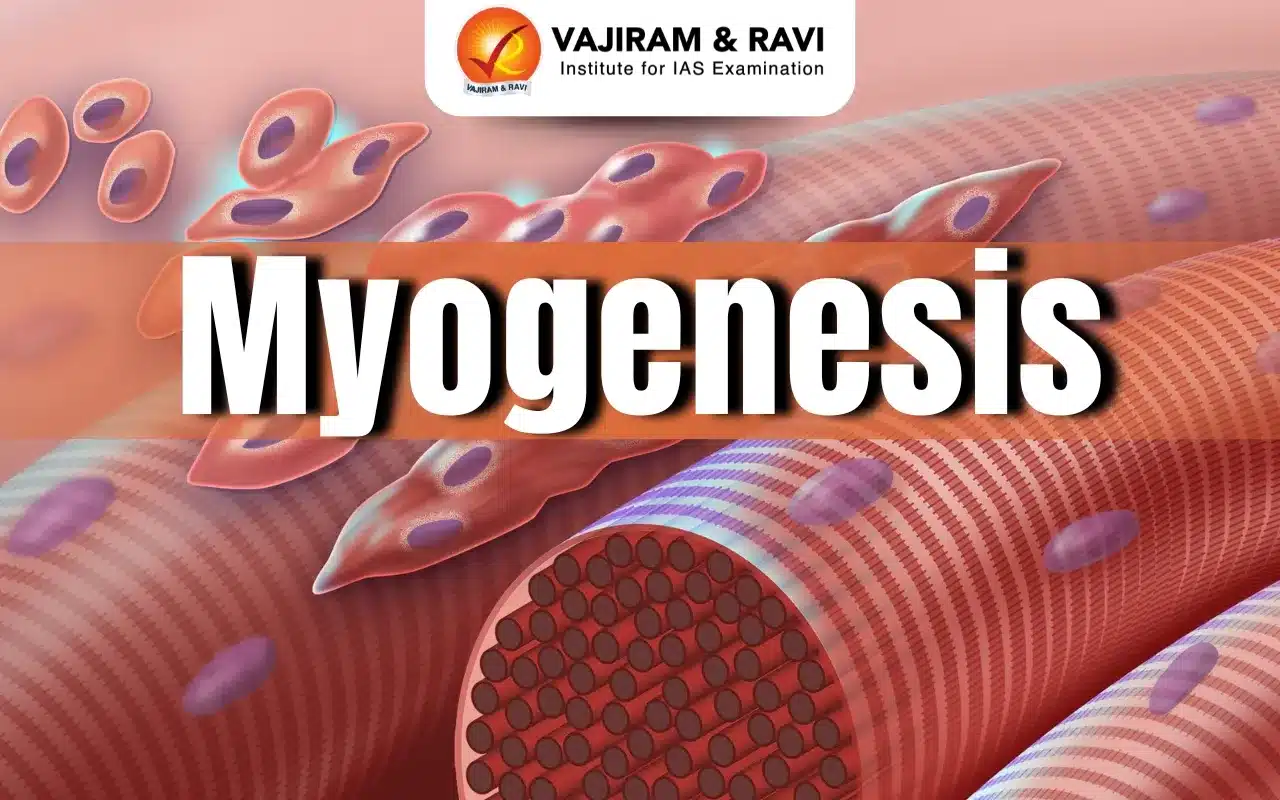
Myogenesis Latest News
Group Captain Shubhanshu Shukla recently launched groundbreaking Myogenesis experiments on the ISS, marking India’s advancements in space research.
About Myogenesis
- It is the process by which muscle fibers are formed.
- It is a complex and highly regulated process that is crucial for the development and maintenance of skeletal muscle tissue.
- The significance of myogenesis lies in its role in forming the musculature of the body, enabling movement, maintaining posture, and regulating metabolism.
- Myogenesis involves the differentiation of precursor cells, known as myoblasts, into multinucleated muscle fibers.
- This process is not only essential during embryonic development but also plays a critical role in muscle repair and regeneration throughout life.
- The study of myogenesis is important for understanding muscle development and related disorders, as well as for developing therapeutic strategies for muscle diseases.


Overview of the Myogenic Process
- The myogenic process can be broadly divided into several stages: myoblast proliferation, differentiation, and fusion into multinucleated myotubes, followed by maturation into muscle fibers.
- Each stage is tightly regulated by a complex interplay of transcription factors, signaling pathways, and cellular processes.
Role of Key Transcription Factors
- Key transcription factors such as MyoD and Myf5 play a crucial role in regulating myogenesis.
- These myogenic regulatory factors (MRFs) are essential for the specification of myoblasts and their differentiation into muscle fibers.
- MyoD is a master regulator that drives myoblast differentiation by activating the expression of muscle-specific genes.
- Myf5 is involved in the early stages of myogenesis, regulating myoblast proliferation and specification.
Cellular Processes Regulating Myogenesis
- Cellular processes such as cell proliferation and differentiation are tightly regulated during myogenesis.
- Cell Proliferation: Myoblast proliferation is a critical step that precedes differentiation. It ensures an adequate number of myoblasts for muscle formation.
- Cell Differentiation: Myoblast differentiation involves a series of molecular changes that enable myoblasts to fuse and form multinucleated myotubes.
Source: TOI

 Last updated on Sep, 2026
→ UPSC 2027 Notification will be released on 13 January 2027 at upsconline.nic.in.
→ Asian Games 2026 are being held in Aichi-Nagoya, Japan, from 19 September to 4 October.
→ Check out the latest UPSC Syllabus here.
→ Download UPSC Model Answers for Mains 2026
→ UPSC Mains Question Paper 2026 is out now for Essay & GS Paper 1, 2, 3 & 4.
→ UPSC Calendar 2027 has been released.
→ Enroll in Vajiram & Ravi’s UPSC Mains Test Series 2027 for structured answer writing practice, expert evaluation, and exam-oriented feedback.
→ Join Vajiram & Ravi’s UPSC Mentorship Program 2027 for personalized guidance, strategy planning, and one-to-one support from experienced mentors.
→ Go through the UPSC Mains Previous Year Papers to enhance your preparation.
→ UPSC has released UPSC Toppers List 2025 with the Civil Services final result on its official website.
→ Also check Best UPSC Coaching in India
Myogenesis FAQs
Q1. What is myogenesis?+
Q2. Which type of cells differentiate into muscle fibers during myogenesis?+
Q3. Which transcription factor is considered the "master regulator" of myoblast differentiation?+
Q4. What is the function of the Myf5 transcription factor in myogenesis?+
Q5. What happens during the differentiation stage of myogenesis?+
Tags: myogenesis prelims pointers upsc prelims current affairs