Facciolella Smithi Latest News
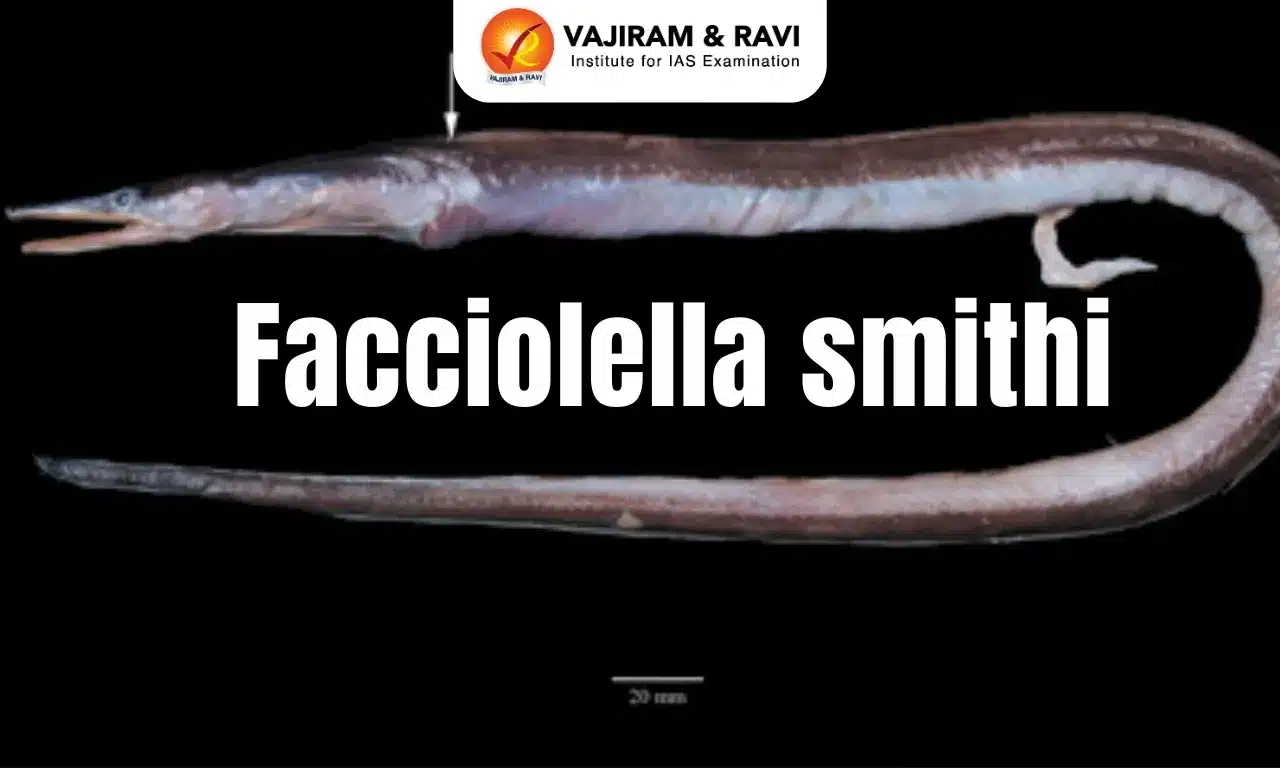
Indian scientists recently discovered a new deep-sea eel species, Facciolella smithi (Smith’s witch eel), in the Arabian Sea.
About Facciolella Smithi
- Facciolella smithi (Smith’s witch eel) is a new species of deep-sea eel.
- It was discovered by the scientists at the ICAR–National Bureau of Fish Genetic Resources, Lucknow.
- The specimen was collected at a depth ranging from 260 to 460 meters off the Kerala coast in the Arabian Sea.
- It belongs to the family Nettastomatidae.
- The eel likely inhabits the seafloor or burrows into soft sediments, navigating the pitch-black waters with the help of its sensory adaptations rather than sight.
- The species has been named in honour of eminent ichthyologist Dr. David G. Smith for his significant contributions to eel taxonomy.


Facciolella Smithi Anatomical Characteristics
- Body Structure: The eel has an elongate, ribbon-like body that reaches just over two feet in length. This slender shape allows it to glide smoothly through deep-sea waters.
- Coloration: One of the most striking visual features is its two-tone body. The upper half is a rich brown, while the underside is described as “milky white.” This contrast may aid in camouflage in the dim oceanic depths.
- Head and Snout: The eel has a notably large head with a duckbill-like snout, giving it a peculiar, almost prehistoric look.
- Eyes and Vision: Despite its large head, the eyes of Facciolella smithi are relatively small, an adaptation to the low-light environment of the deep sea where visual cues are limited.
- Teeth: The mouth contains cone-shaped teeth, likely used to grasp slippery or soft-bodied prey.
- Gills: The gill openings are crescent-shaped, positioned behind the head, consistent with many species of the eel family.
- Tail Regeneration: Remarkably, most of the specimens showed evidence of regrown or regenerated tails, indicating either predator encounters or natural loss due to environmental factors. This regenerative trait is crucial for survival in the harsh and competitive deep-sea ecosystem.
Source: KRISHI

 Last updated on Oct, 2026
→ UPSC 2027 Notification will be released on 13 January 2027 at upsconline.nic.in.
→ Asian Games 2026 are being held in Aichi-Nagoya, Japan, from 19 September to 4 October.
→ Check Nobel Prize 2026 Winners List here.
→ Download PIB PRiSM Monthly Magazine 2026 here.
→ Check UPSC Monthly Current Affairs Magazine The Recitals here.
→ Check out the latest UPSC Syllabus here.
→ Download UPSC Model Answers for Mains 2026
→ UPSC Mains Question Paper 2026 is out now for Essay & GS Paper 1, 2, 3 & 4.
→ UPSC Calendar 2027 has been released.
→ Enroll in Vajiram & Ravi’s UPSC Mains Test Series 2027 for structured answer writing practice, expert evaluation, and exam-oriented feedback.
→ Join Vajiram & Ravi’s UPSC Mentorship Program 2027 for personalized guidance, strategy planning, and one-to-one support from experienced mentors.
→ Go through the UPSC Mains Previous Year Papers to enhance your preparation.
→ UPSC has released UPSC Toppers List 2025 with the Civil Services final result on its official website.
→ Also check Best UPSC Coaching in India
Facciolella smithi FAQ's
Q1. What is Facciolella smithi?+
Q2. Where was Facciolella smithi discovered?+
Q3. To which family does Facciolella smithi belong?+
Q4. Which institution discovered Facciolella smithi?+
Q5. Who was Facciolella smithi named after?+
Tags: facciolella smithi prelims pointers upsc current affairs upsc prelims current affairs