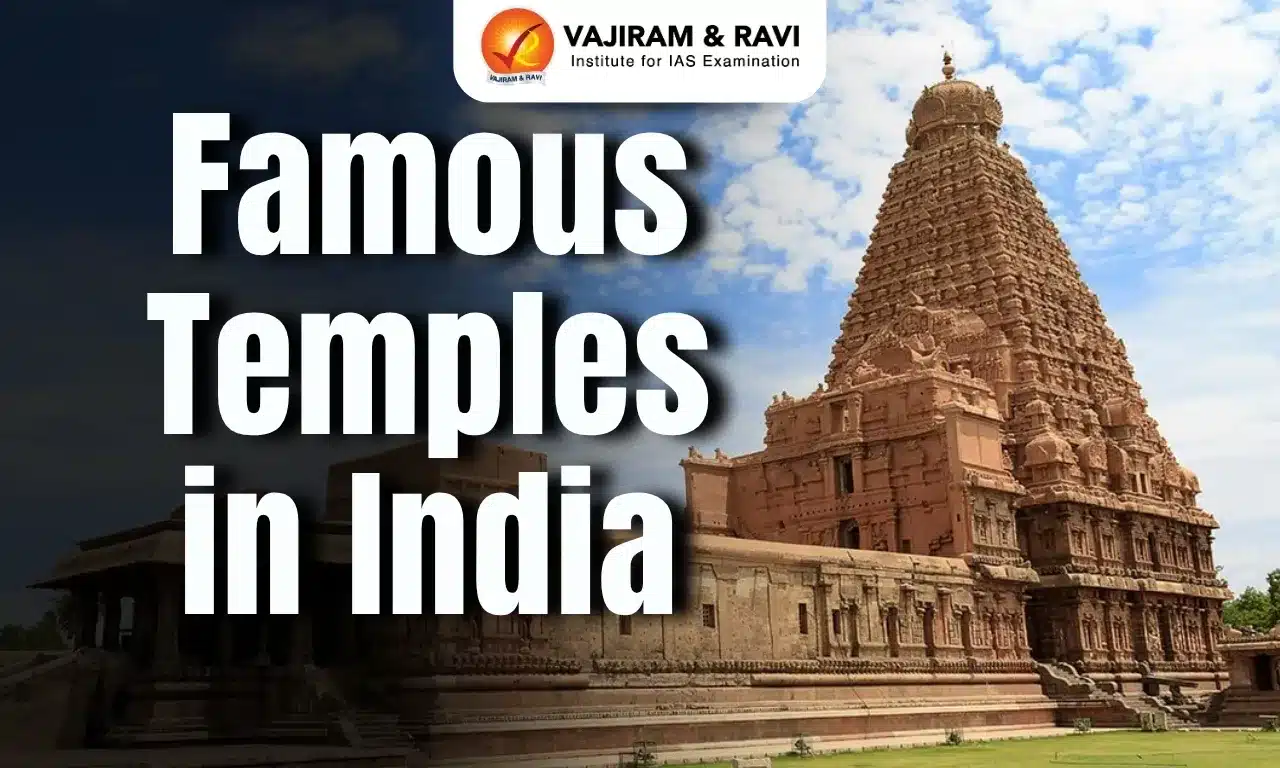
India is home to thousands of temples that reflect its rich history, religious traditions and architectural heritage. From the Himalayan shrines of Kedarnath and Badrinath to the magnificent temple complexes of Tamil Nadu and Odisha, these sacred places attract millions of devotees and tourists every year.
List of Famous Temples in India 2026 State Wise
The following table lists the Most Famous Temples in India and their locations.
| State Wise List of Famous Temples in India 2026 |
||
| Temple Name | Location | State/ Union Territory |
|
|
Rudraprayag |
Uttarakhand |
|
Chhatarpur |
Madhya Pradesh |
|
|
Siddhivinayak Temple |
Mumbai |
Maharashtra |
|
Tirumala |
Andhra Pradesh |
|
|
Varanasi |
Uttar Pradesh |
|
|
Bodh Gaya |
Bihar |
|
|
Konark |
Odisha |
|
|
Puri |
Odisha |
|
|
Thiruvananthapuram |
Kerala |
|
|
Vaishno Devi Temple |
Katra |
Jammu and Kashmir |
|
Anantnag district |
Jammu and Kashmir |
|
|
Rameswaram |
Tamil Nadu |
|
|
Thanjavur |
Tamil Nadu |
|
|
Madurai |
Tamil Nadu |
|
|
Srirangam, Tiruchirappalli |
Tamil Nadu |
|
|
Prabhas Patan |
Gujarat |
|
|
Dwarka |
Gujarat |
|
|
Hampi |
Karnataka |
|
|
Chamoli |
Uttarakhand |
|
|
Guwahati |
Assam |
|
Top 20 Famous Temples in India 2026
1. Kedarnath Temple, Uttarakhand
Kedarnath Temple is one of the most famous Hindu temples in India, located in the Garhwal Himalayas of Uttarakhand.
- Location: Rudraprayag district, near the Mandakini River, at an altitude of approximately 3,583 metres.
- Presiding Deity: Lord Shiva, worshipped in the form of a Jyotirlinga.
- Religious Significance: One of the twelve Jyotirlingas and one of the four temples in Chota Char Dham (also known as the Himalayan Char Dham circuit in Uttarakhand).
- Key Feature: Its stone architecture and Himalayan setting make it an important destination for pilgrims and visitors.
- Architecture:
- Architectural Style and Structure: Kedarnath Temple follows the Nagara style of architecture, featuring a conical Shikhara above the Garbhagriha, which houses the Shiva Lingam worshipped as Sadashiva.
- Construction and Orientation: Built using interlocking grey stone slabs secured with iron clamps without mortar, the temple has an unusual north-south orientation, unlike most Hindu temples facing east or west.
- Sculptures and Temple Layout: The Mandapa contains images of the Pandavas, Krishna and other deities, while Nandi guards the entrance. The walls feature carvings depicting deities, mythological scenes and floral motifs.
2. Khajuraho Temples, Madhya Pradesh
The Khajuraho Group of Monuments is renowned for its intricate sculptures and outstanding examples of medieval Indian temple architecture.
- Location: Chhatarpur district, Madhya Pradesh.
- Historical Background: Most temples were constructed between the 10th and 11th centuries under the Chandela dynasty.
- Religious Significance: The complex includes Hindu temples dedicated to deities such as Shiva and Vishnu, as well as Jain temples.
- Key Feature: The temples feature detailed carvings depicting deities, celestial figures, everyday life and various aspects of human experience.
- UNESCO Recognition: The Khajuraho Group of Monuments was designated a UNESCO World Heritage Site in 1986.
- Architecture of Khajuraho Temples:
- Nagara Style: Khajuraho temples represent the mature form of Nagara-style architecture, characterised by elevated platforms, curvilinear shikharas, interconnected halls and intricate sculptural decorations developed under the Chandela rulers.
- Vastu-Purusha-Mandala: The temple layouts follow a symmetrical geometric grid known as Vastu-Purusha-Mandala, with square-based divisions of 9, 16, 36, 49 or 64 padas arranged around the central sanctum.
- Temple Structure: The temples feature an axial arrangement comprising Ardhamandapa (entrance porch), Mandapa (assembly hall), Mahamandapa (main hall), Antarala (vestibule) and Garbhagriha (sanctum), reflecting organised sacred spatial planning.
- Shikhara and Urushringas: The sanctum is crowned by a curvilinear Shikhara, often surrounded by smaller subsidiary spires called Urushringas. Their ascending arrangement creates a mountain-like appearance symbolising the sacred cosmic mountain.
- Panchayatana Style: Temples such as Lakshmana and Vishvanatha follow the Panchayatana arrangement, featuring a central shrine surrounded by four subsidiary shrines at the corners of a common raised platform.
- Sculptures and Construction: Built mainly using finely carved sandstone and gravity-supported stone joints, Khajuraho temples feature sculptures depicting deities, mythology, everyday activities and the four Purusharthas: Dharma, Artha, Kama and Moksha.
3. Siddhivinayak Temple, Maharashtra
Shree Siddhivinayak Temple in Mumbai is one of the most prominent temples dedicated to Lord Ganesha in western India.
- Location: Prabhadevi, Mumbai, Maharashtra.
- Established: The temple was founded in 1801.
- Presiding Deity: Lord Ganesha, worshipped as the remover of obstacles and the deity of wisdom and prosperity.
- Religious Significance: Devotees visit the temple before important personal and professional undertakings, seeking Ganesha’s blessings.
- Key Feature: The temple attracts large numbers of devotees, particularly on Tuesdays and during the festival of Ganesh Chaturthi.
- Architecture:
- Original Temple Architecture: The original Siddhivinayak Temple featured a traditional layout comprising a sanctum, assembly hall, open courtyard, administrative office and a water tank near the entrance.
- Stone Construction and Design: The temple originally featured black stone construction, a north-facing entrance, two assembly halls and a Nagarkhana, reflecting its traditional architectural arrangement and subsequent structural additions.
- Garbhagriha and Religious Sculptures: The sanctum measures approximately 15 feet in height and 10 feet in width, featuring brass sculptures of Jaya and Vijaya, a dome-shaped stone ceiling and associated Hindu deities.
- Architectural Renovation and Materials: Renovated between 1990 and 1993, the temple incorporated marble and pink granite, drawing architectural inspiration from the Shiva Temple at Ambernath to address Mumbai’s humid coastal climate.
- Multi-Storeyed Temple Structure: The renovated temple features a distinctive six-storeyed, multiangular design, crowned by a central gold-plated dome and smaller ornamental crowns made from gold and panchadhatu (five metals).
- Temple Dome and Sanctum Design: The architectural layout preserves open vertical space above the sanctum, while three main entrances and an elevated central hall facilitate collective worship and devotee access during major religious occasions.
4. Tirumala Venkateswara Temple, Andhra Pradesh
Tirumala Venkateswara Temple is one of India’s most prominent Hindu pilgrimage centres and is widely known for its religious traditions and elaborate rituals.
- Location: Tirumala hills, near Tirupati, Andhra Pradesh.
- Presiding Deity: Lord Venkateswara, a form of Lord Vishnu.
- Religious Significance: The temple is an important centre of Vaishnavism, a tradition centred on the worship of Lord Vishnu and his forms.
- Key Feature: The tradition of offering hair as an act of devotion and the preparation of the famous Tirupati Laddu prasadam.
- Architecture:
- Dravidian Style of Architecture: The Tirumala Venkateswara Temple follows the Dravidian architectural style, with its development traditionally traced to around 300 CE and subsequent expansions under the Cholas, Pandyas and Vijayanagara rulers.
- Gopurams and Prakarams: The temple features three entrances, including the Maha Dwaram, Vendi Vakili and Bangaru Vakili, along with three concentric enclosure walls (Prakarams) that organise access and circumambulation.
- Garbhagriha and Vimana: The sanctum sanctorum, known as Ananda Nilayam, houses the presiding deity Venkateswara. A gold-plated, three-storeyed Vimana stands above the sanctum, reflecting important features of Dravidian temple architecture.
- Mandapas and Temple Tank: The complex includes pillared mandapas such as Tirumamani Mandapam and Snapana Mandapam, alongside the sacred Swami Pushkarni tank, highlighting the ritual and architectural planning of South Indian temples.
5. Kashi Vishwanath Temple, Uttar Pradesh
Kashi Vishwanath Temple is one of the most sacred Hindu temples in Varanasi and holds a central place in the worship of Lord Shiva.
- Location: Varanasi, Uttar Pradesh, near the River Ganga.
- Presiding Deity: Lord Shiva, worshipped as Vishwanath, meaning the Lord of the Universe.
- Religious Significance: One of the twelve Jyotirlingas and a major pilgrimage destination for Shiva devotees.
- Historical Background: The temple has undergone destruction and reconstruction at different points in history. The present main temple was built in the 18th century under the patronage of Ahilyabai Holkar.
- Key Feature: Its golden domes and close association with Varanasi’s sacred geography make it one of India’s best-known temples.
- Architecture:
- Nagara Style of Architecture: Kashi Vishwanath Temple follows the Nagara style, commonly found in northern India, with a quadrangular main structure surrounded by smaller shrines dedicated to various deities.
- Sanctum and Jyotirlinga: The presiding deity is a 60-centimetre-tall Jyotirlinga enshrined on a silver platform inside the Garbha Griha, accessed through a Sabha Griha or congregation hall.
- Temple Spires and Golden Domes: The temple features a 15.5-metre-high spire, a gold-plated dome and a golden spire bearing a flag and trident, earning it the popular name Golden Temple.
- Jnana Vapi and Temple Complex: The Jnana Vapi, or Wisdom Well, lies north of the main shrine. The complex includes subsidiary shrines, while the Kashi Vishwanath Dham corridor connects the temple with Manikarnika Ghat
6. Mahabodhi Temple, Bihar
The Mahabodhi Temple in Bodh Gaya is one of the most important Buddhist pilgrimage sites in the world.
- Location: Bodh Gaya, Bihar.
- Religious Significance: The site is associated with Gautama Buddha’s attainment of enlightenment.
- Historical Background: The original shrine is traditionally associated with Emperor Ashoka’s patronage in the 3rd century BCE, while the surviving complex reflects later phases of construction and restoration.
- Key Feature: The temple is known for its pyramidal tower, carved stone features and sacred surroundings.
- Famous For: The nearby Bodhi Tree is traditionally associated with the Buddha’s enlightenment.
- UNESCO Recognition: The Mahabodhi Temple Complex was designated a UNESCO World Heritage Site in 2002.
- Architecture:
- Gupta Period Brick Architecture: The present Mahabodhi Temple, dating to the 5th–6th centuries CE, is among the earliest surviving brick structures of the Gupta period, influencing subsequent Indian temple architecture.
- Central Tower and Symmetrical Design: The temple features a 55-metre-high central tower surrounded by four smaller towers built in a similar architectural style, reflecting its distinctive structural composition.
- Ancient Stone Railings and Sculptures: The temple complex contains sandstone railings dating to around 150 BCE and later Gupta-period granite railings, featuring carvings of deities, stupas, animals and floral motifs.
- Mauryan Contributions and Vajrasana: Emperor Ashoka established the Diamond Throne (Vajrasana) around 250 BCE at Buddha’s enlightenment site. This sacred stone structure remains an important feature of the temple’s architectural and religious heritage.
7. Konark Sun Temple, Odisha
Konark Sun Temple is a historic monument famous for its distinctive chariot-shaped design and elaborate stone carvings.
- Location: Konark, Puri district, Odisha.
- Built By: King Narasimhadeva I of the Eastern Ganga dynasty in the 13th century.
- Presiding Deity: Surya, the Hindu Sun God.
- Key Feature: Its sculptures depict deities, musicians, dancers and aspects of medieval Indian life.
- UNESCO Recognition: The Konark Sun Temple became a UNESCO World Heritage Site in 1984.
- Architecture:
- Kalinga Style of Architecture: The Konark Sun Temple represents the Kalinga style of temple architecture, developed under the Eastern Ganga dynasty. Its design reflects Odisha’s medieval architectural traditions and artistic excellence.
- Chariot-Shaped Structure: Dedicated to Surya, the temple resembles a massive stone chariot drawn by seven horses. Its 24 intricately carved wheels symbolise the 12 months of the Hindu calendar and their two cycles.
- Temple Layout and Design: The complex included the main sanctum (Rekha Deul), assembly hall (Jagamohana), dance hall (Natamandira) and offering hall (Bhoga Mandapa), reflecting the functional divisions of traditional Hindu temple architecture.
- Sculptures and Iconography: Intricate carvings depict Hindu deities, celestial figures, musicians, animals, daily life and erotic themes. These sculptures provide insights into medieval Odisha’s religious traditions, artistic practices and social life.
8. Jagannath Temple, Odisha
Jagannath Temple in Puri is one of the most important Hindu pilgrimage centres in eastern India and a major centre of Vaishnava traditions.
- Location: Puri, Odisha.
- Presiding Deities: Lord Jagannath, Lord Balabhadra and Goddess Subhadra.
- Historical Background: The present temple structure is generally associated with the 12th century and the reign of King Anantavarman Chodaganga Deva.
- Religious Significance: The temple is one of the four traditional Char Dham pilgrimage destinations.
- Key Feature: The annual Rath Yatra involves the ceremonial procession of the three deities in large decorated chariots.
- Temple Tradition: Mahaprasad prepared in the temple kitchen is an important part of its religious practices.
- Architecture:
- Kalinga Style of Architecture: The Jagannath Temple reflects the Kalinga style of Hindu temple architecture, which developed in ancient Kalinga, present-day Odisha, and is characterised by distinctive structural forms and elaborate stone sculptures.
- Four Structural Sections: The temple comprises four principal structures: Vimana or Deula (sanctum), Mukhashala (frontal porch), Nata Mandapa (dancing or audience hall) and Bhoga Mandapa (offerings hall).
- Rekha Deula Style: The sanctum follows the Rekha Deula style, featuring a tall, curvilinear Shikhara that houses the deities. This architectural form is also visible in Odisha’s Lingaraja Temple.
- Fortified Temple Complex: Spread across more than 400,000 square feet, the complex features two protective walls: Meghanada Pacheri, the outer fortified wall, and Kurma Bedha, surrounding the main temple.
9. Sree Padmanabhaswamy Temple, Kerala
Sree Padmanabhaswamy Temple is a prominent religious landmark in Kerala, known for its distinctive architecture and the form in which Lord Vishnu is worshipped.
- Location: Thiruvananthapuram, Kerala.
- Presiding Deity: Lord Vishnu, reclining on the serpent Anantha.
- Religious Significance: It is an important centre of Vaishnava worship and has strong historical associations with the Travancore royal family.
- Key Feature: The temple received widespread attention following the discovery of valuable objects in its underground vaults.
- Architecture:
- Architecture Style: The temple combines elements of Kerala and Dravidian architectural styles, including a towering entrance structure and intricate stonework.
- Garbhagriha (Main Shrine): The sanctum houses Lord Padmanabha reclining on the serpent Anantha, accompanied by Sridevi, Bhudevi and Brahma, representing distinctive Vaishnavite iconography and religious symbolism in temple architecture.
- Mandapam and Sculptural Features: The Ottakkal-Mandapam is carved from a single massive stone, while the adjoining corridor features 365¼ sculptured granite pillars, highlighting traditional Indian stone craftsmanship and architectural expertise.
- Gopuram and Temple Layout: The temple features a 100-foot-high, seven-tier gopuram built in the Pandyan style, a prakaram and an 80-foot flagstaff, reflecting the Dravidian tradition of monumental temple architecture.
- Subsidiary Shrines: The temple houses additional shrines dedicated to Ugra Narasimha and Krishna as Parthasarathi, alongside deities such as Rama, Sita, Lakshmana, Hanuman and Ganapati, reflecting diverse Vaishnavite traditions.
10. Ramanathaswamy Temple, Tamil Nadu
Ramanathaswamy Temple is one of the most important Shiva temples in southern India and a major destination for Hindu pilgrims.
- Location: Rameswaram island, Tamil Nadu.
- Presiding Deity: Lord Shiva, worshipped as Ramanathaswamy.
- Religious Significance: One of the twelve Jyotirlingas and one of the four traditional Char Dham pilgrimage destinations.
- Historical Association: Hindu tradition connects Rameswaram with the Ramayana and the worship of Lord Shiva by Lord Rama.
- Structural Features: The temple is famous for its long pillared corridors, carved pillars and expansive temple complex.
- Key Feature: Its sacred water tanks, known as theerthams, are associated with ritual bathing and pilgrimage practices.
- Architecture:
- Dravidian Temple Architecture: Ramanathaswamy Temple features a high-walled compound, massive Gopurams and elaborate pillared corridors, reflecting the characteristic features of South Indian temple architecture and its historical development.
- Longest Temple Corridors: The temple is renowned for its extensive outer corridors, measuring approximately 3,850 feet in total, with 1,212 carved pillars showcasing the architectural craftsmanship of different periods.
- Multi-Dynasty Architectural Contributions: The temple evolved over several centuries under the patronage of the Sethupathis of Ramanathapuram, with contributions including the eastern Gopuram and the famous third corridor.
- Temple Complex and Sacred Water Bodies: The complex contains separate shrines, mandapams and 22 sacred water bodies called Theerthams, highlighting the integration of religious practices, ritual bathing and temple architecture.
11. Amarnath Cave Shrine, Jammu and Kashmir
The Amarnath Cave Shrine is a major Himalayan pilgrimage destination associated with Lord Shiva.
- Location: The Himalayas in the Anantnag district of Jammu and Kashmir.
- Presiding Deity: Lord Shiva.
- Religious Significance: The cave is associated with the Hindu tradition of Shiva revealing the secret of immortality to Goddess Parvati.
- Key Feature: A naturally formed ice stalagmite, commonly worshipped as the ice lingam, develops inside the cave under suitable climatic conditions.
- Pilgrimage: The annual Amarnath Yatra is organised during the summer, subject to weather, security arrangements and official permissions.
12. Vaishno Devi Temple, Jammu and Kashmir
The Vaishno Devi shrine is one of India’s most visited pilgrimage destinations dedicated to the Divine Mother.
- Location: Trikuta Hills, near Katra, Jammu and Kashmir.
- Presiding Deity: Mata Vaishno Devi, worshipped as a manifestation of the Divine Mother.
- Religious Significance: The shrine is associated with Shakti worship and attracts devotees from across India.
- Pilgrimage: Devotees undertake a mountain journey to reach the cave shrine.
- Key Feature: Inside the cave, the goddess is worshipped through three natural rock formations known as Pindis, representing the forms of Mahakali, Mahalakshmi and Mahasaraswati in the temple tradition.
13. Brihadeeswara Temple, Tamil Nadu
Brihadeeswara Temple, also known as the Big Temple, is a landmark of Chola architecture and one of India’s most celebrated historic temples.
- Location: Thanjavur, Tamil Nadu.
- Built By: Chola king Rajaraja I in the early 11th century.
- Presiding Deity: Lord Shiva.
- Architecture: The temple is known for its massive vimana, stone construction and monumental scale.
- Historical Significance: It reflects the political power, artistic achievements and temple-building traditions of the Chola dynasty.
- UNESCO Recognition: It forms part of the Great Living Chola Temples, inscribed on the UNESCO World Heritage List in 1987.
14. Meenakshi Amman Temple, Tamil Nadu
Meenakshi Amman Temple is one of the most recognisable temple complexes in southern India, celebrated for its elaborate architecture and religious festivals.
- Location: Madurai, Tamil Nadu.
- Presiding Deities: Goddess Meenakshi, a form of Parvati, and Lord Sundareswarar, a form of Shiva.
- Architecture: The complex features colourful gopurams, intricately carved sculptures, pillared halls and numerous shrines.
- Religious Significance: The temple is central to Madurai’s religious and cultural life.
- Key Feature: The annual Meenakshi Thirukalyanam festival celebrates the divine marriage of Meenakshi and Sundareswarar and attracts large numbers of devotees.
15. Sri Ranganathaswamy Temple, Tamil Nadu
Sri Ranganathaswamy Temple at Srirangam is a major centre of Vaishnavism and one of the most important temples dedicated to Lord Vishnu.
- Location: Srirangam, Tiruchirappalli, Tamil Nadu.
- Presiding Deity: Lord Ranganatha, a reclining form of Lord Vishnu.
- Religious Significance: The temple has a central place in the Sri Vaishnava tradition and is associated with the devotional hymns of the Alvars.
- Architecture: Its extensive complex contains multiple enclosures, shrines, pillared halls and monumental gateway towers.
- Historical Background: The temple developed over several centuries under different South Indian dynasties.
- Key Feature: Its vast layout and numerous gateway towers make it a distinctive example of South Indian temple architecture.
16. Somnath Temple, Gujarat
Somnath Temple is one of the most important Shiva pilgrimage sites in India, with a long history of destruction and reconstruction.
- Location: Prabhas Patan, near Veraval, Gujarat.
- Presiding Deity: Lord Shiva.
- Religious Significance: One of the twelve Jyotirlingas.
- Historical Background: The temple has been rebuilt several times throughout history. The present structure was reconstructed after India’s independence and inaugurated in 1951.
- Architecture: The current temple follows the traditional Chaulukya style of temple architecture.
- Key Feature: Its location on the Arabian Sea coast and its historical significance make it a prominent pilgrimage destination.
17. Dwarkadhish Temple, Gujarat
Dwarkadhish Temple, also known as Jagat Mandir, is an important Hindu pilgrimage site associated with Lord Krishna.
- Location: Dwarka, Gujarat.
- Presiding Deity: Lord Krishna, worshipped as Dwarkadhish, or the King of Dwarka.
- Religious Significance: Dwarka is one of the four traditional Char Dham pilgrimage destinations.
- Historical Association: Hindu traditions identify Dwarka with the kingdom of Lord Krishna.
- Architecture: The temple is known for its towering spire, carved stone structure and traditional temple design.
- Key Feature: It remains a major centre of Krishna worship, particularly during festivals such as Janmashtami.
18. Virupaksha Temple, Karnataka
Virupaksha Temple is a historic Hindu temple in Hampi that continues to function as an active place of worship.
- Location: Hampi, Vijayanagara district, Karnataka.
- Presiding Deity: Lord Shiva, worshipped as Virupaksha.
- Historical Background: Although the temple’s origins predate the Vijayanagara Empire, it received significant patronage during the empire’s rule.
- Architecture: Its prominent features include a towering entrance gateway, pillared halls and traditional South Indian temple structures.
- Religious Significance: It is an important pilgrimage centre in the Hampi region.
- UNESCO Recognition: The temple is situated within the UNESCO World Heritage Site of Hampi, which preserves the remains of the Vijayanagara capital.
19. Badrinath Temple, Uttarakhand
Badrinath Temple is a major Himalayan pilgrimage site dedicated to Lord Vishnu and an important destination in the Char Dham tradition.
- Location: Chamoli district, Uttarakhand, along the Alaknanda River.
- Presiding Deity: Lord Vishnu, worshipped as Badrinarayan.
- Religious Significance: One of the four traditional Char Dham pilgrimage destinations and a key centre of Vaishnava worship.
- Geographical Setting: The temple lies amid the Himalayan mountains and is generally accessible during the warmer months.
- Key Feature: Its colourful façade and religious importance make it one of Uttarakhand’s best-known pilgrimage sites.
20. Kamakhya Temple, Assam
Kamakhya Temple is one of the most important centres of goddess worship in India and a prominent pilgrimage destination in northeastern India.
- Location: Nilachal Hill, Guwahati, Assam.
- Presiding Deity: Goddess Kamakhya.
- Religious Significance: One of the prominent Shakti Peethas and an important centre of Shaktism and Tantric traditions.
- Distinctive Tradition: The main shrine is associated with a natural rock formation symbolising the goddess’s creative power rather than a conventional anthropomorphic idol.
- Key Feature: The annual Ambubachi Mela attracts devotees, ascetics and visitors from across India.
- Architecture: The temple’s distinctive structure combines elements of regional and broader Indian temple-building traditions.


Famous Temples in India by Region
India’s temple architecture varies across regions, reflecting local building traditions, dynastic histories and religious practices.
Famous Temples in North India
North India is home to ancient pilgrimage centres, Himalayan shrines and temples associated with major Hindu traditions.
- Kedarnath Temple, Uttarakhand: One of the twelve Jyotirlingas dedicated to Lord Shiva.
- Badrinath Temple, Uttarakhand: An important pilgrimage destination dedicated to Lord Vishnu.
- Kashi Vishwanath Temple, Uttar Pradesh: A major Shiva temple located in Varanasi.
- Vaishno Devi Temple, Jammu and Kashmir: A prominent pilgrimage shrine dedicated to Mata Vaishno Devi.
- Amarnath Cave Shrine, Jammu and Kashmir: Famous for its naturally formed ice lingam associated with Lord Shiva.
Famous Temples in South India
South India is particularly renowned for its large temple complexes, monumental gopurams, detailed stone carvings and long-standing religious traditions.
- Meenakshi Amman Temple, Tamil Nadu: Famous for its colourful gateway towers and elaborate sculptures.
- Brihadeeswara Temple, Tamil Nadu: A major example of Chola architecture and part of the Great Living Chola Temples.
- Ramanathaswamy Temple, Tamil Nadu: Known for its long pillared corridors and sacred water tanks.
- Sri Ranganathaswamy Temple, Tamil Nadu: One of the most important Vaishnava pilgrimage centres.
- Tirumala Venkateswara Temple, Andhra Pradesh: A major pilgrimage destination dedicated to Lord Vishnu.
- Sree Padmanabhaswamy Temple, Kerala: Renowned for its deity in the reclining form of Lord Vishnu.
- Virupaksha Temple, Karnataka: A historic temple that continues to function as a place of worship.
Famous Temples in East India
Eastern India has a rich temple heritage shaped by regional dynasties, Hindu traditions and Buddhist history.
- Jagannath Temple, Odisha: Famous for the annual Rath Yatra and its association with Lord Jagannath.
- Konark Sun Temple, Odisha: A UNESCO World Heritage Site dedicated to Surya.
- Mahabodhi Temple, Bihar: A major Buddhist pilgrimage site associated with Gautama Buddha’s enlightenment.
- Kamakhya Temple, Assam: An important Shakti Peetha and centre of Tantric traditions.
Famous Temples in West India
Western India features temples associated with major Hindu pilgrimage traditions and distinctive architectural styles.
- Somnath Temple, Gujarat: One of the twelve Jyotirlingas dedicated to Lord Shiva.
- Dwarkadhish Temple, Gujarat: A major pilgrimage centre associated with Lord Krishna.
- Siddhivinayak Temple, Maharashtra: A prominent temple dedicated to Lord Ganesha.
Famous Temples in Central India
Central India preserves important examples of medieval temple architecture and sculpture.
- Khajuraho Temples, Madhya Pradesh: Famous for their intricate carvings and architectural excellence, the temples are part of a UNESCO World Heritage Site.
12 Jyotirlingas in India
The 12 Jyotirlingas are sacred shrines of Lord Shiva, representing his infinite manifestation as a divine pillar of light across different regions of India.
- Meaning: Jyotirlinga combines ‘Jyoti’ (divine light) and ‘Linga’ (symbol of Lord Shiva), representing Shiva’s infinite and supreme form in Hindu tradition.
- Religious Significance: These twelve shrines commemorate the manifestation of Lord Shiva as an endless column of light and hold immense importance in Shaivism.
- Geographical Distribution: The 12 Jyotirlingas are spread across Gujarat, Andhra Pradesh, Madhya Pradesh, Uttarakhand, Maharashtra, Uttar Pradesh, Jharkhand and Tamil Nadu.
Char Dham in India
The Bada Char Dham pilgrimage connects four sacred Hindu sites located in India’s cardinal directions, representing major centres of Vaishnavite and Shaivite religious traditions.
- Badrinath (North): Located in Uttarakhand, this shrine is dedicated to Lord Vishnu in his Badri incarnation.
- Dwarka (West): Located in Gujarat, Dwarkadhish Temple is dedicated to Lord Krishna.
- Puri (East): Located in Odisha, Jagannath Temple is dedicated to Lord Jagannath.
- Rameswaram (South): Located in Tamil Nadu, Ramanathaswamy Temple is dedicated to Lord Shiva.
Chota Char Dham in Uttarakhand
Chota Char Dham comprises four sacred Himalayan pilgrimage sites in Uttarakhand, associated with important Hindu deities and the origins of major rivers.
- Yamunotri: Located in Uttarkashi district, it is dedicated to Goddess Yamuna and associated with the source of the Yamuna River.
- Gangotri: Located in Uttarkashi district, it is dedicated to Goddess Ganga and associated with the origin of the Ganga River.
- Kedarnath: Located in Rudraprayag district, this Shiva temple is one of the 12 Jyotirlingas and lies in the Garhwal Himalayas.
- Badrinath: Located in Chamoli district, it is dedicated to Lord Vishnu’s Badri incarnation and lies in the Alaknanda Valley.
Shakti Peethas in India
Shakti Peethas are sacred centres of Goddess Shakti worship, with different traditions recognising varying numbers, including 4 Adi, 18 Maha and 51 Shakti Peethas.
- Four Adi Shakti Peethas: The four prominent sites are Vimala Temple (Puri, Odisha), Kamakhya Temple (Guwahati, Assam), Kalighat Temple (Kolkata, West Bengal) and Tara Tarini Temple (near Berhampur, Odisha).
- 18 Maha Shakti Peethas: These are associated with the Ashtadasha Shakti Peetha Stotram, traditionally attributed to Adi Shankaracharya, which identifies eighteen sacred seats of the Goddess.
- 51 Shakti Peethas: The Tantra Chudamani tradition identifies 51 sacred sites, associating each with a body part of the Goddess, a form of Shakti and a Bhairava.
- Variations in Number: Different religious texts and traditions mention 51, 52, 64 or 108 Shakti Peethas, reflecting variations in Shakta religious traditions.
UNESCO World Heritage Sites Associated with Famous Temples in India
Several important Indian temples and temple complexes are recognised by UNESCO for their outstanding cultural and historical value.
|
Temple or Monument |
State |
Historical and Architectural Significance |
|
Khajuraho Group of Monuments |
Madhya Pradesh |
Known for medieval Hindu and Jain temple architecture and intricate sculptures. |
|
Konark Sun Temple |
Odisha |
A 13th-century temple designed as a monumental stone chariot dedicated to Surya. |
|
Great Living Chola Temples |
Tamil Nadu |
A group of major Chola-era temples, including Brihadeeswara Temple in Thanjavur. |
|
Mahabodhi Temple Complex |
Bihar |
Associated with Gautama Buddha’s enlightenment and an important centre of Buddhist pilgrimage. |
|
Hampi |
Karnataka |
A historic landscape containing Virupaksha Temple and the remains of the Vijayanagara capital. |
These sites demonstrate India’s architectural achievements and the historical role of religious institutions in art, culture and society.

 Last updated on Nov, 2026
→ UPSC Interview 2026 is scheduled from 7 December 2026 to 12 February 2027.
→ UPSC Interview Guidance Programme (IGP) 2026 by Vajiram & Ravi helps aspirants prepare confidently for the UPSC Personality Test.
→ UPSC DAF 2026 application form is available from 11 to 25 November 2026, till 6:00 PM.
→ UPSC 2027 Notification will be released on 13 January 2027 at upsconline.nic.in.
→ Download PIB PRiSM Monthly Magazine 2026 here.
→ Check UPSC Monthly Current Affairs Magazine The Recitals here.
→ Check out the latest UPSC Syllabus here.
→ UPSC Calendar 2027 has been released.
→ Enroll in Vajiram & Ravi’s UPSC Mains Test Series 2027 for structured answer writing practice, expert evaluation, and exam-oriented feedback.
→ Join Vajiram & Ravi’s UPSC Mentorship Program 2027 for personalized guidance, strategy planning, and one-to-one support from experienced mentors.
→ Go through the UPSC Mains Previous Year Papers to enhance your preparation.
→ UPSC has released UPSC Toppers List 2025 with the Civil Services final result on its official website.
→ Also check Best UPSC Coaching in India
Famous Temples in India FAQs
Q1. Which are the most famous temples in India?+
Q2. Which are the four Char Dham pilgrimage sites in India?+
Q3. Which temples in India are associated with the 12 Jyotirlingas?+
Q4. Which is the richest temple in India?+
Q5. Which temple in India is associated with Gautama Buddha's enlightenment?+
Q6. Which temple in India is famous for the annual Rath Yatra?+
Q7. Which temple in India is famous for its long pillared corridors?+
Q8. Which state is known as the Land of Temples in India?+
Q9. What are the most important temples in India?+
Tags: all temple all temples all temples in india famous temples famous temples in india important temples in india india famous temple indian temple land of temples in india most famous temple in india temple in india temple name temple state of india temples temples in india temples of india temples pictures with names top 10 famous temples in india top 10 famous temples in india with names top 20 famous temples in india top 50 famous temples in india