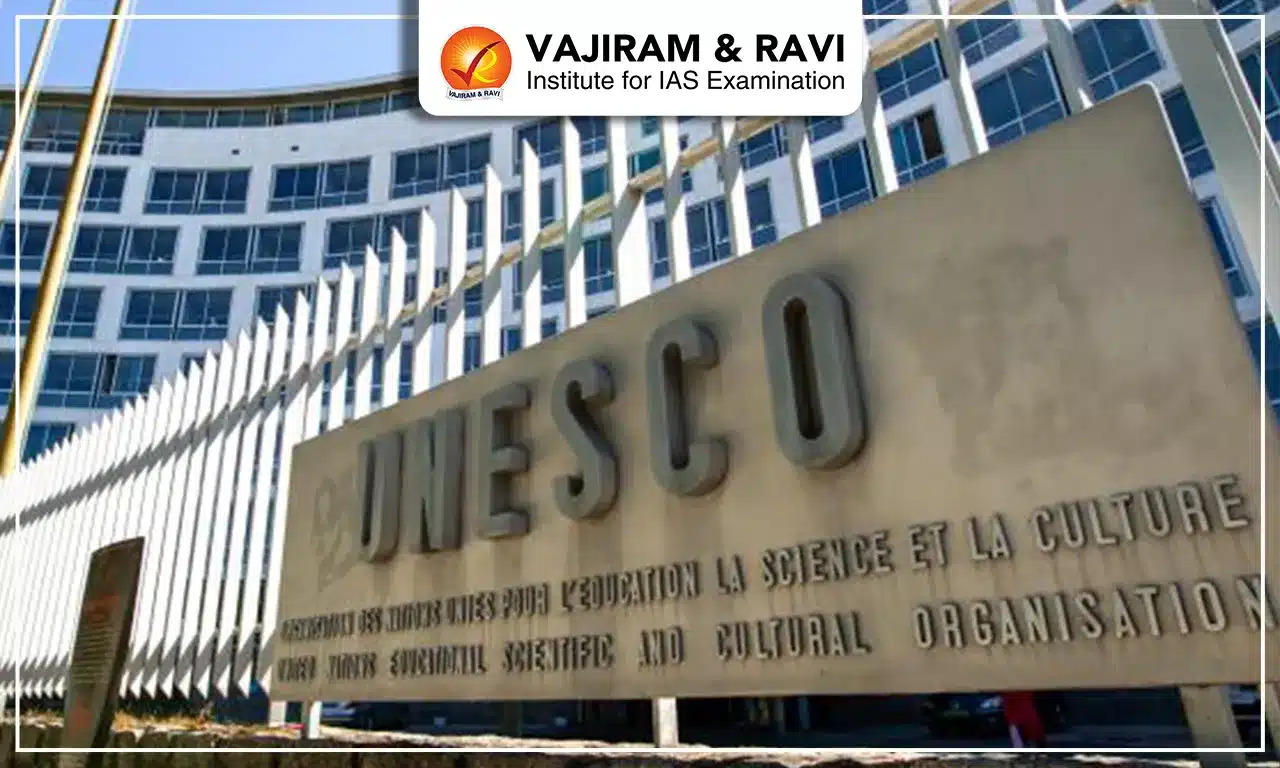
United Nations Educational Scientific and Cultural Organization (UNESCO) is a specialized agency of the United Nations that promotes international cooperation in education, science, culture, communication and information. It works to build peace, equality and sustainable development by sharing knowledge, protecting heritage, supporting quality education and addressing emerging global challenges.
About United Nations Educational Scientific and Cultural Organization (UNESCO)
- UNESCO stands for the United Nations Educational, Scientific and Cultural Organization. It is a specialised agency of the United Nations that promotes international cooperation in education, science, culture, communication and information.
- Promoting peace and cooperation: UNESCO works to strengthen international cooperation and contribute to peace by encouraging dialogue, mutual understanding, equality and respect for cultural diversity.
- Supporting sustainable development: Its work covers areas such as quality education, biodiversity, climate change, science, technology and artificial intelligence, with the aim of supporting sustainable and inclusive development.
- Protecting knowledge and heritage: UNESCO plays an important role in protecting cultural and natural heritage, promoting education and preserving knowledge and traditions for future generations.
- Promoting access to reliable information: It also works to strengthen freedom of expression, press freedom, media literacy and access to trustworthy information across societies.
UNESCO History and Formation
- Early International Cooperation: UNESCO’s roots can be traced to the International Committee on Intellectual Cooperation established under the League of Nations. It worked on areas such as universities, libraries, intellectual property, arts and information.
- Impact of World War II: The activities of these institutions were disrupted by the outbreak of the Second World War, creating the need for a new international organisation focused on education and culture.
- Conference of Allied Ministers of Education: During the war, the Conference of Allied Ministers of Education (CAME) met in London from 1942 to discuss plans for rebuilding education after the war.
- London Conference: On the proposal of CAME, the United Nations Conference for the establishment of an educational and cultural organisation was held in London in November 1945.
- Foundation of UNESCO: Representatives from 40 countries participated in the conference and UNESCO was formally established on 16 November 1945.
- Coming into Force: The UNESCO Constitution came into force on 4 November 1946 after ratification by 20 countries, including India, France, the United Kingdom, the United States and China.
- First General Conference: The first session of the UNESCO General Conference was held in Paris from 19 November to 10 December 1946, marking the beginning of its activities.


UNESCO Governance
- General Conference: It is UNESCO’s main decision-making body and consists of representatives of all Member States. It determines the organisation’s broad policies, programmes and budget.
- Executive Board: The Executive Board consists of elected Member States and works to implement the decisions of the General Conference while overseeing UNESCO’s programmes and activities.
- Secretariat: The Secretariat carries out the day-to-day work of UNESCO and implements the programmes and decisions approved by its governing bodies.
- Director-General: The Director-General heads the Secretariat and is responsible for the overall administration and implementation of UNESCO’s activities.
- National Commissions and field offices: UNESCO works through National Commissions, field offices, institutes and specialised centres to implement its programmes and strengthen cooperation among countries.
UNESCO World Heritage Sites
- World Heritage List: UNESCO maintains the World Heritage List of cultural, natural and mixed properties that have Outstanding Universal Value and deserve protection for future generations.
- Types of Heritage: The World Heritage List includes cultural properties, natural properties and mixed properties that represent important aspects of humanity’s cultural and natural heritage.
- World Heritage Convention: The protection of these sites is guided by the World Heritage Convention, which provides an international framework for identifying and conserving heritage of outstanding universal value.
- World Heritage Committee: The World Heritage Committee considers sites for inscription on the World Heritage List and monitors their conservation status.
- International Assistance: UNESCO also provides international assistance to support the conservation and management of heritage properties facing different challenges.
UNESCO Intangible Cultural Heritage
- Meaning: Intangible cultural heritage includes living cultural practices, traditions, knowledge and skills passed from one generation to another.
- Cultural Diversity: UNESCO works to safeguard traditional performances, handicrafts, festivals, knowledge systems and other cultural practices that reflect the diversity of communities.
- Safeguarding Heritage: The organisation implements the Convention for the Safeguarding of the Intangible Cultural Heritage to promote the protection and transmission of living traditions.
- India’s Intangible Heritage: India has several elements recognised by UNESCO under intangible cultural heritage, reflecting the country’s rich cultural diversity and traditional knowledge.
UNESCO Objectives and Functions
- Promoting quality education: UNESCO works to improve access to inclusive and quality education and supports global efforts under Education 2030 and Sustainable Development Goal 4.
- Supporting science and innovation: It promotes international cooperation in scientific research, technology and innovation to address global challenges and support sustainable development.
- Protecting the environment: UNESCO supports programmes related to water, oceans, biodiversity and climate change, encouraging scientific cooperation and sustainable management of natural resources.
- Promoting ethical use of technology: UNESCO works on emerging areas such as artificial intelligence, with a focus on ethical, inclusive and responsible use of technology.
- Preserving cultural heritage: It protects and promotes cultural and natural heritage, including World Heritage Sites, intangible cultural traditions and documentary heritage.
- Supporting freedom of expression: UNESCO promotes press freedom, safety of journalists, freedom of expression, the right to information and media and information literacy.
- Preserving documentary heritage: Through programmes such as Memory of the World, UNESCO works to protect important documentary heritage and make valuable knowledge accessible to future generations.
- Encouraging international knowledge sharing: UNESCO provides a platform for countries and institutions to exchange knowledge, research, experiences and best practices in education, science, culture and communication.
Major UNESCO Initiatives and Programmes
- Education 2030: This programme supports global efforts to achieve inclusive and equitable quality education and lifelong learning opportunities for all.
- Man and the Biosphere Programme (MAB): The MAB Programme promotes the conservation of biodiversity while supporting sustainable development through the Biosphere Reserve approach.
- International Hydrological Programme: It promotes international scientific cooperation in areas related to water resources, water management and hydrological research.
- Intergovernmental Oceanographic Commission: The programme supports international cooperation in ocean science, marine research and sustainable management of ocean resources.
- World Heritage Programme: It focuses on identifying, protecting and preserving sites of Outstanding Universal Value around the world.
- Memory of the World: This initiative aims to safeguard and improve access to the world’s important documentary heritage, including valuable manuscripts, archives and historical records.
Major Reports by UNESCO
- Global Reports: UNESCO publishes reports examining major global issues, challenges and policy responses across its areas of work.
- Global Education Monitoring Report: The GEM Report tracks progress in education, including learning outcomes, equity, financing and educational gaps, particularly in relation to SDG 4.
- UNESCO Science Report: The report examines trends in science, research, innovation and science policy across different countries and regions.
- Global Report on Cultural Policies: It highlights the role of culture in sustainable development and examines developments in cultural policies.
- State of the Education Report for India: This report focuses on important education-related issues in India, including areas such as climate change, artificial intelligence, teachers and vocational education.
- World Heritage Reports: UNESCO also publishes information and reports concerning heritage conservation, climate risks, biodiversity and the condition of World Heritage sites.
India and UNESCO
- Founding Member: India is among the founding members of UNESCO and participated in the organisation’s first General Conference in 1946.
- Active Participation: India has contributed to UNESCO’s work in areas such as education, cultural diversity, science and development policies.
- Permanent Delegation: India maintains a Permanent Delegation at UNESCO headquarters in Paris and participates in the organisation’s decision-making and programmes.
- World Heritage: India has several UNESCO-recognised cultural and natural heritage properties, including globally important monuments, landscapes and protected areas.
- Intangible Cultural Heritage: Several Indian traditions, performances, crafts, festivals and cultural practices have been recognised under UNESCO’s Intangible Cultural Heritage framework.
- Biosphere Reserves: Indian biosphere reserves are also represented in UNESCO’s World Network of Biosphere Reserves under the Man and the Biosphere Programme.
- Education Cooperation: UNESCO’s cooperation with India covers areas such as literacy, teacher education, ICT-enabled learning, inclusion and the Sustainable Development Goals.
- Communication and Information: Cooperation also extends to media development, freedom of expression, access to information and documentary heritage.
UNESCO World Heritage Sites in India
- UNESCO World Heritage Sites in India: India has 45 UNESCO World Heritage Sites recognised for their cultural, natural or mixed significance, reflecting the country’s diverse heritage and natural wealth.
- Cultural sites: Out of these, 36 sites are cultural, representing India’s rich history, architecture, traditions and artistic achievements.
- Natural sites: 7 sites are natural, highlighting India’s ecological diversity, unique landscapes, wildlife and important natural ecosystems.
- Mixed site: India also has 1 mixed World Heritage Site, recognised for both its cultural and natural significance.
- Major examples: Some notable Indian UNESCO World Heritage Sites include the Taj Mahal, Ajanta and Ellora Caves, Sun Temple at Konark, Kaziranga National Park and the Western Ghats.
- Significance for India: These sites showcase India’s historical legacy, architectural brilliance and ecological diversity, while also highlighting the importance of conserving its heritage for future generations.
- Global position: India ranks sixth globally in terms of the number of World Heritage Sites, reflecting its significant heritage wealth and efforts towards heritage conservation and preservation.

 Last updated on Sep, 2026
→ UPSC 2027 Notification will be released on 13 January 2027 at upsconline.nic.in.
→ Asian Games 2026 are being held in Aichi-Nagoya, Japan, from 19 September to 4 October.
→ Check out the latest UPSC Syllabus here.
→ Download UPSC Model Answers for Mains 2026
→ UPSC Mains Question Paper 2026 is out now for Essay & GS Paper 1, 2, 3 & 4.
→ UPSC Calendar 2027 has been released.
→ Enroll in Vajiram & Ravi’s UPSC Mains Test Series 2027 for structured answer writing practice, expert evaluation, and exam-oriented feedback.
→ Join Vajiram & Ravi’s UPSC Mentorship Program 2027 for personalized guidance, strategy planning, and one-to-one support from experienced mentors.
→ Go through the UPSC Mains Previous Year Papers to enhance your preparation.
→ UPSC has released UPSC Toppers List 2025 with the Civil Services final result on its official website.
→ Also check Best UPSC Coaching in India
United Nations Educational Scientific and Cultural Organization (UNESCO) FAQs
Q1. What is UNESCO?+
Q2. When was UNESCO established?+
Q3. Where is the headquarters of UNESCO located?+
Q4. What are the main functions of UNESCO?+
Q5. What are UNESCO World Heritage Sites?+
Q6. How many UNESCO World Heritage Sites are there in India?+
Q7. What is UNESCO Intangible Cultural Heritage?+
Q8. What is the role of India in UNESCO?+
Tags: unesco upsc current affairs