


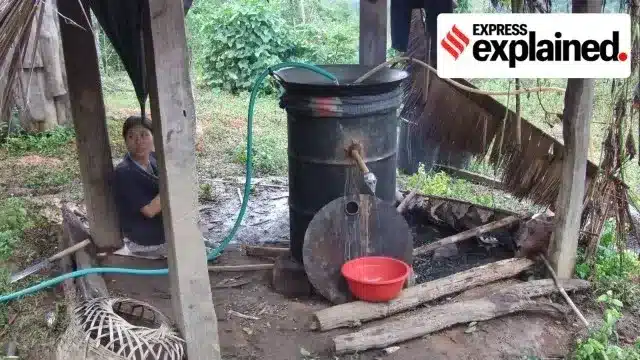
About Hooch
- It is a commonly used term for poor quality alcohol, derived from Hoochinoo, a native Alaskan tribe that was known to produce very strong liquor.
o Unlike branded liquor which is produced in factories with sophisticated equipment and rigorous quality control, hooch is made in much more crude settings.
How is Hooch produced?
- All alcohol is produced using two basic processes: fermentation and distillation.
- Fermentation: When heated, yeast reacts with sugar (from grain, fruits, sugarcane, etc.) to ferment and produce a mixture containing alcohol. This is an age-old process, used to create beverages like beer or wine.
- Limitation: As fermentation continues, and alcohol levels rise, conditions in the mixture become toxic for the yeast. Eventually, no more fermentation can take place. Thus, to make anything stronger (above 14-18% ABC), beverages need to be distilled.
- Distillation: This is the process of physically separating alcohol from a fermented mixture using evaporation and condensation.
- Since different parts of the mixture have different boiling points, heating it up to the correct temperature makes it possible to separate only the alcohol from the water and other remnants. Distilled beverages, or spirits, are far more potent than any fermented beverage.


Why can hooch be dangerous?
- The fermented mixture which is distilled contains more than just consumable alcohol (ethanol). It also contains methanol, an industrial alcohol which is highly toxic for human beings.
- Non-distilled alcoholic beverages like wine contain relatively harmless trace amounts of methanol. But during the distillation, both ethanol and methanol are concentrated. Thus, if done incorrectly, distillation can lead to an end product which contains high quantities of toxic methanol.
What are the effects of spurious liquor?
- Methanol or methyl alcohol can cause impaired vision, high toxicity and metabolic acidosis, a condition in which the body produces excessive acid that cannot be flushed out by kidneys.
- The treatment for this is to intravenously administer Fomepizole and ethanol. However, fomepizole can be expensive and unavailable in many parts of India.
- In such cases, doctors administer a mixture of ethanol and water (1:1 ratio).
- Ethanol inhibits methanol’s conversion into toxins and helps in flushing it out of the body either naturally or through dialysis.
Q1: What is yeast?
It is a living microorganism, which has been present in the world for hundreds of millions of years. It can also be used for beer, wine and other tasty foods thanks to its ability to enable natural fermentation.
Source: Indian Express

 Last updated on Sep, 2026
→ UPSC 2027 Notification will be released on 13 January 2027 at upsconline.nic.in.
→ Check out the latest UPSC Syllabus here.
→ Download UPSC Model Answers for Mains 2026
→ UPSC Mains Question Paper 2026 is out now for Essay & GS Paper 1, 2, 3 & 4.
→ UPSC Calendar 2027 has been released.
→ Enroll in Vajiram & Ravi’s UPSC Mains Test Series 2027 for structured answer writing practice, expert evaluation, and exam-oriented feedback.
→ Join Vajiram & Ravi’s UPSC Mentorship Program 2027 for personalized guidance, strategy planning, and one-to-one support from experienced mentors.
→ Go through the UPSC Mains Previous Year Papers to enhance your preparation.
→ UPSC has released UPSC Toppers List 2025 with the Civil Services final result on its official website.
→ Also check Best UPSC Coaching in India








