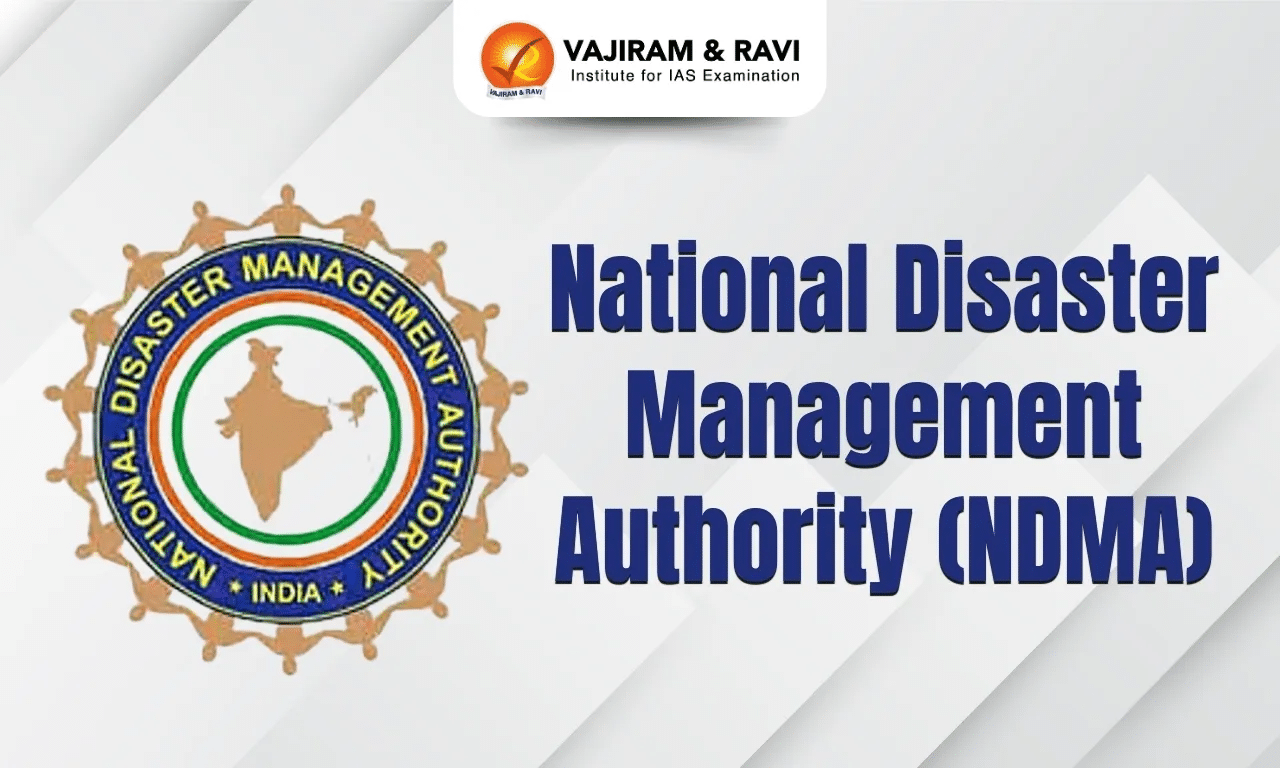
National Disaster Management Authority (NDMA) Latest News
Prime Minister Narendra Modi on August 29, 2025, nominated two people as new members of the National Disaster Management Authority (NDMA) and re-nominated three existing members for three years.
About National Disaster Management Authority (NDMA)
- Establishment: The NDMA, established under the Disaster Management Act, 2005, is the country’s apex body for disaster management and is chaired ex officio by the Prime Minister of India.
- Objectives: NDMA is responsible for laying down the national policies, plans, and guidelines for disaster management, coordinating and enforcing implementation of these policies, and approving plans developed by ministries, states, and other agencies to ensure integrated responses to disasters.
- Vision: NDMA’s vision is to build a safer and disaster-resilient India through proactive, technology-driven, and sustainable strategies involving all stakeholders.


NDMA Organisation Structure
- Composition: The NDMA is chaired by the Prime Minister of India, assisted by a Vice-Chairperson (Cabinet Minister rank) and up to eight Members (Minister of State rank).
- Divisions: It operates through specialized divisions, including Policy & Plans, Mitigation, Operations, Communications & IT, Administration, and Finance.
- Institutional Mechanism: At the state and district levels, State Disaster Management Authorities (SDMAs) and District Disaster Management Authorities (DDMAs) function under NDMA’s overall framework and guidelines.
NDMA Functions and Responsibilities
NDMA, as the apex body, is mandated to lay down the policies, plans and guidelines for Disaster Management to ensure timely and effective response to disasters. Towards this, it has the following responsibilities:-
- Laying down policies, approving the National Disaster Management Plan.
- Framing guidelines for central and state authorities, integrating mitigation measures into development plans.
- Coordinating the enforcement and implementation of disaster management policies and plans.
- Recommending provision of funds for mitigation efforts and capacity building.
- Supporting international disaster relief as directed by the central government.
- Overseeing the functioning of the National Institute of Disaster Management (NIDM).
- Training officials, conducting preparedness drills, and developing community resilience strategies.
Source: TH

 Last updated on Oct, 2026
→ UPSC 2027 Notification will be released on 13 January 2027 at upsconline.nic.in.
→ Asian Games 2026 are being held in Aichi-Nagoya, Japan, from 19 September to 4 October.
→ Check Nobel Prize 2026 Winners List here.
→ Download PIB PRiSM Monthly Magazine 2026 here.
→ Check UPSC Monthly Current Affairs Magazine The Recitals here.
→ Check out the latest UPSC Syllabus here.
→ Download UPSC Model Answers for Mains 2026
→ UPSC Mains Question Paper 2026 is out now for Essay & GS Paper 1, 2, 3 & 4.
→ UPSC Calendar 2027 has been released.
→ Enroll in Vajiram & Ravi’s UPSC Mains Test Series 2027 for structured answer writing practice, expert evaluation, and exam-oriented feedback.
→ Join Vajiram & Ravi’s UPSC Mentorship Program 2027 for personalized guidance, strategy planning, and one-to-one support from experienced mentors.
→ Go through the UPSC Mains Previous Year Papers to enhance your preparation.
→ UPSC has released UPSC Toppers List 2025 with the Civil Services final result on its official website.
→ Also check Best UPSC Coaching in India
National Disaster Management Authority (NDMA) FAQs
Q1. Who heads the National Disaster Management Authority in India?+
Q2. Under which Ministry is NDMA?+
Q3. What are the 12 natural disasters under NDMA?+
Q4. Where is the headquarter of NDMA?+
Tags: national disaster management authority prelims pointers upsc current affairs upsc prelims current affairs