FAO’s Technical Cooperation Programme Latest News
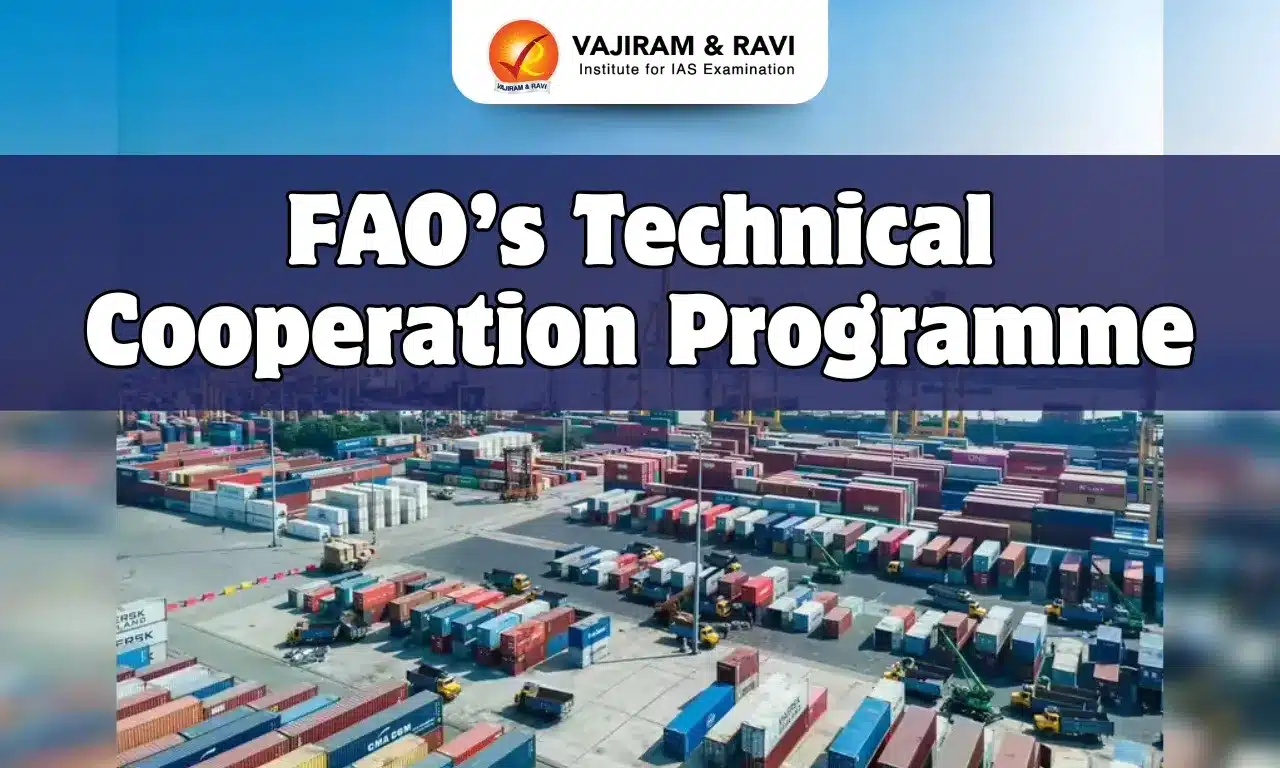
Recently, the Ministry of Fisheries, Animal Husbandry and Dairying has signed a Technical Cooperation Programme (TCP) agreement with the Food and Agriculture Organization (FAO) to strengthen Blue Port infrastructure in India.
About FAO’s Technical Cooperation Programme
- It was created to enable FAO to make its know-how and technical expertise available to member countries upon request.
- Purpose: To help countries improve their population’s food security and alleviate poverty with lasting impact.
- Goal: To assist in solving technical problems in crop production, livestock, fisheries and aquaculture, forestry, nutrition, food safety, rural development and other areas identified in the Country Programming Framework (CPF).
- Funding: The Technical Cooperation Programme is part of FAO’s Regular Programme budget. This means that TCP funds come directly from the dues paid by FAO members.
- The FAO’s TCP programme on ‘Strengthening of Blue Ports’ intends:
- To assist the GoI to strengthen the fishing ports’ technical capacities to address the main environmental, social and economic challenges that affect the aquatic value chain.
- Two pilot fishing ports Vanakbara (Diu) and Jakhau in Gujarat, will benefit from this TCP that will provide them with specific strategic and operational tools to identify and formulate investment projects.
Key Facts about Blue Ports framework
- Under framework, the DoF is leading the development of Smart and Integrated Fishing Harbours that combine technological innovation with environmental stewardship.
- Three pilot harbours namely Vanakbara (Diu), Karaikal (Puducherry), and Jakhau (Gujarat) have been approved.
- These modern harbours aim to revolutionize post-harvest fisheries infrastructure by Ensuring safer, cleaner, and more efficient operations for India’s fishing communities.
- It is supported under the Pradhan Mantri Matsya Sampada Yojana and it involves
- Integrates smart technologies: Such as IoT devices, sensor networks, satellite communication, and data analytics to streamline harbour operations and enable real-time decision-making.
- Eco-friendly features: Rainwater harvesting, energy-efficient lighting, electric-powered equipment, and robust waste management systems etc.
Source: PIB


 Last updated on Oct, 2026
→ UPSC 2027 Notification will be released on 13 January 2027 at upsconline.nic.in.
→ Asian Games 2026 are being held in Aichi-Nagoya, Japan, from 19 September to 4 October.
→ Check Nobel Prize 2026 Winners List here.
→ Download PIB PRiSM Monthly Magazine 2026 here.
→ Check UPSC Monthly Current Affairs Magazine The Recitals here.
→ Check out the latest UPSC Syllabus here.
→ Download UPSC Model Answers for Mains 2026
→ UPSC Mains Question Paper 2026 is out now for Essay & GS Paper 1, 2, 3 & 4.
→ UPSC Calendar 2027 has been released.
→ Enroll in Vajiram & Ravi’s UPSC Mains Test Series 2027 for structured answer writing practice, expert evaluation, and exam-oriented feedback.
→ Join Vajiram & Ravi’s UPSC Mentorship Program 2027 for personalized guidance, strategy planning, and one-to-one support from experienced mentors.
→ Go through the UPSC Mains Previous Year Papers to enhance your preparation.
→ UPSC has released UPSC Toppers List 2025 with the Civil Services final result on its official website.
→ Also check Best UPSC Coaching in India
FAO’s Technical Cooperation Programme FAQs
Q1. What is the technical cooperation program FAO?+
Q2. What is the Food and Agriculture Organisation (FAO)?+
Tags: prelims pointers upsc current affairs upsc prelims current affairs