Nobel Prize 2025 Latest News
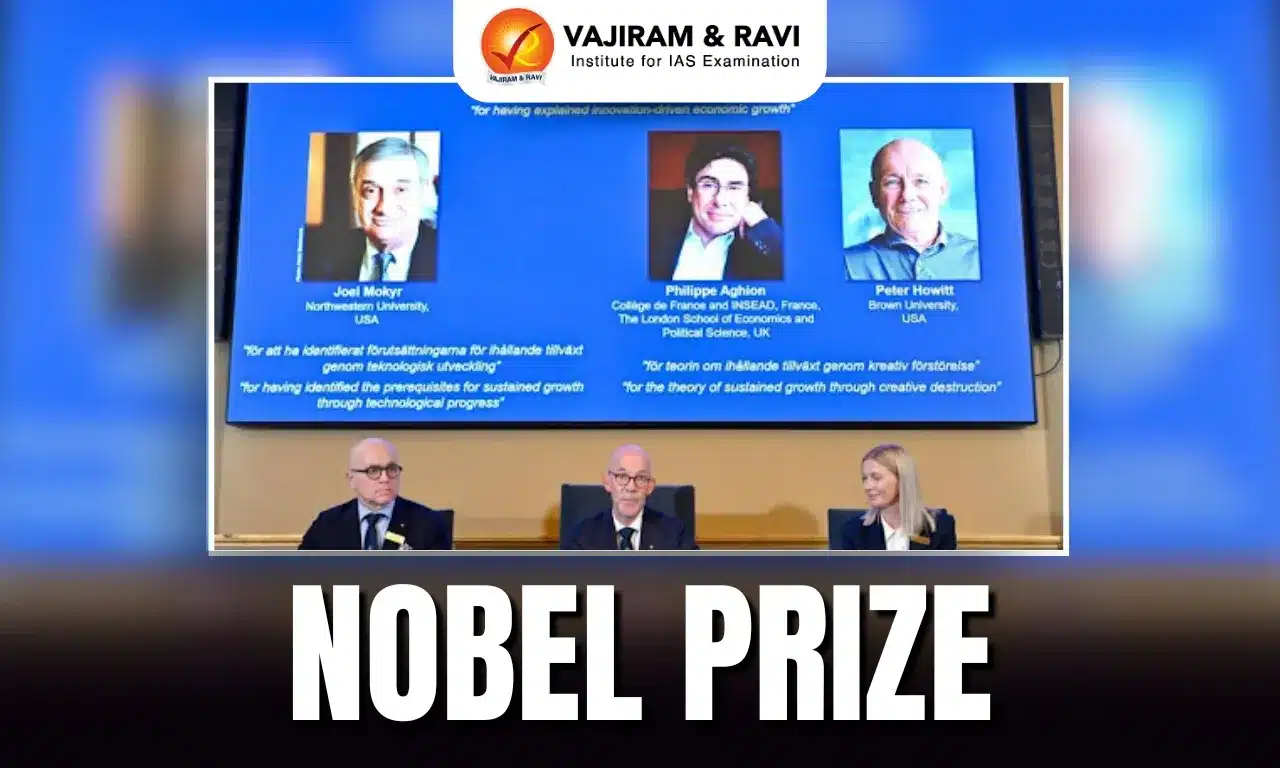
- The 2025 Nobel Prize in Economics has been awarded to Joel Mokyr, Philippe Aghion, and Peter Howitt for their pioneering work in explaining innovation-driven economic growth.
- The Royal Swedish Academy of Sciences announced that half the prize will go to Mokyr, with the remaining half shared by Aghion and Howitt.
- Their research highlights how technological progress and innovation act as key drivers of long-term prosperity.
2025 Economics Nobel Laureates: Pioneers of Innovation-Led Growth
- Joel Mokyr (Netherlands), Professor at Northwestern University, was recognised “for identifying the prerequisites for sustained growth through technological progress.”
- Philippe Aghion (France), Professor at Collège de France, INSEAD, and LSE, and Peter Howitt (Canada, 1946), Professor at Brown University, jointly received the other half of the prize “for the theory of sustained growth through creative destruction.”
- Their combined work has deepened global understanding of how innovation, knowledge, and competition fuel long-term economic prosperity.


Joel Mokyr’s Theory of “Useful Knowledge”
- Joel Mokyr’s research seeks to explain why global economic growth has accelerated and sustained over the past 200 years, breaking centuries of stagnation.
- His work, grounded in economic history, identifies how the systematic creation and application of knowledge triggered the Industrial Revolution and continues to sustain progress today.
The Concept of “Useful Knowledge”
- Mokyr proposed that sustained growth depends on a continuous flow of “useful knowledge”, which he divided into two interconnected parts:
- Propositional Knowledge: Understanding why things work — derived from scientific theories and natural observations.
- Prescriptive Knowledge: Knowing how things work — practical, reproducible instructions or “recipes” that enable implementation, such as technical drawings or process manuals.
- He argued that before the Industrial Revolution, innovators possessed ample propositional knowledge but lacked strong prescriptive knowledge, limiting their ability to apply scientific ideas to real-world production.
The Turning Point: Scientific Revolution and Reproducibility
- According to Mokyr, the transformation began in the 16th and 17th centuries, when scientists started to use precise measurements, controlled experiments, and reproducible results.
- This new scientific discipline created a feedback loop between theoretical understanding and practical application — a dynamic exchange that laid the foundation for continuous technological improvement.
From Theory to Application: Examples of “Useful Knowledge”
- Mokyr illustrated his theory with examples such as:
- The steam engine’s evolution, enabled by deeper insights into atmospheric pressure and vacuums.
- The advancement of steel production, made possible by understanding how oxygen reduces carbon content in molten iron.
- These innovations exemplify how tighter feedback between scientific discovery and practical engineering created self-sustaining progress, driving industrialisation and modern economic growth.
Policy Lessons from Joel Mokyr’s Work: Skills and Openness as Pillars of Sustained Growth
- Joel Mokyr’s research offers two key policy insights for achieving long-term, innovation-led economic growth.
- First, new ideas succeed only when supported by abundant practical, technical, and commercial skills.
- The policy takeaway is that governments must invest heavily in skilling and vocational training to transform innovation into sustained prosperity.
- Second, Mokyr emphasised that societies must remain open to change.
- Innovation inevitably creates winners and losers, and resistance from entrenched interests can stifle progress.
- Therefore, policymakers must foster a culture that embraces technological disruption and mitigates its social costs through inclusive, adaptive institutions.
Aghion and Howitt’s Theory of Creative Destruction: Modelling Innovation and Growth
- Economists Philippe Aghion and Peter Howitt built a mathematical model of “creative destruction”, explaining how innovation drives economic growth by continuously replacing old technologies and firms with new ones.
- Their model assumes that firms invest in research and development (R&D) to create new, patentable products, giving them temporary monopoly power.
- However, innovation is cumulative and competitive — a new firm can develop a better product that displaces the incumbent, shifting profits and market dominance to itself.
- This constant cycle of innovation and replacement fuels long-term economic growth, but also brings instability and structural change.
- Aghion and Howitt’s framework allows economists to study the optimal level of R&D investment in a free-market economy, balancing innovation incentives against the disruptions caused by technological progress.
Balancing Innovation and Efficiency: How Much Should Governments Subsidise R&D
- According to Philippe Aghion and Peter Howitt’s model of creative destruction, government support for research and development (R&D) requires a careful balance between encouraging innovation and avoiding inefficiency.
- On one hand, when new innovations replace old technologies, society continues to benefit from the older inventions even after their creators stop earning profits.
- This social spillover effect justifies public subsidies for R&D, ensuring firms remain motivated to innovate despite diminishing private returns.
- On the other hand, when an innovation offers only incremental improvements but yields disproportionately high monopoly profits for the innovating firm, excessive R&D spending can become socially inefficient.
- In such cases, subsidies may overstimulate research investment with limited societal gains.
- Thus, the optimal level of R&D support depends on the structure of each economy, the pace of technological change, and the extent of knowledge spillovers — a balance policymakers must strike to achieve sustained, innovation-driven growth.

 Last updated on August, 2026
→ UPSC Mains Question Paper 2026 is out now for Essay & GS Paper 1, 2, 3 & 4.
→ UPSC Mains GS Paper 1 2026 is out now.
→ UPSC Mains GS Paper 2 2026 is out now.
→ UPSC Mains GS Paper 3 2026 is out now.
→ UPSC Mains GS Paper 4 2026 is out now.
→ UPSC Mains Indian Language Paper & English Compulsory Paper are out now.
→ Check out the latest UPSC Syllabus 2026 here.
→ UPSC Mains Admit Card 2026 is now out.
→ Enroll in Vajiram & Ravi’s UPSC Mains Test Series 2027 for structured answer writing practice, expert evaluation, and exam-oriented feedback.
→ Join Vajiram & Ravi’s UPSC Mentorship Program 2027 for personalized guidance, strategy planning, and one-to-one support from experienced mentors.
→ Go through the UPSC Mains Previous Year Papers to enhance your preparation.
→ Download UPSC Mains Essay Paper 2025, UPSC Mains GS Paper-I 2025, UPSC Mains GS Paper-II 2025, UPSC Mains GS Paper-III 2025, UPSC Mains GS Paper-IV 2025, UPSC Mains English (Compulsory) Paper 2025, UPSC Mains Hindi (Qualifying) Paper 2025 here.
→ UPSC has released UPSC Toppers List 2025 with the Civil Services final result on its official website.
→ UPSC Calendar 2027 has been released.
→ Also check Best UPSC Coaching in India
Nobel Prize 2025 FAQs
Q1. Who won the 2025 Nobel Prize in Economics?+
Q2. What is Joel Mokyr’s key contribution?+
Q3. What theory did Aghion and Howitt develop?+
Q4. What policy lessons emerge from Mokyr’s work?+
Q5. Should R&D be subsidised according to Aghion and Howitt?+
Tags: mains articles Nobel Prize 2025 upsc current affairs upsc mains current affairs