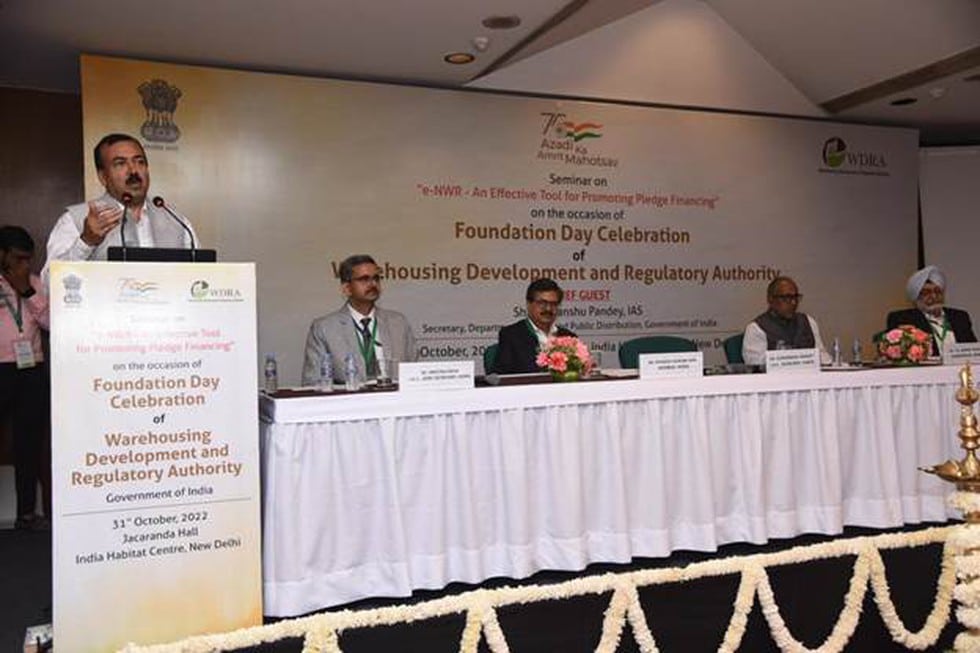
About Warehousing and Electronic Negotiable Warehouse Receipt (e-NWR):
- The negotiable warehouse receipt (NWR) system was launched in 2011 allowing the transfer of ownership of a commodity stored in a warehouse without having to deliver it physically.
- These receipts are issued in negotiable form, making them eligible as collateral.
- This has been enabled by enabling the financing of warehouse receipts through the Warehouse (Development and Regulation) Act, 2007.
- The Warehousing Development and Regulatory Authority (WDRA) regulates the entire operation under NWR.
Salient features of e-NWR:
- An e-NWR is available only in electronic form.
- The single source of information for the e-NWR is the repository system where e-NWR is issued by registered warehouses.
- Confidentiality, integrity and availability of the e-NWR information is provided by the Repository system.
- An e-NWR has time validity.
- All e-NWRS can be traded through off-market or on-market in Commodity Exchanges platforms.
- An e-NWR can be auctioned under certain conditions such as loan not repaid, on expiry and delivery not taken, and on likely damage or spoilage of the commodity in the warehouse.
- e-NWR can be transferred fully or in part.


Benefits:
- Electronic-Negotiable Warehouse Receipt (e-NWR) will help farmers/FPOs to have access to a large number of buyers across the country.
- It will help them get better bargaining powers and realise higher prices by selling graded produce.
- It will provide them with the facility to get their prices quoted and receive immediate payment, besides avoiding distress sales by helping them get loans from banks against warehouse receipts.
Warehousing Development and Regulatory Authority (WDRA):
- WDRA was constituted in 2010 under the Warehousing (Development and Regulation) Act, 2007.
- It is under the Department of Food and Public Distribution (DFPD).
Source: PIB

 Last updated on Oct, 2026
→ UPSC 2027 Notification will be released on 13 January 2027 at upsconline.nic.in.
→ Asian Games 2026 are being held in Aichi-Nagoya, Japan, from 19 September to 4 October.
→ Check Nobel Prize 2026 Winners List here.
→ Download PIB PRiSM Monthly Magazine 2026 here.
→ Check UPSC Monthly Current Affairs Magazine The Recitals here.
→ Check out the latest UPSC Syllabus here.
→ Download UPSC Model Answers for Mains 2026
→ UPSC Mains Question Paper 2026 is out now for Essay & GS Paper 1, 2, 3 & 4.
→ UPSC Calendar 2027 has been released.
→ Enroll in Vajiram & Ravi’s UPSC Mains Test Series 2027 for structured answer writing practice, expert evaluation, and exam-oriented feedback.
→ Join Vajiram & Ravi’s UPSC Mentorship Program 2027 for personalized guidance, strategy planning, and one-to-one support from experienced mentors.
→ Go through the UPSC Mains Previous Year Papers to enhance your preparation.
→ UPSC has released UPSC Toppers List 2025 with the Civil Services final result on its official website.
→ Also check Best UPSC Coaching in India