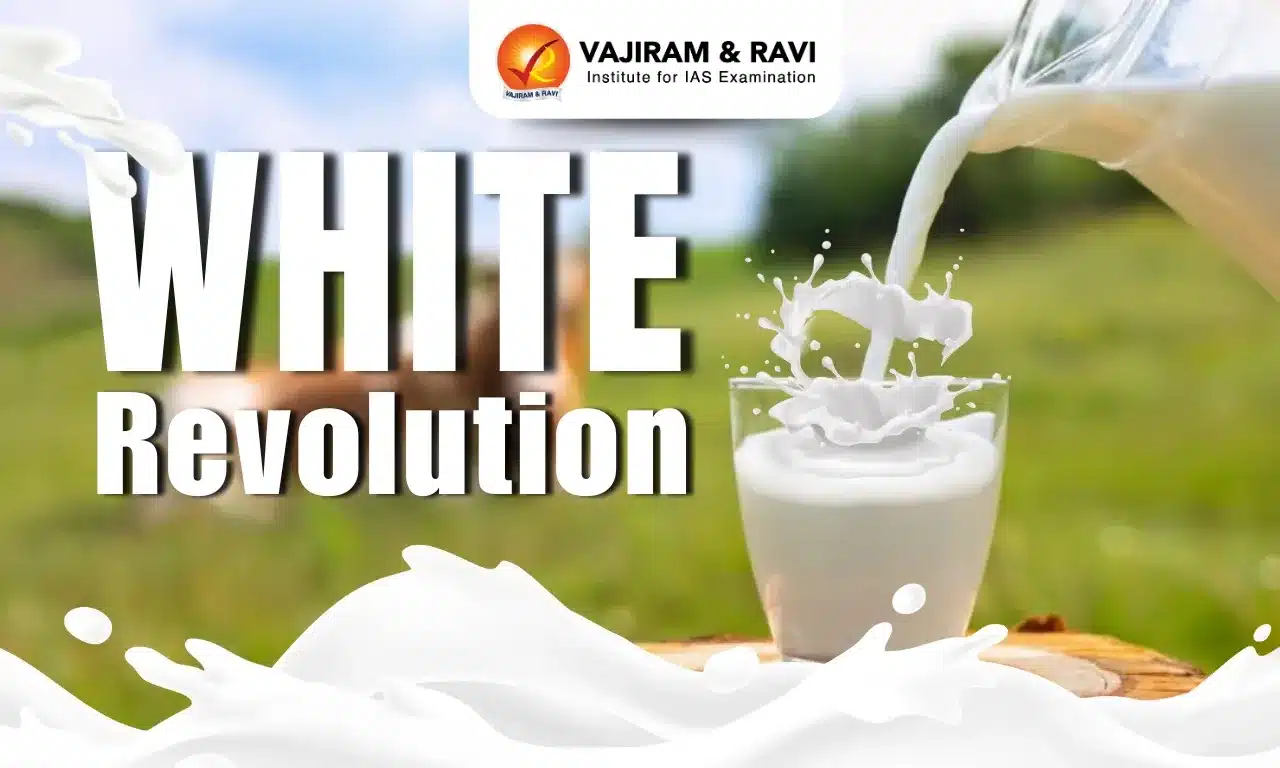
White Revolution was initiated in India during 1970 when the National Dairy Development Board (NDDB) introduced several developments through the “Operation Flood” so as to increase the production of Milk and Dairy. The revolution was carried under the leadership of Professor Verghese Kurien, who is referred to as the Father of White Revolution in India.
White Revolution
During 1951-52, India produced only 17 tonnes of Milk, which marked the dairy production as the highly concerned area. To address this issue, the National Dairy Development Board was set up in 1965 with Prof. V. Kurien as the chairman of the organization appointed by the Prime Minister Shastri. The Revolution along with several operations led to transforming India as one of the largest producers of Milk globally.
Also Read: Blue Revolution
Operation Flood
Operation Flood was the programme that led to the major contribution for White Revolution in India. It was launched in 1970 by NDDB led by Kurien to increase the production of milk by focusing on the high yield, reasonable price for the consumers, while ensuring the producers to get fair profit without including middlemen in the process of distribution. It created a massive link between the Rural Producers and Urban Consumers. The Operation was carried under three phases:
- Phase I: 1970-80: Improved organized dairy sector established in metropolitan cities like Mumbai, Chennai, Delhi, etc and focussed on developments of dairy in the rural areas.
- Phase II: 1981-85: Increase in the number of- Milk Sheds (136), Urban Outlets (290) and covering more than 42 lakhs of producers.
- Phase III: 1985-96: Strengthened the infrastructure leading to the production of large scale milk and emphasized research & development and healthcare through veterinary services.


White Revolution Objectives
The White Revolution has the major aim as given below:
- Increasing the production of Milk and transforming India from Milk Deficit Country to a Top Producer Globally.
- Setting Up Milk Sheds, Urban Outlets by connecting the rural and urban population directly by eliminating the middlemen.
- Emphasize on Veterinary Health, First Aid, Artificial Insemination, and other facilities so as to improve the cattle breed.
- Development of Chilling Centres to store milk after collecting from the producers before distribution to the urban areas along with the facility of transportation.
- Focus on the supply of Milk as well as Dairy Products to the consumers.
- Providing Cattle Feed to the Rural Producers.
Also Read: Golden Revolution
White Revolution Significance
The White Revolution has contributed to the robust change of the image of India in the field of production of Milk and Dairy in the World. The significance of the revolution can be highlighted below:
- Milk Production: India has ranked top in the Production of Milk by producing 231 million tonnes during 2022-23. As per the report published by Basic Animal Husbandry Statistic 2023, the States- Uttar Pradesh, Rajasthan, Madhya Pradesh, Gujarat and Andhra Pradesh have together contributed to 53.08% of the total Milk Production.
- Employment Generation: The operation has set up various Milk Sheds, Chilling Centres, and focussed on other activities (transportation, veterinary healthcare, etc.); this leads to the generation of various jobs at multiple levels. As per data, the dairy industries provide employment to over 8.5 crore people.
- Woman Empowerment: The operation incorporated women in the activities highlighting growth of females in the economic, social and communal terms. This assisted many women through means of livelihood and status in the society. The
- Rural Development: The revolution has helped many rural producers by providing support in the distribution of milk, reducing the cost of transportation. It supported the rural households by providing job opportunities in the dairy sector.
- Other: Few other importance of the White Revolution can be seen through-
-
- Role in the Alleviation of Poverty (specifically rural)
- Helped in Combating Malnutrition through increased milk production
- Development of the Agriculture sector for Cattle Feed
White Revolution Challenges
Despite several advancements and achievements in the terms of production and distribution of Milk and Dairy Products, India is facing several issues at the present time such as:
- The Rate of Production of Milk has eventually decreased from 6.47% in 2018-19 to 3.83% in 2022-23.
- Two-third of the marketed milk is under the unorganized sector, which is about 63% of the total production, as remaining stock is kept by the producer for their personal consumption.
- In spite of high yield, the price of Milk has been increased per litre from 42 to 60, making it unaffordable to most consumers.
- 32% of the Human Caused Methane Emission is due to the livestock feed (manure) and gastroenteric release, major issue for Global Warming.
- Uneven yield of Milk particularly due to Cross Breed (8.55 kg/animal/day) and Indigenous Breed (3.44 kg/animal/day).
- Disparity of the production of Milk in the North and Eastern states, eg: Punjab yields 13.49 kg/ animal/ day whereas West Bengal yields 6.30 kg/ animal/ day.
- The focus on the Cross Breed or Exotic Breeds have increased the production of milk but it is leading to the decline in the number of indigenous breed which are more suitable for the local environment.
Also Read: Pink Revolution
White Revolution 2.0
To address the above listed challenges, the Ministry of Cooperation has brought the Standard Operating Procedures (SOPs) for the White Revolution 2.0. The Revolution Phase 2.0 majorly focuses on the production of Milk along with the contribution of Women Farmers, and by strengthening the infrastructure & increased export. It has targeted the procurement of Milk to 100 million kilograms within 5 years of initiating. It aims to improve the breed by Genetic Modification, Embryo Transfer and Artificial Insemination, etc. which will eventually reduce the input cost and maximize the production.
White Revolution UPSC
The White Revolution has shown a great result in the earlier phases making India the top producer of Milk among others. However the present situation faces multiple issues that can be tackled by the proper implementation of the regulations as created through the White Revolution 2.0 Margdarshika SOPs. The Programme also helps in addressing issues such as Malnutrition, Unemployment, Rural Development, Inflation, etc by sustainable development and process. It aims to increase the rate of National Per Capita Availability (current 459 grams per day).

 Last updated on Sep, 2026
→ UPSC 2027 Notification will be released on 13 January 2027 at upsconline.nic.in.
→ Asian Games 2026 are being held in Aichi-Nagoya, Japan, from 19 September to 4 October.
→ Check out the latest UPSC Syllabus here.
→ Download UPSC Model Answers for Mains 2026
→ UPSC Mains Question Paper 2026 is out now for Essay & GS Paper 1, 2, 3 & 4.
→ UPSC Calendar 2027 has been released.
→ Enroll in Vajiram & Ravi’s UPSC Mains Test Series 2027 for structured answer writing practice, expert evaluation, and exam-oriented feedback.
→ Join Vajiram & Ravi’s UPSC Mentorship Program 2027 for personalized guidance, strategy planning, and one-to-one support from experienced mentors.
→ Go through the UPSC Mains Previous Year Papers to enhance your preparation.
→ UPSC has released UPSC Toppers List 2025 with the Civil Services final result on its official website.
→ Also check Best UPSC Coaching in India
White Revolution FAQs
Q1. What was the need for White Revolution?+
Q2. What are the major organizations under White Revolution 2.0?+
Q3. Which Country is the Largest Producer of Milk?+
Q4. Who is the Father of White Revolution?+
Q5. What is the objective of White Revolution 2.0?+
Tags: white revolution