Ramban Sulai Honey Latest News
The Prime Minister, during the 128th episode of his radio programme ‘Mann Ki Baat’ noted that Ramban Sulai honey from Jammu and Kashmir, made from wild basil, gained wider recognition after receiving a GI tag.
About Ramban Sulai Honey
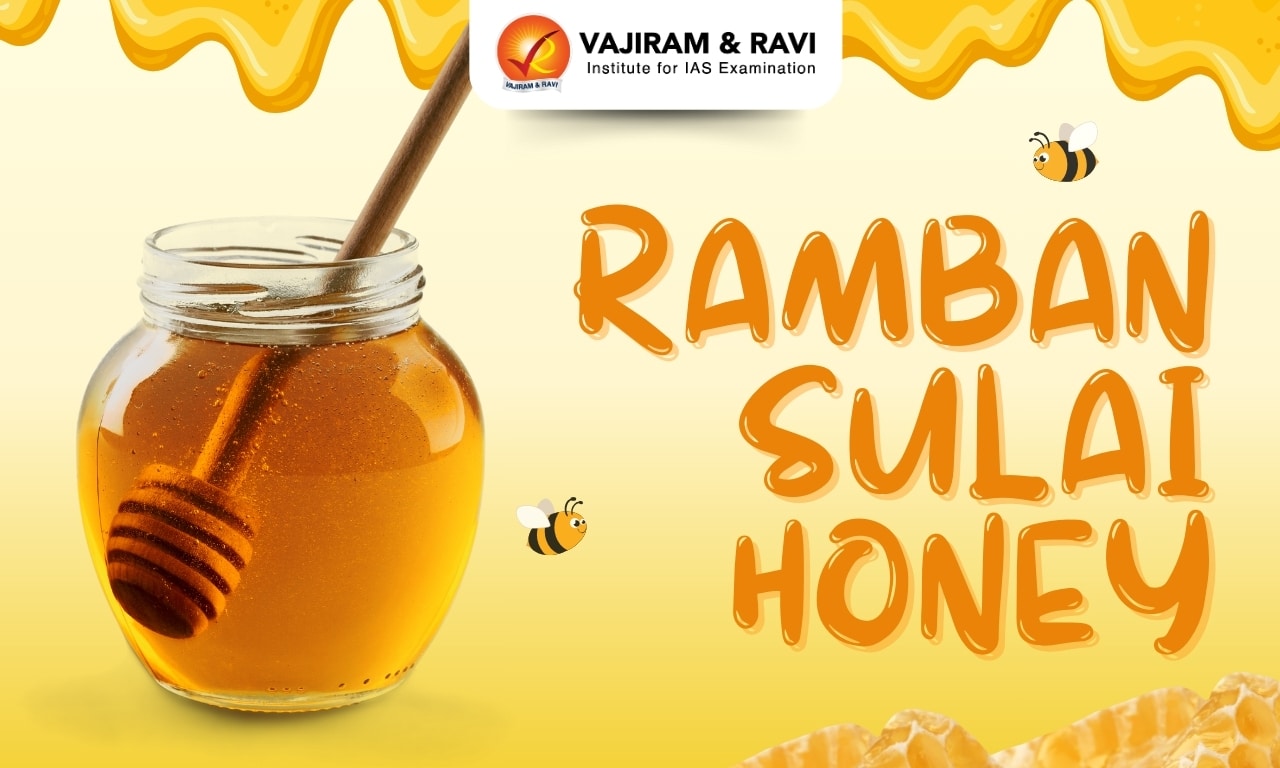
- Ramban Sulai Honey, produced in the Ramban District of Jammu and Kashmir, is known for its rich taste, aromatic floral undertones, and high nutritional value.
- Extracted from Sulai plants growing in the Himalayas, it is prized for its medicinal properties and purity.
- The bees forage on the nectar of snow-white blossoms of Sulai during the months of August to October to produce this well-rounded, naturally sweet honey with floral undertones.
- This crystal-clear honey, ranging from white to amber, contains essential minerals, enzymes, and vitamins that enhance its health benefits.
- Due to superior bee strains and favourable climatic conditions, the honey yield in Ramban is significantly higher than in other regions.
- It earned a Geographical Indication (GI) tag in 2021.
- The Government of India declared Ramban Sulai Honey as the district’s “One District, One Product.”


What is a Geographical Indication (GI) Tag?
- A geographical indication, or GI, is a sign used on products that have a specific geographical origin and possess qualities or a reputation that are due to that origin.
- It highlights the unique qualities, reputation, or characteristics that are tied to that region.
- GIs are recognized as an aspect of intellectual property rights (IPRs) under the Paris Convention for the Protection of Industrial Property and the Trade-Related Aspects of Intellectual Property Rights (TRIPS) Agreement.
- The Geographical Indications of Goods (Registration and Protection) Act, 1999, is the main law in India that oversees the registration and protection of geographical indications.
- This act prohibits the use of GI-tagged products and their names without authorization.
- GIs are protected for 10 years and can be renewed forever.
- Examples of GI-tagged items in India include Darjeeling Tea, Mysore Silk, and Kashmiri Saffron.
Source: DDN

 Last updated on Oct, 2026
→ UPSC 2027 Notification will be released on 13 January 2027 at upsconline.nic.in.
→ Check Nobel Prize 2026 Winners List here.
→ Download PIB PRiSM Monthly Magazine 2026 here.
→ Check UPSC Monthly Current Affairs Magazine The Recitals here.
→ Check out the latest UPSC Syllabus here.
→ Download UPSC Model Answers for Mains 2026
→ UPSC Mains Question Paper 2026 is out now for Essay & GS Paper 1, 2, 3 & 4.
→ UPSC Calendar 2027 has been released.
→ Enroll in Vajiram & Ravi’s UPSC Mains Test Series 2027 for structured answer writing practice, expert evaluation, and exam-oriented feedback.
→ Join Vajiram & Ravi’s UPSC Mentorship Program 2027 for personalized guidance, strategy planning, and one-to-one support from experienced mentors.
→ Go through the UPSC Mains Previous Year Papers to enhance your preparation.
→ UPSC has released UPSC Toppers List 2025 with the Civil Services final result on its official website.
→ Also check Best UPSC Coaching in India
Ramban Sulai Honey FAQs
Q1. Ramban Sulai Honey is primarily produced in which region of India?+
Q2. From which plant do bees collect nectar to produce Ramban Sulai Honey?+
Q3. Ramban Sulai Honey earned the Geographical Indication (GI) tag in which year?+
Q4. During which months do Sulai plants bloom, enabling honey production in the Ramban region?+
Tags: prelims pointers ramban sulai honey upsc current affairs upsc prelims current affairs