El Nino Latest News
There is a chance that the El Nino phenomenon may occur after July this year, but clarity will only emerge in April, according to the director-general of the India Meteorological Department (IMD).
Normal Climatic Conditions
- In “neutral” conditions, surface water in the Pacific Ocean is cooler in the east and warmer in the west.
- The “trade winds” tend to blow east-to-west, taking warm water from South America towards Asia.
- To replace that warm water, cold water rises from the depths — a process called upwelling.


What is El Niño-Southern Oscillation (ENSO)?
- El Niño and La Niña are two opposing climate patterns that break normal climatic conditions.
- Scientists call these phenomena the El Niño-Southern Oscillation (ENSO) cycle.
- El Niño and La Niña can both have global impacts on weather, wildfires, ecosystems, and economies.
- Episodes of El Niño and La Niña typically last nine to 12 months but can sometimes last for years.
- El Niño and La Niña events occur every two to seven years, on average, but they don’t occur on a regular schedule.
- Generally, El Niño occurs more frequently than La Niña.
What is El Nino?
- El Niño is a climate pattern that describes the unusual warming of surface waters in the eastern tropical Pacific Ocean.
- El Niño is the “warm phase” of the ENSO.
- During El Niño, surface temperatures in the equatorial Pacific rise, and trade winds — east-west winds that blow near the Equator — weaken.
- They falter and change direction to turn into westerlies, bringing warm water from the western Pacific towards the Americas.
- The phenomena of upwelling is reduced under El Niño.
- This in turn reduces phytoplankton. Thus, fish that eat phytoplankton are affected, followed by other organisms higher up the food chain.
- Warm waters also carry tropical species towards colder areas, disrupting multiple ecosystems.
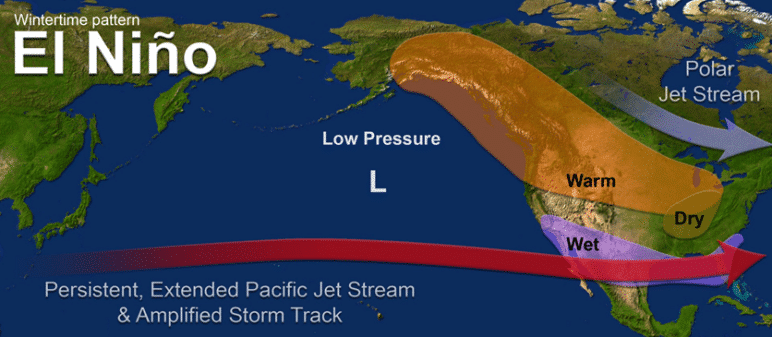
- Since the Pacific covers almost one-third of the earth, changes in its temperature and subsequent alteration of wind patterns disrupt global weather patterns.
- El Niño causes dry, warm winters in the Northern U.S. and Canada and increases the risk of flooding in the U.S. gulf coast and south-eastern U.S.
- It also brings drought to Indonesia and Australia.
What is La Nina?
- La Niña, the “cool phase” of ENSO, sees cooler than average sea surface temperature (SST) in the equatorial Pacific region.
- Trade winds are stronger than usual, pushing warmer water towards Asia.
- On the American west coast, upwelling increases, bringing nutrient-rich water to the surface.
- Pacific cold waters close to the Americas push jet streams — narrow bands of strong winds in the upper atmosphere — northwards.
- Impacts:
- This leads to drier conditions in the Southern U.S., and heavy rainfall in Canada.
- La Niña has also been associated with heavy floods in Australia.
Impact on India’s monsoons
In India, El Niño causes weak rainfall and more heat, while La Niña intensifies rainfall across South Asia, particularly in India’s northwest and Bangladesh during the monsoon.
Source: TH

 Last updated on Sep, 2026
→ UPSC 2027 Notification will be released on 13 January 2027 at upsconline.nic.in.
→ Asian Games 2026 are being held in Aichi-Nagoya, Japan, from 19 September to 4 October.
→ Check out the latest UPSC Syllabus here.
→ Download UPSC Model Answers for Mains 2026
→ UPSC Mains Question Paper 2026 is out now for Essay & GS Paper 1, 2, 3 & 4.
→ UPSC Calendar 2027 has been released.
→ Enroll in Vajiram & Ravi’s UPSC Mains Test Series 2027 for structured answer writing practice, expert evaluation, and exam-oriented feedback.
→ Join Vajiram & Ravi’s UPSC Mentorship Program 2027 for personalized guidance, strategy planning, and one-to-one support from experienced mentors.
→ Go through the UPSC Mains Previous Year Papers to enhance your preparation.
→ UPSC has released UPSC Toppers List 2025 with the Civil Services final result on its official website.
→ Also check Best UPSC Coaching in India
El Nino FAQs
Q1. What is El Niño?+
Q2. El Niño represents which phase of El Niño-Southern Oscillation (ENSO)?+
Q3. How do trade winds behave during an El Niño event?+
Q4. What is the effect of weakened trade winds on ocean water movement during El Niño event?+
Q5. How does El Niño affect upwelling in the eastern Pacific?+
Tags: el nino prelims pointers upsc current affairs upsc prelims current affairs