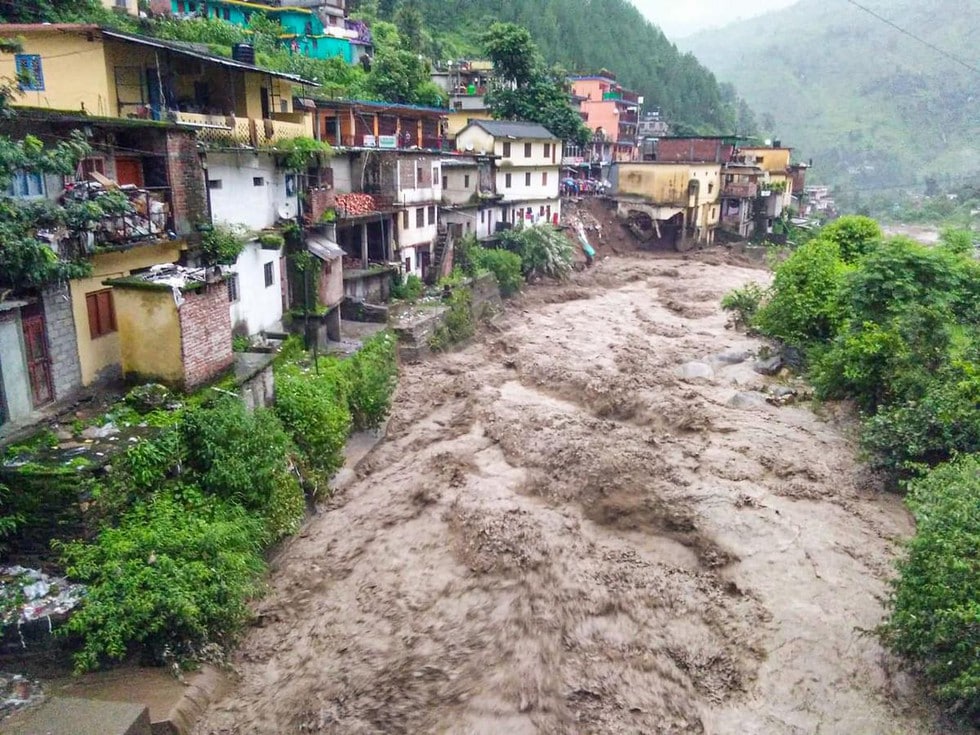
About CSIR-NGRI’s Early Warning System:
- The scientists in the institute have identified a few locations in the higher reaches of Uttarakhand for “densification” of seismometers and river gauges to take the total number to 100 from 60.
- The objective is to closely monitor the river flows in specific areas along the catchment to detect any sudden rise in water levels or flooding threshold that can lead to a hazard.
- Scientists have decided to take cognisance of the vibrations or “noise” recorded by the seismometers, which need not be due to earthquakes but can also be because of vehicular traffic, animal movement, rain, river flows and so on.
- These instruments are crucial for the safety of large infrastructure projects and hydroelectric power plants in this region.
- Currently, scientists are able to detect and assess a sudden flow 30-40 km away since the seismic wave is faster than the flow, and hence, the advance warning comes at least half an hour before.
- The NGRI has started utilising Machine Learning to detect these observations faster than the normal approach.
Initiative by Geological Survey of India (GSI):
- Scientists at the Geological Survey of India (GSI), a scientific agency established under the Ministry of Mines to conduct geological surveys and studies of India, in collaboration with the British Geological Survey, have been evaluating a prototype to predict landslides in the Darjeeling district of West Bengal and the Nilgiris in Tamil Nadu.
- If the model proves successful, it is likely to be deployed in some parts of India as early as 2025.
Early warning systems:
- Early warning systems have been recognized as an effective tool to reduce vulnerabilities and improve preparedness and response to hazards, according to the United Nations Development Programme.
- The Sendai Framework for Disaster Risk Reduction (2015–2030), an international document adopted by United Nations (UN) member states in 2015, requires countries to set out an early warning system with a multi-hazard approach by 2030.
Source : The Hindu


 Last updated on Oct, 2026
→ UPSC 2027 Notification will be released on 13 January 2027 at upsconline.nic.in.
→ Check Nobel Prize 2026 Winners List here.
→ Download PIB PRiSM Monthly Magazine 2026 here.
→ Check UPSC Monthly Current Affairs Magazine The Recitals here.
→ Check out the latest UPSC Syllabus here.
→ Download UPSC Model Answers for Mains 2026
→ UPSC Mains Question Paper 2026 is out now for Essay & GS Paper 1, 2, 3 & 4.
→ UPSC Calendar 2027 has been released.
→ Enroll in Vajiram & Ravi’s UPSC Mains Test Series 2027 for structured answer writing practice, expert evaluation, and exam-oriented feedback.
→ Join Vajiram & Ravi’s UPSC Mentorship Program 2027 for personalized guidance, strategy planning, and one-to-one support from experienced mentors.
→ Go through the UPSC Mains Previous Year Papers to enhance your preparation.
→ UPSC has released UPSC Toppers List 2025 with the Civil Services final result on its official website.
→ Also check Best UPSC Coaching in India