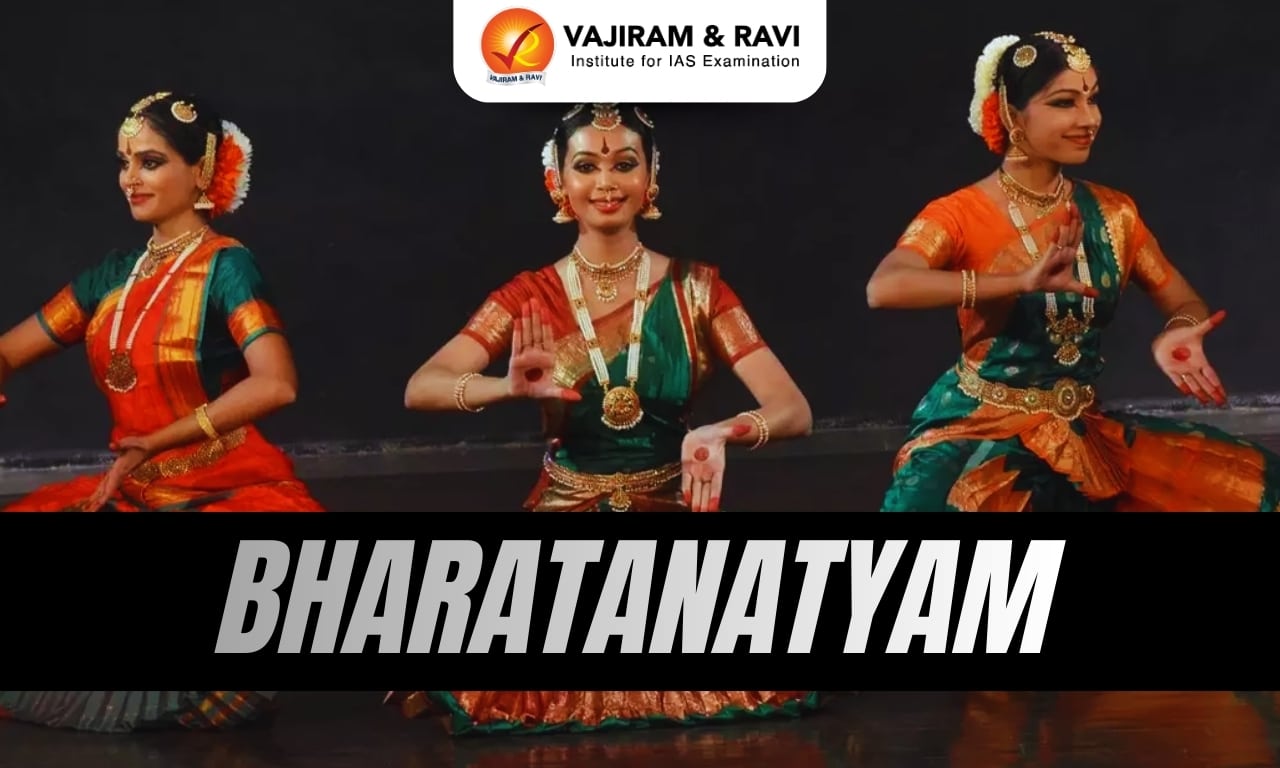
Bharatanatyam is one of the oldest classical dance forms of India, originating in the state of Tamil Nadu. It is known for its graceful movements, fixed upper body, bent legs, expressive hand gestures, and powerful facial expressions. Traditionally performed in temples, Bharatanatyam combines dance, music, devotion, and storytelling into a single artistic expression.
Bharatanatyam Historical Evolution
The historical evolution of Bharatanatyam spans over 2,000 years, making it one of the most ancient living art forms. It developed from temple traditions and was initially known as Sadir Attam. Over time, it evolved through royal patronage, social reforms, and modern revival.
- Bharatanatyam was originally nurtured in temples of South India as a sacred art form.
- It was performed by Devadasis, who were women dedicated to temple service and worship of the deity.
- Dance was considered a medium of devotion, storytelling, and ritual expression.
- The Chola and Pallava kings were among the greatest patrons of this dance form.
- Bharatanatyam draws strong inspiration from Shaivite traditions.
- Many dance postures are reflected in ancient Shiva sculptures found in Hindu temples.
- The depiction of Nataraja (dancing Shiva) symbolizes cosmic rhythm and balance.
- Cave 1 of the Badami Cave Temples (7th century) shows Shiva performing the Tandava, closely resembling Bharatanatyam poses.
Also Read: Folk Dances of India
Elements of Bharatnatyam
Bharatanatyam is built on a well-defined and systematic framework that combines rhythm, movement, expression, and music. Each element plays an important role in conveying emotions, stories, and spiritual ideas. Together, these elements create a balanced and complete classical dance performance.
Elements of Bharatanatyam:
- Nritta – Pure dance movements performed without expression, focusing on rhythm, posture, and technique.
- Nritya – Expressive dance that combines movements with emotions and meaning.
- Natya – Dramatic storytelling through dance, often depicting mythological themes.
- Bhava – Expression of emotions such as love, devotion, anger, and compassion.
- Raga – The melodic framework of the accompanying music.
- Tala – The rhythmic cycle that guides footwork and movements.
- Abhinaya – The art of expression using facial movements, eyes, hand gestures, and body language.
- Mudras (Hastas) – Symbolic hand gestures used to communicate ideas and narratives.


Bharatanatyam in Ancient Texts and Inscriptions
- Natya Shastra (Bharata Muni, 200 BCE-200 CE) outlines Tandava, Rasa, Bhava, Abhinaya, Mudras, and 108 fundamental dance poses (Karanas).
- Abhinaya Darpana (Nandikesvara, 4th-5th century BCE) details techniques of gestures, body movements, and facial expressions.
- Tamil epics like Silappatikaram and Manimegalai describe training and performances of Sadir/Devadasi dancers.
- Chidambaram Temple (12th century) gopuram features 108 karana sculptures reflecting Natya Shastra.
- Badami, Kanchipuram, and Thanjavur temples showcase sculptures of dance poses, mudras, and Nataraja (cosmic dance of Shiva).
- Arachalur Cave Inscription (200-250 CE) records rhythmic syllables matching Bharatanatyam footwork patterns.
Bharatanatyam in UNESCO and Global Recognition
Bharatanatyam itself is not listed as a separate entry on UNESCO’s primary heritage lists, but its foundational text, the Natya Shastra, has received global recognition through inclusion in the UNESCO Memory of the World Register.
- In April 2025, manuscripts of the Natya Shastra (along with the Bhagavad Gita) were inscribed in the UNESCO Memory of the World Register.
- The Memory of the World Register recognizes documentary heritage of universal significance and seeks to preserve it for future generations.
- The Natya Shastra, attributed to Bharata Muni (compiled c. 500 BCE-500 CE), is the world’s oldest surviving encyclopedia on drama, dance, and music.
- It provides a systematic guide to stage design, music theory, facial expressions (bhava), body movements, and the concept of rasa (aesthetic experience).
- UNESCO recognition emphasizes the global cultural and historical importance of Bharatanatyam as an art form.
Also Read: Performing Arts
Bharatnatyam Features
Bharatanatyam is distinguished by its unique combination of rhythm, expression, and precision, making it one of India’s most structured classical dance forms. Its features emphasise both technical skill and emotional expression, allowing dancers to convey stories and devotion effectively.
- Known as Ekaharya, where a single dancer performs multiple roles in one performance.
- Involves transitional movements of legs, hips, and arms.
- Uses expressive eye movements and hand gestures (mudras) to convey emotions.
- Incorporates the core elements: Bhava (expression), Raga (melody), Rasa (aesthetic emotion), and Tala (rhythm).
- Dance can be slow and graceful or fast and fluid, earning the nickname “Fire Dance”.
- Accompanied by an orchestra consisting of:
- Vocalist – sings and guides mood
- Mridangam player – provides rhythm
- Violinist or Veena player – adds melody
- Flautist – enhances musical depth
- Cymbal player – marks beats
- Performance coordinated by the Nattuvanar, who recites rhythmic syllables and signals movements.
Famous Exponents
Bharatanatyam has been preserved and popularized by several legendary dancers whose dedication and mastery have brought this classical art form to national and global audiences.
- Rukmini Devi Arundale – Pioneered the modern revival of Bharatanatyam and established Kalakshetra in Chennai.
- Balasaraswati – Renowned for her expressive abhinaya and devotion-centered performances.
- Yamini Krishnamurthy – Famous for her strong technique and vibrant stage presence.
- Padma Subrahmanyam – Scholar and dancer known for reconstructing the 108 Karanas of Bharatanatyam.
- Alarmel Valli – Celebrated for lyrical style and emotive storytelling.
- Mallika Sarabhai – Promoted Bharatanatyam internationally and blended it with contemporary themes.
- Adyar K. Lakshman – Noted for his rhythmic precision and teaching legacy.

 Last updated on Oct, 2026
→ UPSC 2027 Notification will be released on 13 January 2027 at upsconline.nic.in.
→ Check Nobel Prize 2026 Winners List here.
→ Download PIB PRiSM Monthly Magazine 2026 here.
→ Check UPSC Monthly Current Affairs Magazine The Recitals here.
→ Check out the latest UPSC Syllabus here.
→ Download UPSC Model Answers for Mains 2026
→ UPSC Mains Question Paper 2026 is out now for Essay & GS Paper 1, 2, 3 & 4.
→ UPSC Calendar 2027 has been released.
→ Enroll in Vajiram & Ravi’s UPSC Mains Test Series 2027 for structured answer writing practice, expert evaluation, and exam-oriented feedback.
→ Join Vajiram & Ravi’s UPSC Mentorship Program 2027 for personalized guidance, strategy planning, and one-to-one support from experienced mentors.
→ Go through the UPSC Mains Previous Year Papers to enhance your preparation.
→ UPSC has released UPSC Toppers List 2025 with the Civil Services final result on its official website.
→ Also check Best UPSC Coaching in India
Bharatanatyam FAQs
Q1. Where did Bharatanatyam originate?+
Q2. What was Bharatanatyam earlier called?+
Q3. Which ancient text forms the foundation of Bharatanatyam?+
Q4. What are the main elements of Bharatanatyam?+
Q5. What themes are depicted in Bharatanatyam performances?+
Tags: bharatanatyam