Three New Moth Species Latest News
Researchers recently identified three previously unknown species of moths that had remained hidden in the high-altitude landscapes of the Himalayas.
About Three New Moth Species
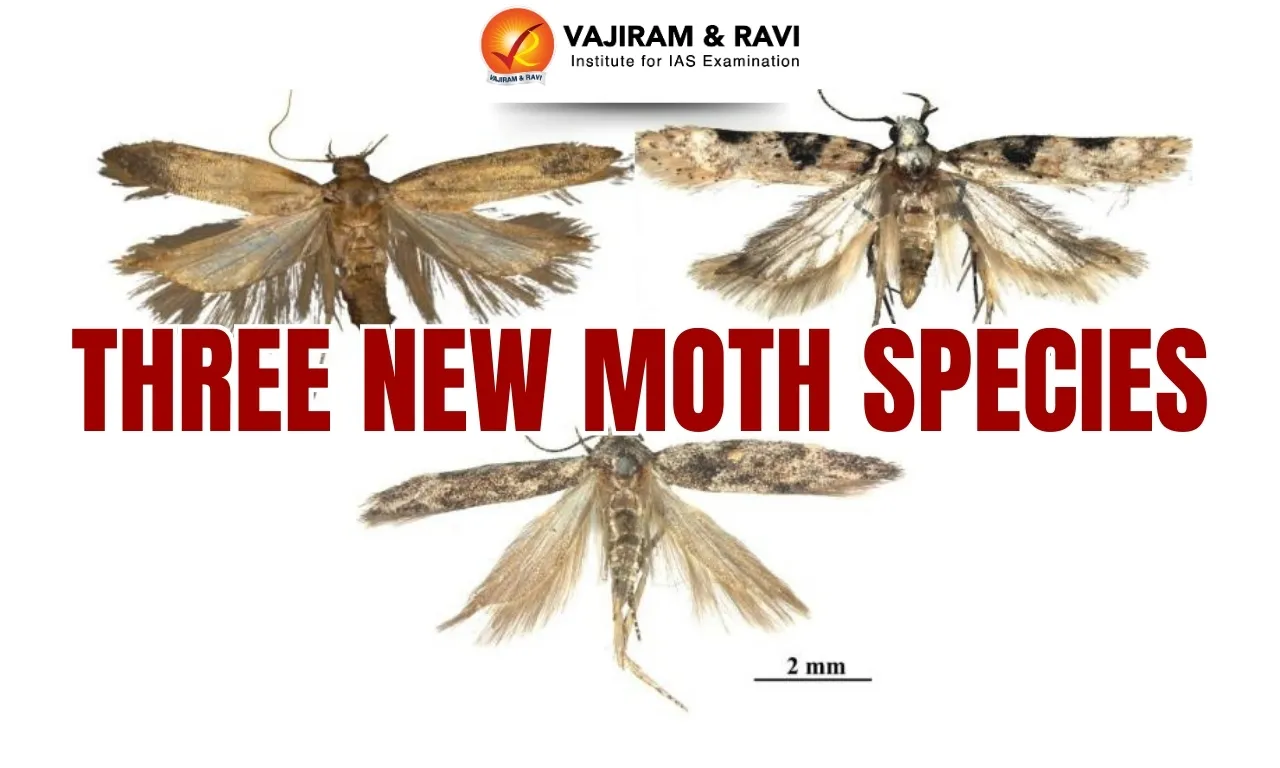
- The three species are Gelechia bilobuncusa, Gelechia adi, and Istrianis ladakhensis.
- They were discovered in the high-altitude landscapes of the Himalayas.
- Gelechia bilobuncusa:
- It was found in Himachal Pradesh.
- Its name is a scientific nod to the unique bilobed shape of its uncus, a part of the male genitalia.
- It is characterised by pale brown wings with irregularly scattered black scales.
- Gelechia adi:
- It was discovered in the Ramsing area of Arunachal Pradesh.
- It is named in honour of the local Adi tribe inhabiting the Upper Siang district.
- It is visually distinct, featuring ivory-white forewings interrupted by a dramatic black streak across the base and triangular spots.
- Istrianis ladakhensis:
- It is named after its type locality in Ladakh.
- This moth is adapted to the high-altitude environment, sporting light brown wings mottled with dark grey, white, and orange scales, distinguishing it from its closest relatives in the genus.


What are Moths?
- Moths are insects that belong to the order Lepidoptera, which they share with butterflies.
- There are around 160,000 known species of moths, far outnumbering butterfly species.
- Highly adapted, they live in all but polar habitats.
- Moths vary greatly in size, ranging in wingspan from about 4 mm (0.16 inch) to nearly 30 cm (about 1 foot).
- They often have duller colors compared to butterflies, which helps with camouflage. Some, like the luna moth or atlas moth, are vividly colored.
- Moth antennae are often feathery, unlike the thin and clubbed antennae of butterflies.
- Most moths are active at night, but some are diurnal.
- The larvae and adults of most moth species are plant eaters.
Source: RM

 Last updated on Oct, 2026
→ UPSC 2027 Notification will be released on 13 January 2027 at upsconline.nic.in.
→ Check Nobel Prize 2026 Winners List here.
→ Download PIB PRiSM Monthly Magazine 2026 here.
→ Check UPSC Monthly Current Affairs Magazine The Recitals here.
→ Check out the latest UPSC Syllabus here.
→ Download UPSC Model Answers for Mains 2026
→ UPSC Mains Question Paper 2026 is out now for Essay & GS Paper 1, 2, 3 & 4.
→ UPSC Calendar 2027 has been released.
→ Enroll in Vajiram & Ravi’s UPSC Mains Test Series 2027 for structured answer writing practice, expert evaluation, and exam-oriented feedback.
→ Join Vajiram & Ravi’s UPSC Mentorship Program 2027 for personalized guidance, strategy planning, and one-to-one support from experienced mentors.
→ Go through the UPSC Mains Previous Year Papers to enhance your preparation.
→ UPSC has released UPSC Toppers List 2025 with the Civil Services final result on its official website.
→ Also check Best UPSC Coaching in India
Three New Moth Species FAQs
Q1. Gelechia bilobuncusa was discovered in which Indian state?+
Q2. Gelechia adi is named in honour of which indigenous group?+
Q3. What is the wing coloration of Istrianis ladakhensis?+
Q4. What type of environment is Istrianis ladakhensis adapted to?+
Tags: prelims pointers three new moth species upsc current affairs upsc prelims current affairs