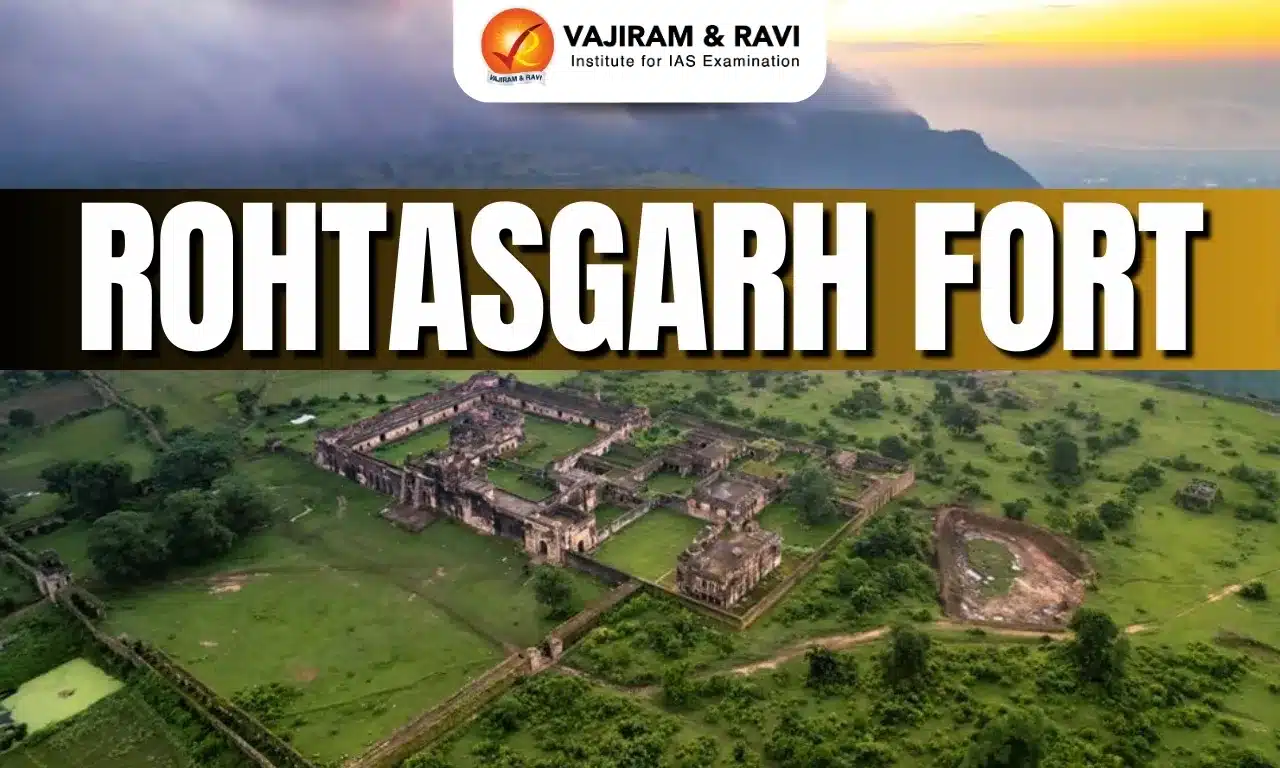
Rohtasgarh Fort Latest News
An under-construction ropeway being built to improve access to the historic Rohtasgarh Fort in Bihar’s Rohtas district collapsed during a trial run recently.
About Rohtasgarh Fort
- The Rohtasgarh Fort, also known as Rohtas Fort, is located in the city of Rohtas on the banks of the Sone River in Bihar.
- It is one of the largest forts not only in India but in the whole world and is spread over a radius of 26 miles.
- It is situated on the top of a hill and is one of the most ancient forts in India, known for its large defensive walls and impressive architecture.
- The hill on which the fort is situated has a height of 1500 m.
- The fort complex includes gates, palaces, temples, and reservoirs, showcasing Indo-Afghan architectural styles.


Rohtasgarh Fort History
- The fort was built by the 36th ruler of the Solar dynasty, Raja Harishchandra. It was named after his son, Rohitashva.
- Inscriptions at the fort suggest that the fort has passed through the hands of several empires, including the Hindu Shahis, the Ghurids, the Mughals, and eventually the British Raj.
- Sher Shah Suri conquered the fort in 1539 after losing the Fort of Chunar to Humayun, a Mughal ruler.
- The fort, in its present form, was significantly strengthened by Sher Shah Suri. During his rule, the fort was guarded by 10,000 armed soldiers.
- The Jama Masjid, built to the west of the fort by Haibat Khan (a close aide of Sher Shah), is made of white sandstone and completed in 1543.
- Akbar acquired the fort in 1587 and gave it to Raja Maan Singh, who was appointed the Governor of Bihar.
- In the 16th century, Jahangir’s son, Prince Khurram, sought refuge at the fort.
- In the 17th century, Mir Kasim, the Nawab of Bengal, sought refuge at the fort after losing a battle against the British.
- However, the fort was handed over to British Captain Goddard by the Diwan of Rohtas, and the fort’s defenses were destroyed.
- The fort remained abandoned until 1857, during the First War of Independence, when Babu Kunwar Singh’s younger brother, Amar Singh, sought refuge there.
- Finally, the British recaptured Rohtasgarh and soon abandoned it.
Source: IE

 Last updated on Oct, 2026
→ UPSC 2027 Notification will be released on 13 January 2027 at upsconline.nic.in.
→ Check Nobel Prize 2026 Winners List here.
→ Download PIB PRiSM Monthly Magazine 2026 here.
→ Check UPSC Monthly Current Affairs Magazine The Recitals here.
→ Check out the latest UPSC Syllabus here.
→ Download UPSC Model Answers for Mains 2026
→ UPSC Mains Question Paper 2026 is out now for Essay & GS Paper 1, 2, 3 & 4.
→ UPSC Calendar 2027 has been released.
→ Enroll in Vajiram & Ravi’s UPSC Mains Test Series 2027 for structured answer writing practice, expert evaluation, and exam-oriented feedback.
→ Join Vajiram & Ravi’s UPSC Mentorship Program 2027 for personalized guidance, strategy planning, and one-to-one support from experienced mentors.
→ Go through the UPSC Mains Previous Year Papers to enhance your preparation.
→ UPSC has released UPSC Toppers List 2025 with the Civil Services final result on its official website.
→ Also check Best UPSC Coaching in India
Rohtasgarh Fort FAQs
Q1. Where is the Rohtasgarh Fort located?+
Q2. After whom was the Rohtasgarh Fort named?+
Q3. Which architectural styles are reflected in the structures of Rohtasgarh Fort?+
Q4. Which ruler significantly strengthened the fort in its present form?+
Q5. Which Mughal prince sought refuge in Rohtasgarh Fort in the 16th century?+
Tags: Rohtasgarh Fort