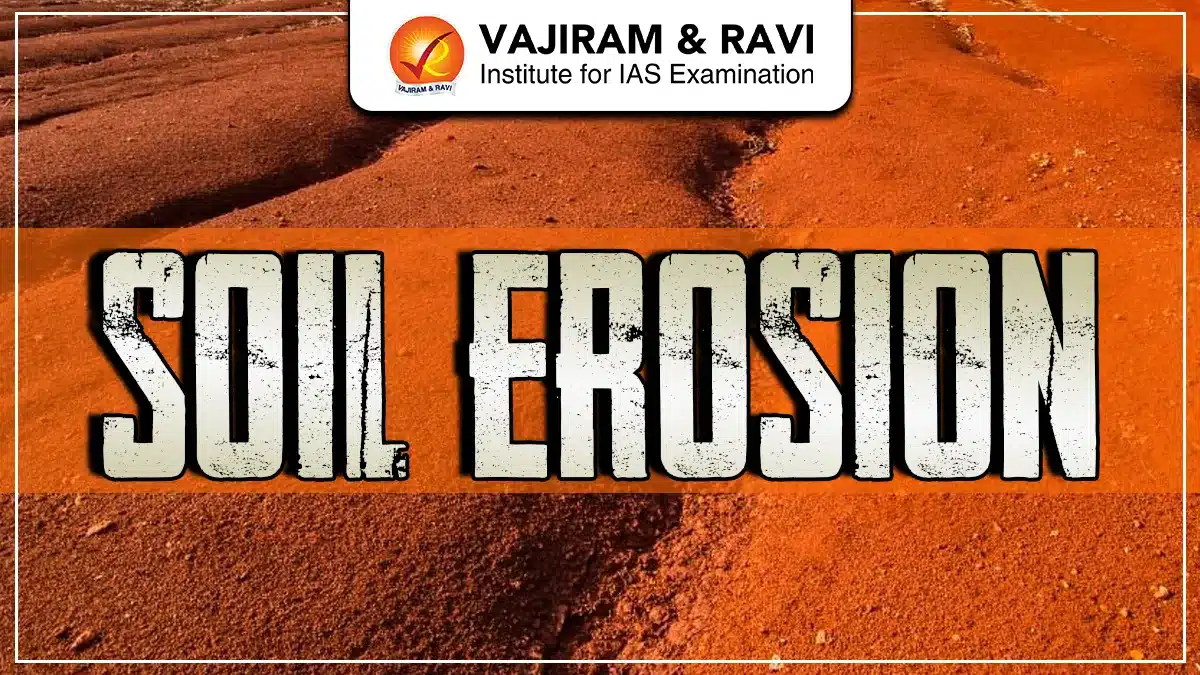
Soil Erosion is a natural geomorphological process involving the detachment and removal of soil and weathered rock materials by exogenetic forces such as water, wind, ice, gravity, plants, animals, and human activities. Under natural vegetation cover, soil erosion occurs slowly as part of denudation and remains largely balanced by soil formation. However, when this natural equilibrium is disturbed, erosion accelerates rapidly.
Soil Erosion
Soil Erosion refers to the loosening, detachment, transport, and deposition of topsoil particles from land surfaces by physical agents, primarily water and wind. In its natural form, also called geological erosion, soil removal occurs slowly and uniformly over long periods. Accelerated soil erosion, also known as man induced erosion, results from human altered land use patterns and removes soil at rates ten to several thousand times faster than natural soil formation.
According to L.D. Meyer and W.H. Wischmeier, soil particle detachability is the critical stage in erosion, controlled by grain size, cohesion, and flow velocity. Particles larger than 0.2 mm require higher water velocity for detachment. When erosion exceeds soil regeneration capacity, it transforms into severe soil degradation, undermining ecological balance and agricultural sustainability.
Soil Erosion Types
The types of Soil Erosion based on dominant physical agents along with their mechanisms and consequences are listed below:
- Water Erosion: Caused by rainfall and surface runoff, water erosion includes splash, sheet, rill, gully, streambank, landslide, and coastal erosion.
- Raindrop (Splash) Erosion: Raindrops of about 5 mm diameter strike soil at 32 km/hr, dislodging particles and destroying soil aggregates. It is a sub-type of water erosion.
- Sheet Erosion: Uniform removal of thin topsoil layers by overland flow, often unnoticed but responsible for major nutrient losses.
- Rill Erosion: Formation of shallow finger-like channels after sheet erosion, which gradually deepen and multiply annually.
- Gully Erosion: Deep channels exceeding 30 m in width and depth, severely restricting land use and farm operations.
- Streambank Erosion: Wearing away of riverbanks during floods, altering river courses and damaging infrastructure and farmland.
- Landslide Erosion: Sudden downslope movement of soil due to gravity, slope instability, or saturation, causing major land loss.
- Coastal Erosion: Wave action and sea ingress remove coastal soils, depositing sand inland and degrading agricultural land.
- Wind Erosion: Dominant in arid and semi arid regions, removing fine particles through suspension, saltation, and surface creep.
- Tillage Erosion: Soil displacement caused by repeated ploughing on slopes, often exceeding water erosion in cultivated lands.


Soil Erosion Factors
The natural and human induced drivers controlling Soil Erosion intensity and processes across landscapes in a concise, process oriented manner have been described below:
- Rainfall Intensity: High intensity rainfall produces greater kinetic energy, increasing splash erosion, runoff velocity, and sediment transport, especially on bare or saturated soils.
- Soil Texture and Structure: Sandy and silty soils detach easily, while clay and organic rich soils resist erosion due to better aggregation and particle cohesion.
- Slope Gradient and Length: Longer and steeper slopes increase runoff speed, enhancing rill, gully, and mass movement erosion under heavy precipitation.
- Vegetation Cover: Roots bind soil particles, canopy intercepts raindrops, and litter improves infiltration; vegetation removal dramatically increases erosion rates.
- Climate Variability: Extreme rainfall events, droughts, and temperature fluctuations alter soil moisture and structure, intensifying erosion processes.
- Deforestation: Removal of forest litter, humus, and root networks exposes mineral soil, increasing runoff and erosion by several orders of magnitude.
- Agricultural Practices: Deep tillage, monocropping, slope cultivation, and bare fallow periods break soil structure and accelerate water and wind erosion.
- Overgrazing: Livestock trampling compacts soil, reduces vegetation cover, and initiates surface runoff and gully formation.
- Irrigation Mismanagement: Excess irrigation causes waterlogging, salinity, reduced infiltration, and increased surface runoff.
- Construction and Urbanisation: Soil excavation, compaction, and impervious surfaces increase runoff volume and sediment transport into water bodies.
What is Land Degradation?
Land degradation refers to the decline in land’s productive capacity due to Soil Erosion, nutrient depletion, salinisation, waterlogging, and chemical contamination. Slight degradation reduces yields by 10%, moderate degradation by 10-50%, and severe degradation causes over 50% productivity loss. Globally, over 4.85 billion acres of land are degraded, with water and wind erosion responsible for 84% of this degradation.
Soil Erosion Impact
The on site and off site consequences of Soil Erosion across agriculture, ecology, hydrology, and human systems have been listed below:
- Loss of Fertile Topsoil: Nutrient rich fine particles and organic matter are removed, exposing less fertile subsoil.
- Reduced Agricultural Productivity: Crop yields decline due to nutrient loss, poor water retention, and seedling removal.
- Water Resource Degradation: Sedimentation of rivers, reservoirs, and dams reduces storage capacity and water quality.
- Aquatic Ecosystem Damage: Sediments smother fish spawning grounds and reduce biodiversity in freshwater and coastal systems.
- Desertification Risk: Persistent erosion converts productive land into barren landscapes, especially in dry regions.
- Infrastructure Damage: Roads, canals, and settlements suffer from sediment deposition and bank erosion.
- Air Pollution: Wind blown dust carries pesticides and heavy metals, causing respiratory and climatic impacts.
- Flood Intensification: Reduced infiltration increases runoff, enhancing flood frequency and severity.
- Climate Feedbacks: Soil organic carbon loss weakens carbon sequestration, reinforcing climate change impacts.
- Human and Animal Mortality: Landslides and erosion induced floods cause fatalities and displacement.
Soil Conservation
Major proven and emerging strategies to prevent Soil Erosion and restore soil health using scientific, policy driven, and ecological approaches are as follows:
- Vegetative Cover: Afforestation, cover crops, and grasses reduce runoff velocity and soil detachment.
- Terracing: Step like slope modification reduces runoff length and erosion on hilly terrain.
- Contour Farming: Ploughing across slopes reduces water flow speed and soil loss.
- Crop Rotation: Improves soil structure, nutrient balance, and organic carbon content.
- No Till Farming: Minimises soil disturbance, preserving aggregates and reducing erosion.
- Windbreaks: Shelterbelts reduce wind velocity and protect agricultural fields.
- Biochar Application: Pyrolysed organic matter improves soil water retention and nutrient holding capacity.
- Biofertilisers: Microbial inoculants enhance soil fertility while reducing chemical input dependence.
- Precision Agriculture: Drone based nutrient mapping optimises fertiliser use and limits soil degradation.
- Policy Interventions: Soil Health Card Scheme, NMSA, PKVY, and Neem coated urea promote sustainable soil management.
Soil Erosion Global Aspects
Globally, Soil Erosion has emerged as a major environmental challenge due to population pressure, land misuse, deforestation, intensive agriculture, infrastructure expansion, and climate change. Each year, approximately 75 billion tonnes of fertile soil are lost worldwide, far exceeding natural soil regeneration rates. This loss directly threatens food security, water quality, ecosystem stability, and long term land productivity.

 Last updated on Oct, 2026
→ UPSC 2027 Notification will be released on 13 January 2027 at upsconline.nic.in.
→ Check Nobel Prize 2026 Winners List here.
→ Download PIB PRiSM Monthly Magazine 2026 here.
→ Check UPSC Monthly Current Affairs Magazine The Recitals here.
→ Check out the latest UPSC Syllabus here.
→ Download UPSC Model Answers for Mains 2026
→ UPSC Mains Question Paper 2026 is out now for Essay & GS Paper 1, 2, 3 & 4.
→ UPSC Calendar 2027 has been released.
→ Enroll in Vajiram & Ravi’s UPSC Mains Test Series 2027 for structured answer writing practice, expert evaluation, and exam-oriented feedback.
→ Join Vajiram & Ravi’s UPSC Mentorship Program 2027 for personalized guidance, strategy planning, and one-to-one support from experienced mentors.
→ Go through the UPSC Mains Previous Year Papers to enhance your preparation.
→ UPSC has released UPSC Toppers List 2025 with the Civil Services final result on its official website.
→ Also check Best UPSC Coaching in India
Soil Erosion FAQs
Q1. What is Soil Erosion?+
Q2. What are the main causes of Soil Erosion?+
Q3. Which type of Soil Erosion is most common?+
Q4. How does Soil Erosion affect Agriculture?+
Q5. How can Soil Erosion be controlled?+
Tags: soil erosion