Molybdenum Disulfide Latest News
Scientists recently developed an electronic system using molybdenum disulphide only a few atoms thick; high-energy particles pass through it without causing damage.
About Molybdenum Disulfide
- Molybdenum disulfide (MoS2) is an inorganic compound made up of sulfur and molybdenum.
- It exists in nature in the mineral molybdenite.
- In its bulk form, it appears as a dark, shiny solid.
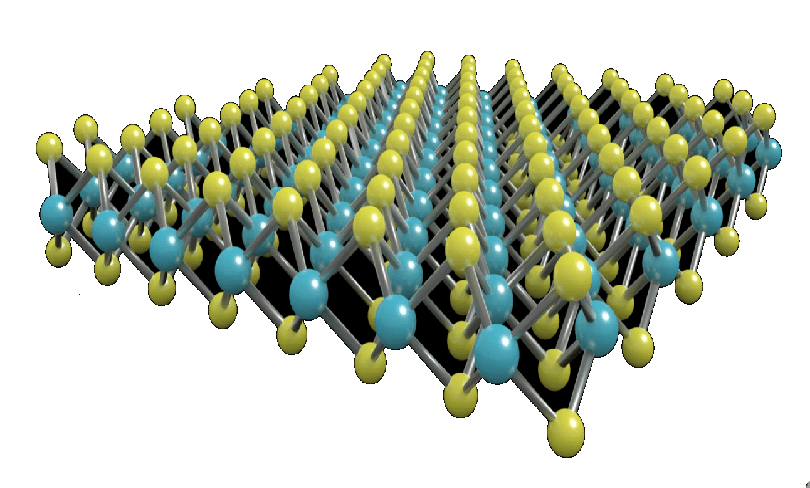
- It belongs to a class of materials called ‘transition metal dichalcogenides’ (TMDCs).
- Materials in this class have the chemical formula MX₂, where M is a transition metal atom (groups 4-12 in the periodic table) and X is a chalcogen (group 16).
- Its crystals have a hexagonal layered structure that is similar to graphite.
- Like most mineral salts, MoS2 has a high melting point, but it begins to sublime at a relatively low 450 ºC. This property is useful for purifying the compound.
- Because of its layered structure, hexagonal MoS2, like graphite, is an excellent solid lubricant.
- It can be used as surface coatings on machine parts (e.g., in the aerospace industry), in two-stroke engines (the type used for motorcycles), and in gun barrels (to reduce friction between the bullet and the barrel).
- Unlike graphite, MoS2 does not depend on adsorbed water or other vapors for its lubricant properties.
- It can be used at temperatures as high as 350 ºC in oxidizing environments and up to 1100 ºC in nonoxidizing environments.
- Its stability makes it useful in high-temperature applications in which oils and greases are not practical.
- MoS2 is highly resistant to oxidation and corrosion, making it an effective lubricant for high-humidity and saltwater environments.
- In addition to its lubricating properties, MoS2 is a semiconductor.
Source: TH


 Last updated on Sep, 2026
→ UPSC 2027 Notification will be released on 13 January 2027 at upsconline.nic.in.
→ Asian Games 2026 are being held in Aichi-Nagoya, Japan, from 19 September to 4 October.
→ Check out the latest UPSC Syllabus here.
→ Download UPSC Model Answers for Mains 2026
→ UPSC Mains Question Paper 2026 is out now for Essay & GS Paper 1, 2, 3 & 4.
→ UPSC Calendar 2027 has been released.
→ Enroll in Vajiram & Ravi’s UPSC Mains Test Series 2027 for structured answer writing practice, expert evaluation, and exam-oriented feedback.
→ Join Vajiram & Ravi’s UPSC Mentorship Program 2027 for personalized guidance, strategy planning, and one-to-one support from experienced mentors.
→ Go through the UPSC Mains Previous Year Papers to enhance your preparation.
→ UPSC has released UPSC Toppers List 2025 with the Civil Services final result on its official website.
→ Also check Best UPSC Coaching in India
Molybdenum Disulfide FAQs
Q1. What is molybdenum disulfide (MoS₂)?+
Q2. In which mineral form does molybdenum disulfide (MoS₂) occur naturally?+
Q3. To which class of materials does molybdenum disulfide (MoS₂) belong?+
Q4. What is the crystal structure of molybdenum disulfide?+
Q5. Why is molybdenum disulfide (MoS₂) an effective solid lubricant?+
Tags: molybdenum disulfide prelims pointers upsc current affairs upsc prelims current affairs