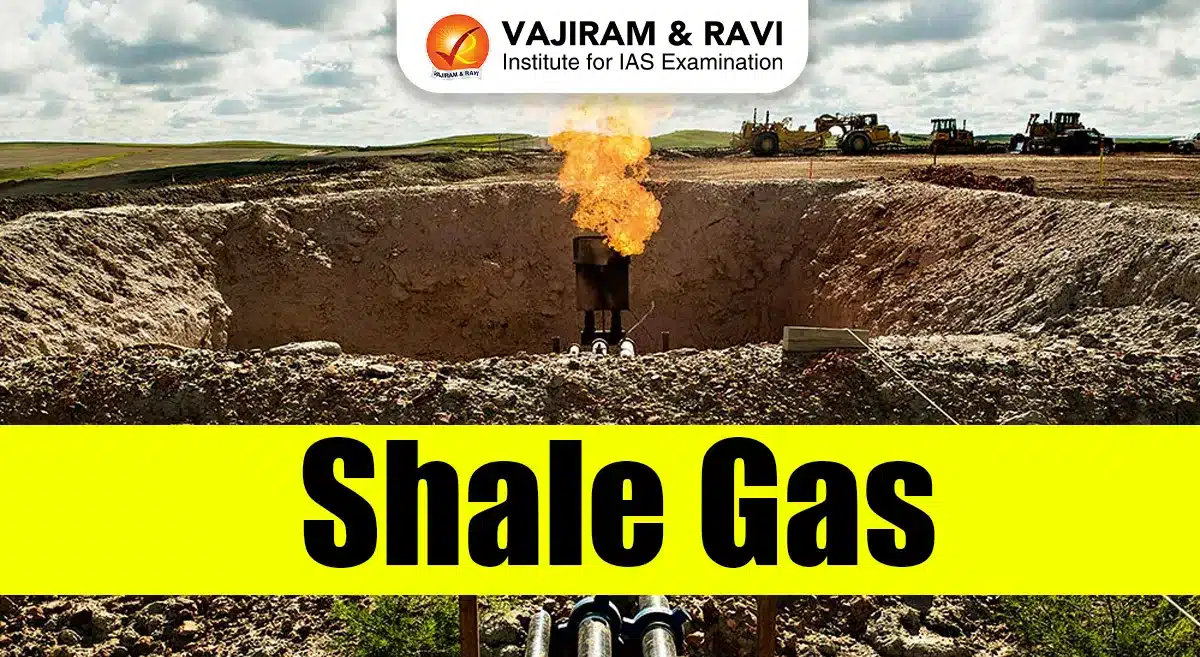
Shale gas is an unconventional natural gas found in shale deposits. Shale is a fine-grained sedimentary rock, formed as a result of the compaction of clay, silt, mud and organic matter. India imports 50% of its natural gas.
About Shale Gas
- Shale gas consists of 70 to 90 per cent methane (CH4).
- It is a relatively cleaner fossil fuel, as it emits significantly lower amounts of carbon dioxide, sulphur dioxide, nitrogen oxides, and particulate matter compared to coal.
- Unlike conventional natural gas, which flows easily from porous rocks like sandstone, shale gas is trapped in the tiny pores of impermeable rock and requires advanced technology to extract.
- The most common way to extract shale gas is ‘hydraulic fracturing’ (fracking), a process in which high-pressure water mixed with sand and chemicals creates fractures in the rock, allowing gas to escape.
- In India Shale Gas formations are spread over several sedimentary basins such as Cambay, Gondwana, Krishna-Godavari and Cauvery on-land.
Shale Gas Regulation in India
In India, all hydrocarbons – oil, natural gas, shale gas, etc are owned by the Union, irrespective of where they are located geographically as all hydrocarbons fall under Union List powers and are governed by central laws and policies like the Oilfields (Regulation and Development) Act, 1948 and the Hydrocarbon Exploration and Licensing Policy (HELP).


Hydrocarbon Exploration and Licensing Policy (HELP)
- The Hydrocarbon Exploration and Licensing Policy (HELP) was introduced by the Government of India in 2016 to comprehensively reform the hydrocarbon exploration and production sector.
- It replaced the earlier New Exploration Licensing Policy (NELP) and aimed to move India from a highly regulated, government-controlled regime to a simplified, transparent, and investor-friendly framework.
- Under HELP, the government introduced a single, unified licence for exploration and production of hydrocarbons.
- Earlier, different licences were required for conventional oil and gas, shale gas, tight gas, and coal bed methane (CBM), which led to regulatory overlap and delays.
Open Acreage Licensing Programme (OALP)
- Open Acreage Licensing Programme (OALP) is the operational mechanism through which HELP is implemented on the ground.
- Under OALP, the government no longer decides in advance which exploration blocks will be auctioned. Instead, companies can identify blocks of their choice at any time based on available geological data.
- OALP allows companies to submit an Expression of Interest (EOI) for any unlicensed area throughout the year. Once sufficient interest is received, the government notifies the area for competitive bidding.
Under the Hydrocarbon Exploration and Licensing Policy (HELP), 2016, shale gas is formally recognised as a hydrocarbon resource. Companies that win exploration licences or contracts gain rights to extract shale gas from the specified block, but the resource itself remains the property of the state

 Last updated on Oct, 2026
→ UPSC 2027 Notification will be released on 13 January 2027 at upsconline.nic.in.
→ Check Nobel Prize 2026 Winners List here.
→ Download PIB PRiSM Monthly Magazine 2026 here.
→ Check UPSC Monthly Current Affairs Magazine The Recitals here.
→ Check out the latest UPSC Syllabus here.
→ Download UPSC Model Answers for Mains 2026
→ UPSC Mains Question Paper 2026 is out now for Essay & GS Paper 1, 2, 3 & 4.
→ UPSC Calendar 2027 has been released.
→ Enroll in Vajiram & Ravi’s UPSC Mains Test Series 2027 for structured answer writing practice, expert evaluation, and exam-oriented feedback.
→ Join Vajiram & Ravi’s UPSC Mentorship Program 2027 for personalized guidance, strategy planning, and one-to-one support from experienced mentors.
→ Go through the UPSC Mains Previous Year Papers to enhance your preparation.
→ UPSC has released UPSC Toppers List 2025 with the Civil Services final result on its official website.
→ Also check Best UPSC Coaching in India
Shale Gas FAQs
Q1. What is shale gas?+
Q2. How is shale gas extracted?+
Q3. Why is shale gas called an unconventional energy resource?+
Q4. What is the status of shale gas in India?+
Q5. How does shale gas contribute to India’s energy security?+
Tags: shale gas