About Electromagnetic Ion Cyclotron (EMIC) waves:
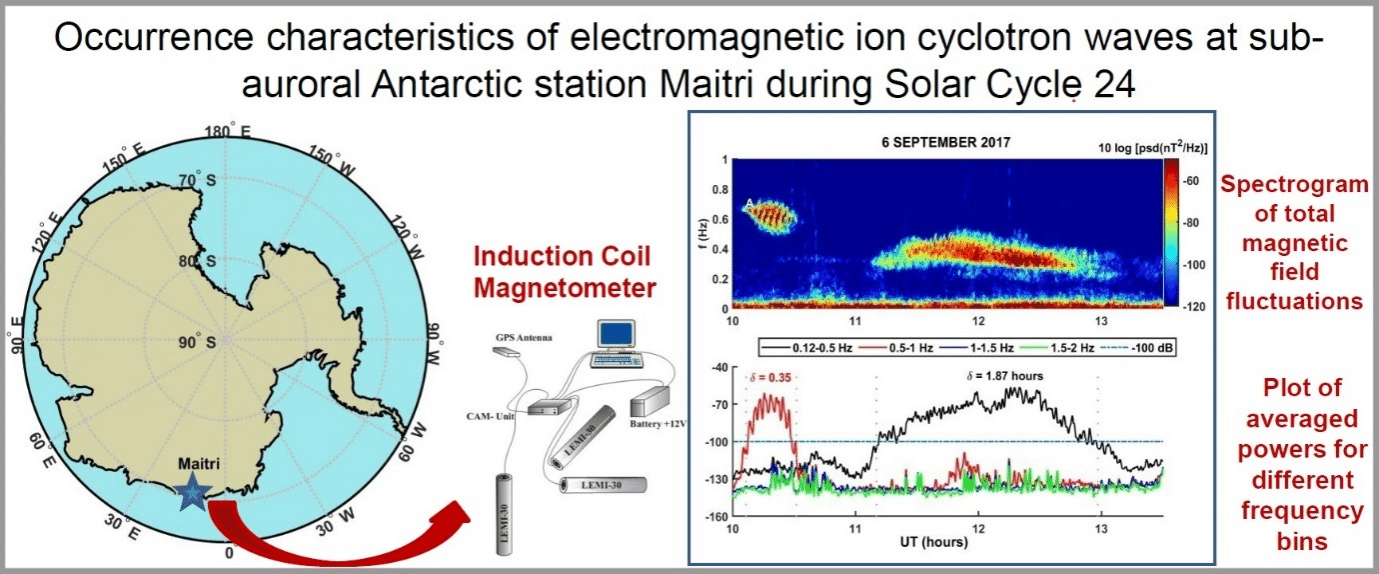
- These are the discreet electromagnetic emissions observed in the Earth’s magnetosphere.
- These waves are generated in the equatorial latitudes and propagate along magnetic field lines to their footprint in the high-latitude ionosphere.
- Their signatures can be recorded in both spaces as well as ground-based magnetometers.
- These waves are higher during magnetically disturbed days (53.1%) as compared to quiet days (41.1%).
- The dependence of EMIC occurrence on solar flux is evident and they are more frequent during the descending phase of the solar cycle.
- The interesting observational feature is the peak occurrence of EMIC in the noon-dusk sector, which is attributed to the presence of plasma plumes at that time in the Earth’s magnetosphere.
What is Magnetosphere?
- A magnetosphere is that area of space, around a planet, that is controlled by the planet’s magnetic field.
- Earth has the strongest one of all the rocky planets.
- Earth’s magnetosphere is a vast, comet-shaped bubble, which has played a crucial role in our planet’s habitability.
- The Earth’s magnetosphere is a highly dynamic structure that responds dramatically to solar variations.
- It is generated by the convective motion of charged, molten iron, far below the surface of Earth’s outer core.
- The magnetosphere shields the earth from solar and cosmic particle radiation, as well as erosion of the atmosphere by the solar wind
Q1) What is Radiation?
Radiation is the energy that is transmitted in the form of waves or particles through space or through a material medium. There are several different types of radiation, including electromagnetic radiation (such as radio waves, microwaves, infrared radiation,etc) and particle radiation (such as alpha particles, beta particles, and neutrons).


 Last updated on Sep, 2026
→ UPSC 2027 Notification will be released on 13 January 2027 at upsconline.nic.in.
→ Asian Games 2026 are being held in Aichi-Nagoya, Japan, from 19 September to 4 October.
→ Check out the latest UPSC Syllabus here.
→ Download UPSC Model Answers for Mains 2026
→ UPSC Mains Question Paper 2026 is out now for Essay & GS Paper 1, 2, 3 & 4.
→ UPSC Calendar 2027 has been released.
→ Enroll in Vajiram & Ravi’s UPSC Mains Test Series 2027 for structured answer writing practice, expert evaluation, and exam-oriented feedback.
→ Join Vajiram & Ravi’s UPSC Mentorship Program 2027 for personalized guidance, strategy planning, and one-to-one support from experienced mentors.
→ Go through the UPSC Mains Previous Year Papers to enhance your preparation.
→ UPSC has released UPSC Toppers List 2025 with the Civil Services final result on its official website.
→ Also check Best UPSC Coaching in India